Vivek Menezes
Few places can rival Goa for our front-row seat to the grand pageantry of the annual monsoon, so vital to flora, fauna, agriculture and economy that it is legitimately referred to as “the real finance minister.” These timeless “trade winds” are the fundamental civilizational reality of India’s western coastline, and the main reason why so many of the world’s most significant ancient entrepôts arose in Malabar and the Konkan, early nerve centres of what we now call globalisation. Their fierce gusting predictability (albeit now increasingly disrupted) made it relatively easy throughout history to set sail on one side of the Arabian Sea, and get blown directly across the depths with your cargo.

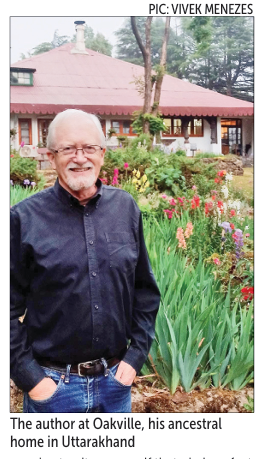
That breathtaking history shaping power still plays out here every year, but I have also come to appreciate another extraordinary monsoon vantage at Landour, in the Garhwal Himalayas above Mussoorie in Uttarakhand. There, with the advantage of elevation (around 7500 feet above sea level) and the vast tableau of the Doon Valley just below, the climatic drama comes right up to what seems like eye level. Here is how Stephen Alter describes the scene outside his gorgeous old family home: “Stepping outside in the first light before dawn, I could see that the sky above me was a pale blue but off in the distance, beyond the Shivalik Hills on the other side of the Doon Valley, layers of dark clouds smeared the horizon. A light but steady breeze was blowing in my face and the trees around me swayed and trembled. Within twenty minutes, the advancing storm had crossed the Shivalik, like a shadowy wave breaking over a reef.
Bright streaks of lightning lanced the bruised and swollen clouds while the thunder grew louder. Instead of a far-off rumble, it now boomed and crackled.” Then, he says, “the wind grew stronger and rougher, buffeting the deodar trees overhead while the imminent dawn retreated back into darkness. A flash of lightning to the east was followed, almost immediately, by a blast of thunder. Moments later, another lightning bolt tore through the gloom and struck a ridge below. The detonation shook the ground beneath my feet as hailstones, the size of chickpeas, began to pelt the flower beds behind me. One hit my head, and another ricocheted off my arm. Turning, I ran towards the house…” Those vivid descriptions are from The Fragrance of Rain: A Brief History of the Monsoon (Aleph) the latest tour-de-force of expository writing from one of India’s very best writers, even if that obvious fact is very rarely acknowledged as it should be.
Alter’s contributions have been monumental, including Wild Himalaya: A Natural History of the Greatest Mountain Range on Earth (winner of the 2020 Banff Mountain Book Award), the searing and unforgettable Becoming a Mountain: Himalayan Journeys in Search of the Sacred and the Sublime (which I rate as one of the best non-fiction books of the 21st century), The Cobra’s Gaze: Exploring India’s Wild Heritage (it was launched at GALF2024 in conversation with Nandini Velho) and my personal favourite All the Way to Heaven: An American Boyhood in the Himalayas, along with another score acclaimed novels and non-fiction books that have won major awards in many places except, rather shamefully, in the land of his birth and lifelong home base. The Fragrance of Rain is a small masterpiece, just 130 pages and 10 short chapters of richly descriptive prose that manages to be scientifically rigorous at the same time, including a superb précis of the origins of the monsoon that ranges authoritatively from myths to meterology, and most beguilingly “demonstrates how climactic events like the monsoon are not isolated in time and space but are dynamic, ever-changing phenomena linked to everything from continental drift, butterfly wings or yak tails, dust plumes, as well as the brief life cycle of plankton.” Of special interest to us, of course, is the happy circumstance that India’s smallest state features prominently throughout this fine new book, as Alter explains he wanted to “let the monsoon come to me [and] I retreated to Goa where my wife, Ameeta, and I have owned a small flat for the past twelve years.
While Mussoorie remains my primary home, Goa provides us with a welcome escape from cold Himalayan winters. In that sense, I suppose we are climate migrants, enjoying the warmer temperatures and tropical greenery of Siolim, a small town where we now live for part of the year.” He clearly loves this location, writing that “sitting out on the balcony of our flat, I looked out over a lush garden of flowering shrubs that attracts well over a hundred species of birds, from kingfishers and pittas to bulbuls and sunbirds. In the sky, white egrets were stencilled upon dark indigo clouds. Every morning and evening, as if following a strict flight schedule, a flock of great hornbills winged their way over the treetops.
When it rained, the areca nut palms swayed in the wind and shed the deluge like giant parasols, while the humid aid felt almost cold.” I was surprised and delighted to find my own writing quoted by Alter (whom I have also had the privilege of meeting in Landour) and thoroughly enjoyed his deft pen portraits of Goa and Goans, like this one about one of the most beloved Siolkars: “At the age of eighty, Alexyz continues to live in Siolim with his wife, Tecla. A spry, slender man with a trimmed, grey beard and a shy yet generous smile, he spoke with a firm sense of commitment to the causes he has supported throughout his life. ‘Many of my cartoons were used on protest posters’, he told me. ‘People waited for them in the newspaper every morning. My editor sometimes gave me eight columns a day!’ When I complained that there are hardly any political cartoons in the press these days, Alexyz nodded. ‘People are too cautious now and the newspapers are all owned by business houses who don’t want to offend politicians.