ANIL KUMAR MISHRA
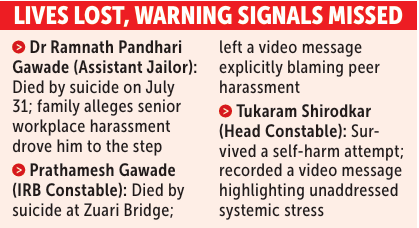
A disturbing pattern of suicides and self-harm at tempts within the Goa Police and prison departments has exposed a silent, deep-seated mental health crisis among the State’s law enforcement personnel. The recent suicide of 54-year-old Assistant Jailor at Colvale Central Jail and noted Konkani author Dr Ramnath Pandhari Gawade (also known as Dr R P Ga wade), following self-harm attempts by lower-ranking staff, has sparked intense scrutiny over institutional harassment, chronic un derstaffing, and the lack of trusted psychological sup port. As authorities scramble to defend existing wellness programmes, experts warn that a rigid institutional hier archy and the stigma of vul nerability are keeping thou sands of stressed personnel from seeking help before hitting a breaking point. Dr Gawade died by suicide at his residence in Ponda on July 31. His family subsequently alleged that persistent work place harassment by senior prison officials had driv en him to take the extreme step.

Gawade had reportedly submitted his resignation on July 7, citing work-related stress and additional administrative responsibilities, including supervision of the prison food system. He later withdrew the resignation due to family financial requirements. While allegations surrounding individual cases require investigation, the incidents have brought renewed atten tion to the working conditions and mental health of per sonnel at the lower and middle levels of the police and prison departments. The recent self-harm attempt by Head Constable Tukar am Shirodkar has raised questions over whether existing mechanisms to identify and address stress among police personnel are reaching those who need them most. The in cident has also revived concerns over allegations of harass ment faced by lower-ranking personnel and the need for timely, confidential, and accessible psychological support within the force. Last year, the death of IRB constable Prathamesh Gawade similarly exposed the gravity of the problem. Gawade died by suicide after jumping from the Zuari Bridge and had re corded a video message in which he allegedly blamed har assment by fellow personnel. The fact that both Gawade and Shirodkar recorded video messages before taking drastic steps has raised concerns over whether warning signs are being missed within the system. Dr Abhijit Nadkarni, Co-director of the Addictions & Re lated Research Group at Sangath, said, “Police stress in Goa is likely to reflect several of the pressures seen among po lice personnel nationally. There is no reason to believe that police stress in Goa would not mirror the national pattern of understaffing, long duty hours, and career stagnation.” He pointed out that Goa also faces a distinctive challenge, with a relatively small permanent police force having to cope with a major seasonal influx of tourists. A study of Goa Police personnel has previously reported significant oper ational stress associated with age and gender, with head constables and assistant sub-inspectors showing notable maladjustment, he added. According to Dr Nadkarni, the department has recently attempted to address the issue through the Manas Men tors programme. Around 14 stress-management sessions were conducted under the initiative, reaching nearly 700 personnel in partnership with the Indian Medical Associa tion (IMA), Goa, and Sangath.
However, he noted that such interventions have a limited impact if personnel remain reluctant to seek help. “The stigma around seeking help for psychological dis tress likely means self-reported stress is under-reported,” Nadkarni said, adding that in highly hierarchical policing systems, emotional vulnerability is often perceived as a weakness. Concerns about confidentiality, career pro gression, fitness for duty, and professional reputation can further discourage personnel from seeking psychological assistance. “When stress accumulates silently, it can manifest as anxiety, depression, burnout, substance dependence, ag gression, family conflicts, and emotional detachment—and in extreme cases, suicide,” Nadkarni said. GOACAN coordinator Roland Martins said the recurrence of suicides within the force warrants a time-bound action plan rather than isolated interventions. “Policing is undoubtedly a stressful job. Considering that there have been cases of suicides within the Goa Po lice Force, it is time that a time-bound action plan is put in place to handle stress at all levels of the force,” Martins said. He called for counsellors to be made available at both district headquarters, with arrangements specifically en suring that women constables and lady police sub-inspec tors also have access to the facility.
Martins suggested that the period between World Sui cide Prevention Day on September 10 and World Mental Health Day on October 10 could be used to launch a struc tured initiative for police personnel. Bailancho Saad convenor Sabina Martins linked the is sue to the broader problem of staff shortages and excessive workloads across public services. “Any profession where the workload is high due to the non-appointment of the required strength causes stress,” she said, citing teachers, police personnel, and judges among those affected. She termed the situation a “systemic failure”, questioning why vacancies remain unfilled despite qualified individuals awaiting employment. According to her, shortages result in an overload of work, and public services suffer as a consequence. Superintendent of Police (Training) Vishram Borkar said the department is already conducting stress-management programmes for its personnel. “We have been conducting sessions for staff on stress management. We invite specialists and resource persons. It is done depending upon the requirements,” Borkar said. He added that the department also employs a yoga teacher who conducts meditation and yoga sessions for personnel. While such initiatives indicate an acknowledgement of the problem, these recent cases underscore the need to examine whether existing support systems are sufficient ly accessible, confidential, and trusted by rank-and-file personnel. For a force that routinely deals with death, vi olence, accidents, crime, public anger, and long working hours, mental resilience cannot be treated merely as an individual responsibility.
The emerging concern is not simply whether coun selling sessions are being conducted, but whether a con stable under severe stress feels safe enough to seek help before reaching a breaking point. The cases involving Ga wade, Shirodkar, and others have therefore placed a dif ficult question before the police administration: Can the system recognise distress among its own personnel early enough—before a crisis becomes irreversible?