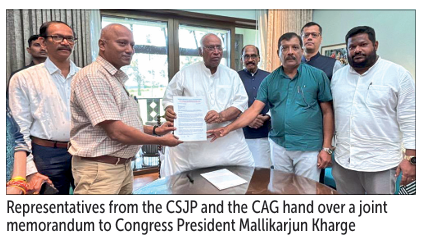
The Council for Social Justice and Peace (CSJP) and the Catholic As sociation of Goa (CAG) have urged Congress president Mallikarjun Kharge to con tinue opposing the pro posed Foreign Contribution (Regulation) Amendment Bill, 2026, warning that its provisions could adversely affect minority institutions and organisations serving the poor and vulnerable. The organisations sub mitted a joint memorandum to Kharge, appreciating the Congress stand in Parliament against the Bill and its sup port for referring the legisla tion to a Joint Parliamentary Committee (JPC).
They urged the party to oppose the Bill in its present form and ensure that provisions affecting civil society organisations, minor ity institutions and organisa tions serving vulnerable sec tions are suitably amended or withdrawn. The memo raised a key concern over the proposed power of a Designated Au thority to take over, man age and dispose of assets created from foreign con tributions when an organ isation’s FCRA registration is cancelled, surrendered or ceased due to non-renewal. They said the provision could impact minority-run educational, healthcare and social service institutions, including schools, colleges, hospitals, orphanages, old age homes and charitable organisations. These institution have relied on foreign contributions for infrastructure and wel fare activities, they said. Fr Savio Fernandes said the organisa tions feared the amendments could result in delays or denial of FCRA renewals, affect ing the functioning of institutions engaged in social and community work. The memorandum highlighted the recent cancellation of FCRA registrations of two organisations affiliated with the Archdio cese of Goa and Daman — the Diocesan So ciety of Education and the Diocesan Centre for Social Communications Media. It stated that the Bombay High Court had stayed the cancellations after the Central government revoked their FCRA registra tions on the ground that the organisations had not received foreign contributions for three consecutive years.

The organisations said the episode raised concerns over the functioning of minority institutions and questioned the consequences of the proposed provisions if registrations are cancelled or cease to re main valid. They raised concerns over the implica tions of the amendments for constitutional protections under Articles 25, 26, 29 and 30. The organisations said the proposed provisions could affect freedom of con science, religious autonomy and the cultur al and educational rights of minorities. CAG president Cyril A Fernandes said the association was particularly concerned about the proposed powers over assets, warning that broad executive discretion could have a chilling effect on civil society organisations working in areas including education, healthcare, human rights, envi ronmental protection, livelihood support, disaster relief, disability services, tribal welfare and child protection. The organisations called for a trans parent and inclusive JPC process, with stakeholder testimony, expert opinion and public consultation, and urged Congress to seek amendments or withdrawal of provi sions that could adversely affect legitimate civil society and minority institutions.
The memorandum also raised concerns over provisions relating to inspection and approval of accounts and activities, as well as ambiguities concerning who may be pro hibited from accepting foreign contribu tions and the manner in which appeals and exemptions could operate. The organisa tions warned that unclear provisions could lead to misinterpretation and misuse. The organisations also sought greater ju dicial oversight and procedural safeguards, arguing that affected organisations should have adequate opportunity to respond be fore action is taken against their registra tion or assets. Kharge received the memorandum and, according to the joint CSJP-CAG press state ment, assured the delegation that the Con gress Party “has been strongly opposing the proposed FCRA amendments and will continue to do so”. CSJP and CAG expressed appreciation for the assurance and urged that the concerns of civil society, minorities and marginalised communities be given due consideration during the parliamentary process.
The organisations urged Congress to specifically highlight Goa’s minority insti tutions in Parliament, including the risk of asset takeover, the threat to constitutional protections and the recent FCRA cancella tions affecting the Archdiocese of Goa and Daman. The memorandum also called for a wid er parliamentary and public debate on the role of foreign contributions in India’s development, education, health and social sectors. Separately, CAG has submitted another memorandum to GPCC president Girish Chodankar, raising its concerns relating to the selection of candidates for the 2027 Assembly elections. The organisation has sought that its views be taken into consid eration in the party’s electoral prepara tions
Catholic body slams CM for lacking FCRA knowledge
The Catholic Association of Goa (CAG) has hit out at Chief Min ister Pramod Sawant over his statement that there was ‘nothing to oppose’ in the proposed Foreign Contribution (Regulation) Amendment Bill, 2026, with CAG vice-president Melwin Fernandes saying the remark showed a lack of understanding of the legislation. “If the Chief Minister is saying there is nothing to oppose in the amend ments, then it shows his lack of knowledge about the Bill and that he has neither read nor studied the Bill properly before making such a statement,” Fernandes alleged. It may be recalled that Chief Minister Pramod Sawant, responding to media queries about the opposition to the FCRA Bill, had said, “I don’t know why they are oppos ing the FCRA Bill, 2026.
It is clear-cut; there is noth ing to oppose.” Fernandes said that under the existing FCRA provisions, authorities had already sought to re voke the registration of two church bodies, forcing them to approach the High Court, which subsequent ly granted them relief. He questioned what would happen in the future if such action was being tak en even under the existing provisions. He said the church bodies were forced to ap proach the court after be ing denied funds for three years. “If this is the situ ation under the existing law, what will happen af ter the proposed amend ments come into force?” he questioned. Fernandes said the pro posed amendments were more serious as they could allow properties to be at tached even on the basis of an allegation, without waiting for an investiga tion to be completed. He said such properties had been creat ed for nation-building and attaching them based on an allegation would defeat the very purpose for which they were estab lished.
He said the Chief Minister should first study the Bill’s provisions properly before commenting on whether there was any thing to oppose. Fernandes also pointed out that the CAG had already submitted a representation to the President of India, the Prime Minister and the Union Home Minister explaining why it was opposing the amendments. He said the representation contained relevant information that should be considered be fore making such statements. “We will also write to the Chief Minis ter and all Catholic MLAs highlighting the points which we are opposing,” Fernandes said. Meanwhile, data available on the Union Ministry of Home Affairs’ FCRA dashboard shows that of the 200 organisations regis tered under the FCRA in Goa, 78 currently have active registrations. Registrations of 80 organisations have been cancelled, while 42 are classified as ‘deemed ceased’. The Lok Sabha has referred the FCRA Amendment Bill, 2026, to a Joint Parlia mentary Committee for detailed exami nation. Among the provisions that have drawn opposition are those empowering a government-appointed authority to man age and dispose of assets created from foreign contributions after an organisation loses its FCRA registration.