
Recent incidents, a low conviction rate and concerns over policing have renewed questions about Goa’s law-and-order situation, with voices from policing, law, public life and administration pointing to gaps in deterrence, investigation, accountability and the functioning of institutions. KARSTEN MIRANDA reports
Goa’s law-and-order situation has come under renewed scrutiny following a series of incidents in recent days, but the concerns are not confined to any single case. The firing at casino group director Shrinivas Nayak in Porvorim, violence in Panjim following a night out and incidents at Colvale Jail have once again brought public safety into focus. Behind these incidents are wider questions about deterrence, whether citizens trust the police to act independently, and whether weaknesses within the criminal-justice system are allowing problems to persist.

Chief Minister and Home Minister Pramod Sawant defended the government’s record, pointing to the high detection rate and steps being taken to strengthen the police. On the Porvorim shooting, he ordered a detailed probe and informed the House that the case had been handed over to the Crime Branch.
THE FEAR OF THE LAW
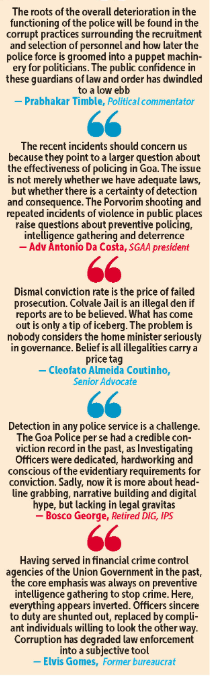
For political commentator Prabhakar Timble, the issue is ultimately one of public confidence. “The roots of the deterioration in the police functioning will be found in the corrupt practices surrounding the recruitment and selection and how the force is groomed into a puppet machinery for politicians. The public confidence in them has dwindled to a low ebb,” Timble said.
Timble acknowledged that there is stress on the system because of personnel shortages, but argued that increasing numbers would not improve policing. “It is true that there is stress on the system due to shortage of personnel. But, just making it quantitatively stronger will not ensure effective policing,” he said. He emphasised that the police see their role as serving political demands rather than defending law and order. Timble also raised concerns over corruption within police stations and jails, adding that “under the BJP rule, communal prejudices have gripped the police force.”
For retired DIG and IPS officer Bosco George, the problem is reflected in widespread insecurity. “There is no doubt about insecurity among honest citizens. The quality of tourists we have targeted includes the riff-raff class who are a burden on society, and the entitled lot who think they can get away by dropping names,” George said. He attributed part of the problem to the politicisation of the force. “Priority is given to political masters rather than to the discipline of the police hierarchy. There is no deterrence,” he said.
“Besides, there is a severe trust deficit—however genuine the grievance, citizens feel the police will do what the political masters want them to do.”
PORVORIM AND THE QUESTION OF DETERRENCE

The Porvorim firing provides a stark example of these concerns, given the attack occurred close to a police station. George cautioned against assuming that proximity to a police station should have prevented the attack.
“The proximity to the police station cannot be considered a deterrent; what matters is the motive behind the act. A firing incident so close to a police station does create panic in the minds of citizens,” he said.

Whether intelligence and surveillance could have prevented the incident, he added, would depend on whether the complainant had taken the police into confidence. “The recent incidents point to a larger question about the effectiveness of policing. The issue is not merely whether we have adequate laws, but whether there is a certainty of detection and consequence,” he added.
MANPOWER OR THE WAY IT IS USED?
Government figures presented in the House put the sanctioned strength of the Goa Police at 5,034 against an actual strength of 4,459, leaving 575 vacancies. Recent reporting highlighted the police promotion structure, where 19 DySPs were elevated to SP rank, while only 11 DySPs were serving against a sanctioned strength of 47.
“Shortage is not the real problem. The placement and distribution of staff at police stations or units has no rationality. Postings are political and not based on the requirements or priorities of the police stations or units,” George said.
Elvis Gomes, former bureaucrat questioned the use of the personnel shortage as an explanation. “Recent job scams have paved the way for entry of the incompetent. The plea of a ‘shortage of 575 personnel’ is an excuse as Goa maintains one of the highest police-to-population ratios,” Gomes said.
RECRUITMENT, PROMOTIONS AND THE POLICE HIERARCHY
The issue of manpower leads to fundamental questions about the quality of the force. Timble places recruitment and selection at the beginning of the chain, arguing that corruption at that stage has long-term consequences.
George has been critical of the promotion system, describing it as “garbage in, garbage out.” “As long as the Command & Control of the police service is only on paper with the DGP, do not be surprised by such misconduct,” he said.
WHEN DETECTION DOES NOT MEAN CONVICTION
Goa’s crime-detection rate was put at 98.92 per cent, while the conviction rate was 5.85 per cent. Around 9,000 of 12,795 criminal cases were reported as pending.
The disparity was highlighted by Opposition MLAs in the Assembly, questioning whether detection alone demonstrated an effective system.
Adv Antonio Da Costa, SGAA president said the recent incidents point to a larger question about the effectiveness of policing.
“The issue is not merely whether we have adequate laws, but whether there is a certainty of detection and consequence,” he said.
“Detection is a challenge. The Goa Police per se had a credible conviction record in the past, as Investigating Officers were dedicated, hardworking and conscious of the evidentiary requirements for conviction,” George said.
“Sadly, now it is more about headline grabbing, narrative building and digital hype, but lacking in legal gravitas.”
COLVALE AND LAWLESSNESS WITHIN THE SYSTEM
The developments surrounding Colvale Jail bring the question of institutional discipline into sharper focus. George described the system as archaic and unable to keep pace with the digital age, pointing to low morale, lack of discipline and inadequate training. “A recipe for incompetence and connivance with criminals,” he noted.
Cleofato Almeida Coutinho, Senior Advocate took a broader view, arguing that the administration had lost its grip on law and order. “Entire administration has collapsed. There is no fear of law. Everyone feels everything can be ‘worked out’,” he said.
He cited the assault on Rama Kankonkar and the shooting at Majestic as examples of criminals taking the police and home minister for granted.
THE REGULATORY SIDE OF LAW AND ORDER
For Gomes, the law-and-order debate cannot be separated from the wider regulatory environment.
He focused on the casino industry, arguing that systemic weaknesses in regulation have been exploited. “The casino industry has exploited systemic weaknesses in the regulatory machinery to its distinct advantage. Generating massive amounts of money, a portion of these funds is routinely deployed to keep the regulatory framework paralysed and compliant,” Gomes said.
He questioned the legal basis for casino operations in the absence of framed rules and argued that revenues should be scrutinised as proceeds of crime under the Prevention of Money Laundering Act (PMLA).
Gomes also pointed to allegations involving senior officials as examples of wider institutional problems, noting that systemic collapse becomes inevitable when the administration itself is under scrutiny for land and property dealings.
THE QUESTION OF ACCOUNTABILITY
The political response has centered on the government’s record and steps to address crime. The Opposition, however, has questioned whether government figures reflect effectiveness, particularly when set against the conviction rate and case backlog.
The concerns raised by the experts move beyond the response to individual crimes; they point toward a common difficulty: restoring confidence requires more than reacting to an incident after it occurs. “Having served in financial crime control agencies of the Centre, the core emphasis was always on preventive intelligence gathering to stop crime. Here, everything appears inverted,” Gomes noted.
For Goa, the core question remains whether the system is creating enough confidence—among citizens, police officers and those who interact with the criminal-justice system—that the law will be applied fairly. The test of law and order is ultimately what happens when the law is challenged. And when citizens begin to feel that influence, money or connections can weaken that challenge, the issue is no longer about individual crimes. It is about the credibility of the system itself.