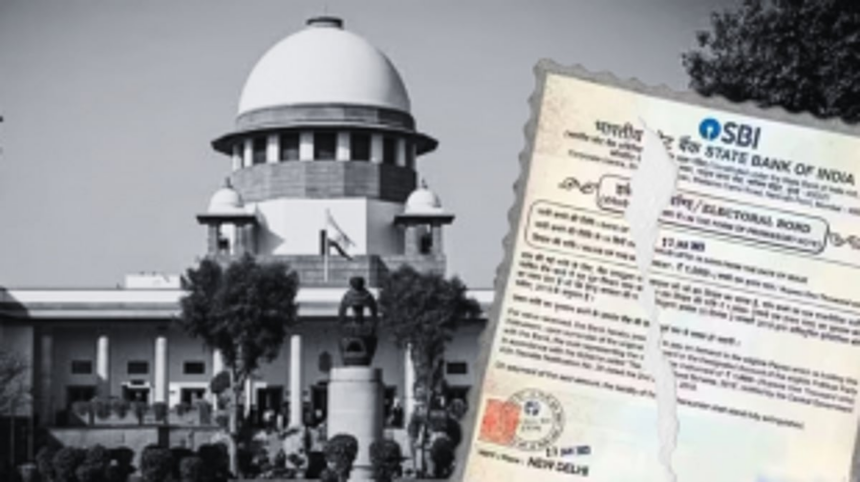
In a landmark ruling on Thursday, the Supreme Court delivered a significant judgment on the electoral bonds scheme, declaring anonymous electoral bonds as a violation of the right to information under Article 19(1)(a) of the Constitution. The decision, reached by a constitution bench comprising Chief Justice DY Chandrachud and Justices Sanjiv Khanna, BR Gavai, JB Pardiwala, and Manoj Misra, comes after a series of hearings over three days, culminating in the verdict delivered on Thursday morning.
While the court arrived at a unanimous decision, Chief Justice DY Chandrachud delivered the lead judgment, with Justice Khanna offering a concurring opinion with slightly different reasoning. Addressing two crucial questions, the judgments examined whether the non-disclosure of information on voluntary contributions to political parties and the amendments to various acts violated the right to information under Article 19(1)(a) of the Constitution and whether unlimited corporate funding to political parties violated the principles of free and fair elections.

Chief Justice Chandrachud emphasized the importance of transparency in political funding, stating that “information about the funding of political parties is essential for the effective exercise of the choice of voting.” He highlighted concerns regarding the influence of financial contributions on policymaking and the potential for quid pro quo arrangements.
The court ruled that the electoral bonds scheme failed to meet the proportionality standard and that alternative means exist to achieve the legitimate objective of curbing black money. It held that the scheme infringed upon the right to information and rejected arguments that the scheme adequately balanced conflicting rights.
As part of its directives, the Court ordered the immediate cessation of electoral bond issuance by the issuing bank and instructed the State Bank of India to provide details of all electoral bonds purchased since April 12, 2019, to the Election Commission of India. Additionally, the bank must disclose details of political parties that have received contributions through electoral bonds and publish this information on the ECI’s website.
Electoral bonds within the validity period but not yet encashed by political parties are to be returned to the purchaser, with the issuing bank refunding the amount. The Court granted a three-week deadline for the submission of information to the ECI, with publication on its website by March 13, 2024.
Senior advocates Kapil Sibal, Prashant Bhushan, Shadan Farasat, Nizam Pasha, and Vijay Hansaria represented the petitioners, while the Union Government was represented by Attorney General R Venkataramani and Solicitor General Tushar Mehta.