“Punjab is not just about makke di roti and
sarson da saag,” declares Kirandeep Kaur as she begins her session, ‘Artistic
Journeys: Embroidery, Life and Weaving Dreams’ in conversation with art critic,
curator and writer, Dr Alka Pande as part of the Goa Arts and Literary Festival
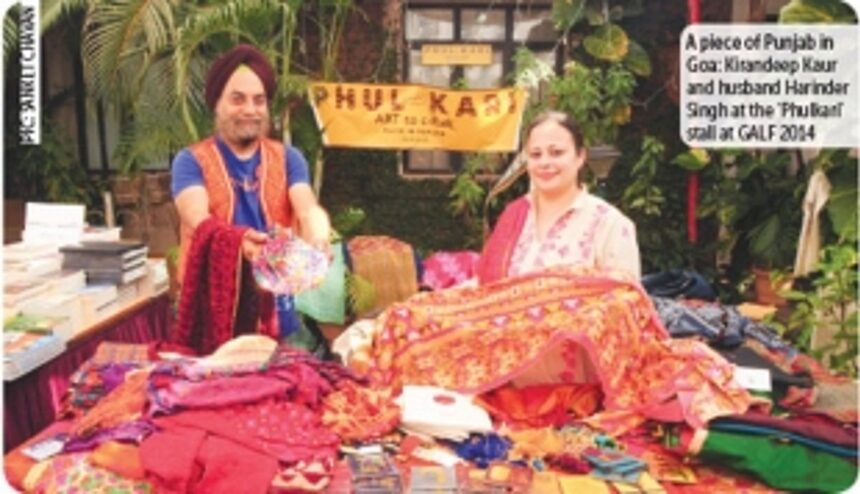
2014. Along with her husband Harinder Singh, Kirandeep has taken the initiative
to display the traditional craft of ‘Phulkari’ – on which the women of Punjab
embroider their dreams during different stages of their lives. The word
‘Phulkari’ comes from the word ‘Gulkari’ and literally means ‘flower-making’.
“Every auspicious occasion in Punjab was
accompanied with a Phulkari – a beautiful piece of textile of dreams, magic and
personal memoir. Phulkari was never woven for commercial use. It came into
existence to create gifts for the family and therefore has an emotional
connect. Like the ‘Chope’ (one of the many stitches) is mostly passed on by a
grandmother to her granddaughter, similarly, a ‘Vari-da Bagh’ is gifted to a new
bride by her in-laws,” explains Kirandeep as she picks up each variety and
points out the difference between a square pattern of ‘Kaudi Bagh’ and diamond
pattern of ‘Suraj mukhi’ phulkari traditionally done on ‘khaddar’ (coarse
cotton fabric) to be wrapped around the head and shoulder. To add to the list,
there is also the ‘Parantha’ (triangular pattern that covers the whole of the
fabric) and the ‘Panchranga’ (five colours).

The couple was initially only into the
business of printed garments focusing mainly on the retail and commerce aspect
of it. For the past few years, they have been diverting their attention to
bringing the handmade art back, apart from digitising all the old prints and
putting them as wearable attire so that those who cannot afford the original
textile, can still have the taste of the original. Dr Pande, while speaking
about the effort of the duo, says that the couple has been infusing life into
the traditional arts and crafts of Punjab in the way William Morris led the
Arts and Crafts movement in the UK. Dr Pande says, “They are trying to bring
back a kind of validation to the arts and crafts of Punjab. What is also
helping is the big Punjabi diaspora which comes back to their country
particularly in the winters and longs to take a little memento back home while
going back.”
“We
have taken this oath to not just familiarise the people with Phulkari and make
products but to also try and bring back some economic independence to women in
Punjab. We are working with an NGO that is working with families of farmer
suicide victims in Sangrur in Punjab. It is an uphill task to get these
traumatised women back into leading a normal life and encourage them to get
involved in the art of Phulkari, but we are slowly getting there,” concludes a
rather pleased Kirandeep.