Dolcy D’Cruz
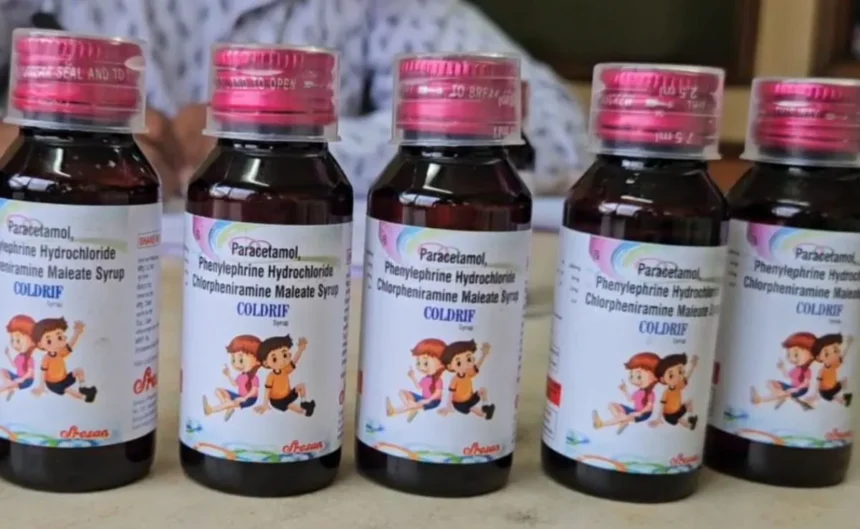
A cough syrup found to contain dangerously high levels of a toxic chemical is under investigation after 14 children allegedly died from consuming it. Indian health authorities confirmed that Coldrif cough syrup, made by Sresan Pharma in Tamil Nadu, contained diethylene glycol (DEG), a highly toxic industrial solvent.

“The samples are found to contain DEG beyond the permissible limit,” said the Indian Health Ministry in a statement. Following the discovery, Madhya Pradesh, Uttar Pradesh, and Rajasthan banned the syrup, and the manufacturer now faces criminal action.
As panic spreads among parents, doctors are emphasising the importance of safe practices when treating cough in children.
Paediatrician and neonatologist Dr Shivanand Gauns explained that cough is a symptom, not a disease, and not every case requires medication. “Each case is different. If a child has a severe cough, visit a doctor. We need to check whether it’s an infection, pneumonia, allergy, or asthma,” he said.
He listed several red flags: “If the cough lasts more than two weeks, or the child has fast breathing, high fever, refuses food, or seems too tired to play — these could be signs of pneumonia, which is an emergency.”
Dr Gauns reassured that around 70 percent of coughs in children are caused by simple viral infections that resolve on their own. “A child with a runny nose, mild fever, but still active — that’s not a serious cough,” he said.
Paediatrician Dr Nathaniel John Pinto advised parents to avoid unnecessary medication, especially cough syrups, as the first line of treatment. “Parents should start with home remedies. Honey with ginger works very well for children aged one to ten. Below one year, honey should be avoided. Mix a tablespoon of honey with a few drops of crushed ginger juice, three times a day — it soothes the throat and reduces irritation,” he suggested.
He also recommended honey with turmeric and salt water or Betadine gargles for throat-related coughs. “These should ideally be done three times a day — morning, afternoon, and night,” he added.
Dr Pinto further clarified that if a child spits out a fever medicine, parents can give it again. “But cough syrups are different — if the child spits it out, don’t repeat the dose. Better to skip it than risk a side effect,” he cautioned.
For fever, suppositories can be an alternative if children refuse oral medication, though “for cough and cold, suppositories aren’t available, so we have to manage with what’s safe and effective,” he said.
In light of the tragedy, doctors urge parents to begin with simple remedies, avoid self-medication, and always consult a professional before giving cough syrups. Incorrect dosing can be ineffective — or dangerously fatal.
Dr Gauns also warned against the misconception that every cough must be stopped immediately. “Coughing is a natural defence system; it helps clear the lungs. But we often suppress it unnecessarily,” he said.
He advised treatment only when the cough is severely disruptive. “If the symptom is so strong that the child cannot eat or speak comfortably, then treatment is needed. But not every cough needs a syrup,” he concluded.