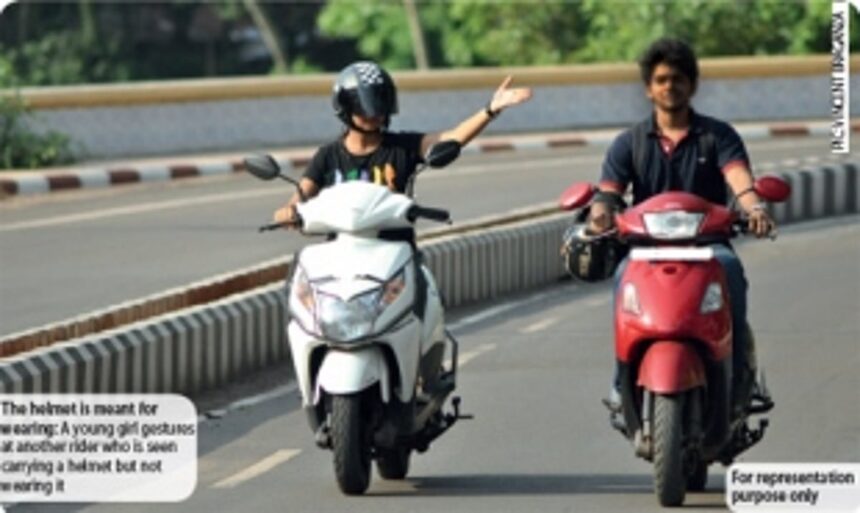
Before April 1, the mandatory helmet rule
applied only for highways while post April 1,
the government made wearing of helmets
compulsory on all roads in Goa. The day
of implementation saw RTO officials and
traffic cell of the Goa police spread out
across all corners of the state, ready to pull
up violators who were moving around with
no headgear.
On the first day alone, 600 challans
were issued and the numbers swelled to
60,000 by day ten! However, after the initial
burst of energy and show of commitment,
the traffic department ran out of steam and
a month and half later, they’re back to the
old status quo.
A few cases show that the short lived
enforcement drive wasn’t a complete
failure. “When the compulsory helmet
rule was implemented, I wasn’t a great fan
of it as wearing a helmet seemed like an
inconvenience. I opted for an open front
helmet as it is more comfy. But after wearing
it since then, I feel different now; much
safer. I now realise that if I ever meet with an
accident, I will have a 60-70 per cent extra
chance of survival than before. I hope other
riders understand this in time,” says David
Aguiar from Colva.
As per traffic department records, road
accident deaths involving two-wheelers
have gone up from 57 per cent in 2010 to
66 per cent in 2014. In 2014, 144 twowheeler
riders and 21 pillion-riders died in
fatal accidents while in 2013, 127 people
died due to road accidents involving bikes.
Vibhav Sawant, member of biking group
Goan Enthusiasts and RideRS (GEARS),
feels that the government’s move to make
helmets compulsory for both the rider
and the pillion is commendable. This bike
enthusiast from Panjim says, “We at GEARS
have always promoted safe riding. I hope
people realise the importance of helmets
and wear them to protect themselves and
not merely to avoid challans.”
According to the Bombay Neuroscience
Association, the umbrella body of city’s
neurosurgeons and neuro-physicians ,
every year, India has been getting the rather
unenviable distinction of having the highest
number of cases of head injury in the world.
The doctors at National Institute of Mental
Health and Neuro-sciences (NIMHANS),
Bangalore have been campaigning for the
helmet rule, pointing out that helmets can
enhance safety for riders of two-wheelers
just as seat-belts can minimise the incidence
of deaths in accidents involving cars.
According to Arun Desai, Director of
Transport, Government of Goa, as per
section 129 of the Central Motor Vehicle Act
rule, it is compulsory to wear a safety head
gear once someone rides a two wheeler,
either as a rider or as pillion.
The motorcycle pilots however are not too happy about this rule and have called for
an exception for Goa, given the one-of-itskind
nature of their business. “We will keep the
spare helmet but who will wear it? We get all
types of passengers, including fisher-folk with
fish baskets on their heads. Customers would
be reluctant to wear helmets and we would
end up paying the fines,” says a motorcycle
pilot from Margao.
Clyde Rodrigues from Majorda brings up
the point that there is no real requirement
for a helmet on village roads as the roads are
all in such a terrible state that one has to be
extra careful at all times anyways. Reacting
to complaints about the condition of village
roads, Desai feels that this issue should give
people all the more reason to wear helmets as
it would reduce risk of injuries.
When the traffic police were asked as to
why they had not succeeded in implementing
the rule, they point out that the enforcement
drive is in progress but they have other duties
as well, such as regulating traffic, which takes
up most of their time. They added that they do
penalise riders who are not wearing helmets
and that they will be using CCTV cameras
installed in various parts of Goa to issue
challans to those found violating the rules.