Elsa Angel Rose
The Supreme Court of India has acknowledged homemakers as nation builders and has set a notional monthly income of rupees thirty thousand as compensation for the loss of a homemaker’s life. The 24-hour and 360-day job, often considered ‘invisible work’, getting some recognition, even though after light years, is still a relief. Homemaking is not for the faint-hearted. It breaks you, drains you, and at times, can even feel like the end of you. For anyone to be successful at what they do, they need to be well-fed, well-dressed, and have their basic needs taken care of. But when you have a family and a home, your responsibility extends beyond yourself; you have to make a home too. Encouragingly, homemaking has evolved and is still evolving beyond its traditional gender roles and expectations, becoming something that the caretakers of the family share through an equal division of chores.

THE SHIFTING DYNAMICS OF HOMEMAKING
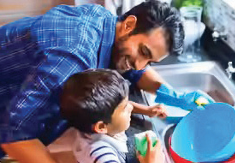
“We do what works and usually in tandem. My wife makes breakfast, after which I drop my son off at school. At meal times, she will cook and serve us, while I usually clear up and do the dishes,” said Dr Brian Mendonca, a writer and poet from Porvorim. It is possible to divide housework equally and reduce the burden on one person. “My wife gave up her job in Mumbai and joined me in Delhi as a homemaker. She continued to do so after we returned to Goa in 2011,” said Dr Brian. He added, “People ask me, ‘Does she work?’ and I have always said, ‘Yes. She is a homemaker.’ It’s important to care and share the work. As long as you value what your partner is doing, and do not take him/her for granted, it makes things easy.” Although such equal division of tasks is the ideal situation, not always does this happen. In fact, the National Time Use Survey, 2024, found that women spend 289 minutes a day doing unpaid labour compared to men who spend 88 minutes on unpaid labour. “I definitely do the lion’s share of household work. I know it goes against my belief system, but I guess sometimes it’s just easier to do the work yourself rather than have to ask and remind others to get work done at home!” shared Sheryl Afonso, a clinical nutritionist and homemaker. When asked about whether the ways of homemaking have changed for the better, she replied, “More paid help and technology to keep the home clean and assist with the cooking have helped. However, on the flip side, the need for equal participation in household chores remains unresolved.”
CHANGING THE WAY SOCIETY VIEWS CARE WORK
Going by traditional norms and the associated unwanted yet inevitable stereotypes, homemaking is still predominantly considered a woman’s job and is still predominantly done by women in most households. But this needs to change. There should be liberty for women to choose, and also to ensure an equal share of responsibilities. Dr Aida Dourado, a sociology expert, educator and homemaker from Salcete, shared, “Mostly, people shy away from even talking about being homemakers, as society discriminates againstsuch people, and value is often attributed to those working outside the home. Homemakers are viewed as being less educated or less ambitious. Household work is considered only a woman’s responsibility. Homemakers are perceived as not contributing financially to the family. These misconceptions ignore the skills, dedication, and value involved in managing a home. Even I, as an academician, have observed that when students are asked about their parents’ occupations, they often say, ‘My mother is just a housewife,’ or ‘My father just stays at home’, reflecting how homemakers are often undervalued.” Some men are aware and help with house chores. Dr Aida shared, “Many men also choose to be stay-at-home parents or homemakers. Modern families increasingly share household responsibilities, and homemaking is being recognised as a shared responsibility rather than one based on gender.
As a sociologist, I am glad these stereotypes have been broken down, but societal acceptance is still too slow.” Whether waking up early, taking care of oneself and the family by cooking food, keeping the house clean, running errands, tutoring, caring for the kids and elderly, and sustaining the mental ecosystem of the family can be measured through a paycheck is extremely doubtful. Even if it can be represented, it will never be completely accurate. “Yes, it would not be wise to quantify,” said Dr Brian. “A homemaker’s work is very valuable, huge and can be measured in terms of the time, effort, skills, and responsibilities involved. Often, homemakers do not receive the recognition they deserve. Their work is sometimes taken for grantedbecause it is unpaid and done within the home. However, awareness is increasing, and many families and communities are beginning to appreciate the important role homemakers play,” said Dr Aida. More than any monetary value, being acknowledged and respected for what a homemaker does for a family is the most meaningful recognition.