Maria Amanda Pereira
‘A saint is not someone who is perfect, but someone who belongs completely to God.’ Throughout history, many men and women have dedicated their lives to God, but only a few have left behind a legacy that continues to inspire millions even centuries later. One such saint is Saint Anthony of Padua. Born to Vicente Martins and Teresa Pais Taveira on August 15, 1195 in Lisbon, Portugal. His birth name was Fernando Martins de Bulhões. From childhood, Fernando was known to be prayerful, obedient, and devoted to God. He belonged to a wealthy family, but he was never attracted by riches. He spent much of his time in prayer and learning about the Scriptures. A well-known story from his childhood recounts how birds were destroying the grain stored by his family. Trusting in God’s help, young Fernando prayed, and the birds obediently gathered in one place. This event is often remembered as an early sign of his holiness and special bond with God’s creatures. At the age of 15, Fernando joined the Augustinian Order at the Abbey of St Vincent in Lisbon. Later, he moved to the Monastery of the Holy Cross in Coimbra to focus more on prayer and studies without distractions from family and friends. There he studied theology, Scripture, and Latin. A turning point came in 1220 when the bodies of five Franciscan missionaries who had been martyred in Morocco were brought to Coimbra. Their courage deeply inspired Fernando. He felt called to dedicate his life completely to Christ and to spread the Gospel. He left the Augustinian Order and joined the Franciscan Order. When he became a Franciscan, he took the name ‘Anthony.’ Anthony had a strong desire to become a missionary and even hoped to die as a martyr. He travelled to Morocco, but soon became seriously ill. On his return journey, a storm blew his ship off course and he landed in Italy. There, God revealed a different plan for him. Instead of becoming a missionary martyr, he became a preacher whose words touched thousands of people. St Anthony had already been ordained a priest before joining the Franciscans. As a Franciscan priest, he lived a simple and humble life. He preached in villages, towns, and cities across Italy and France. His knowledge of the Bible was extraordinary, and many people returned to the faith after listening to him. He cared deeply for the poor, the sick, and those who were suffering. Many people ask why St Anthony has a 13-day or 13-Tuesday Novena instead of the usual 9-day Novena. Normally, a Novena consists of nine days of prayer. However, St Anthony’s feast is celebrated on June 13, the day he died and entered eternal life. Over time, devotees began a special devotion of 13 days or 13 Tuesdays in his honour. The number 13 became closely connected with St Anthony because of his feast day and the many graces received through his intercession. This tradition is called the ‘Tredicina’ (Italian for ‘thirteen’) and is widely followed throughout the world.

THE MIRACLES OF ST ANTHONY
Preaching to the Fish
When some people refused to listen to St Anthony’s preaching, he went to the seashore and began preaching to the fish instead. According to tradition, hundreds of fish gathered near the shore and raised their heads above the water as if listening attentively to his sermon. Witnessing this remarkable event, many people were moved and returned to the faith.
The Miracle of the Mule (Donkey)
A man who doubted the Real Presence of Jesus in the Holy Eucharist challenged St Anthony. The man agreed to keep his mule without food for three days and then place food before it while St Anthony held the Blessed Sacrament. On the appointed day, instead of rushing to the food, the hungry mule knelt before the Blessed Sacrament in adoration. This miracle strengthened the faith of many people in the Eucharist.
The Infant Jesus appearing in his arms
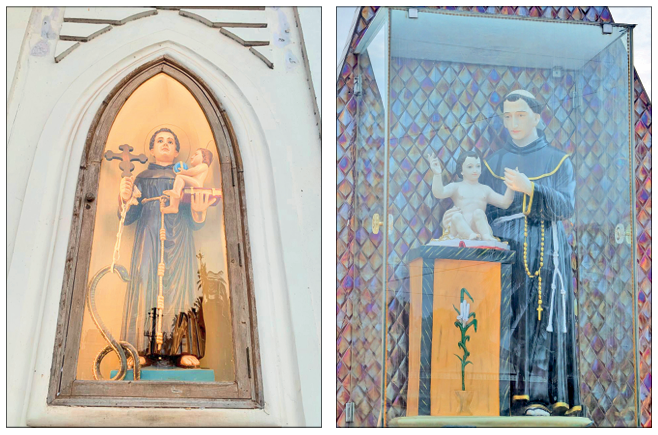
One of the most beloved stories about St Anthony tells of a nobleman who secretly looked into Anthony’s room while he was praying. He saw a bright light filling the room and witnessed the Child Jesus appearing in St Anthony’s arms. Anthony lovingly embraced the Infant Jesus, who smiled at him. This vision is the reason many statues and images of St Anthony show him holding the Child Jesus.
Healing the sick and helping the needy
Throughout his life, many people sought St Anthony’s prayers for physical and spiritual healing. Numerous accounts describe people being cured of illnesses, recovering from injuries, and finding comfort during times of suffering after receiving his blessing or asking for his intercession. He was especially known for helping the poor, comforting the sorrowful, and encouraging those who had lost hope.
Finding lost things and bringing people back to faith
St Anthony is best known today as the patron saint of lost things. This devotion originated from an incident in which a novice took a valuable book of Psalms that belonged to St Anthony. After St Anthony prayed for its return, the novice repented and brought the book back. Since then, countless people have prayed to St Anthony when they have lost something important and have reported finding it. He is also known for helping people rediscover their faith, return to prayer, and find their way back to God. Because of these miracles, St Anthony became known as the Wonder Worker and Saint of Miracles. Even today, people pray to him especially for: Finding lost items Finding lost opportunities or relationships Help in family problems Guidance in difficult situations Protection during travel Strengthening faith Finding a suitable life partner St Anthony died on June 13, 1231 in Padua, Italy. People immediately recognized his holiness. Less than a year after his death, he was canonized as a saint on May 30, 1232 by Pope Gregory IX. He became one of the fastest canonized saints in Church history.
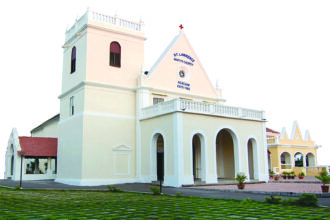
CHURCHES AND CHAPELS ARE DEDICATED TO ST ANTHONY In Goa, many churches and chapels are dedicated to St Anthony. Some well known ones include: St Anthony’s Church, Marna, Siolim It is one of the most famous churches dedicated to St Anthony in Goa and is known for its unique statue of St Anthony holding a rope tied to a serpent, symbolizing the victory of good over evil. The church attracts thousands of devotees during the feast and the thirteen-day novena celebrations.
St Anthony’s Chapel, Deussua, Chinchinim
One of the most famous centres of devotion to St Anthony in Goa. Situated in Deussua village of Chinchinim, the chapel is especially known for its Tuesday novenas, thirteen-day feast celebrations (Trezena), and the relic of St Anthony preserved there. Thousands of devotees from different parts of Goa visit the chapel every year seeking blessings, miracles, and St Anthony’s intercession for lost things, family needs, and personal intentions.
St Anthony Chapel, Monte de Guirim, Guirim
The chapel is located on the scenic hill of Monte de Guirim, a place known for its Franciscan heritage and the famous St Anthony’s High School. It is a peaceful centre of prayer and devotion where many faithful gather for Tuesday devotions, novenas, and feast celebrations in honour of St Anthony. The hilltop location offers a calm spiritual atmosphere and beautiful views of the surrounding villages and fields. These places attract many devotees every Tuesday and during the novena and feast celebrations. St Anthony’s life reminds us that holiness does not come from doing extraordinary things. It comes from loving God, helping others, remaining humble, and trusting God’s plan even when life changes unexpectedly. From a young boy named Fernando to one of the most beloved saints in the world, his journey continues to inspire millions of people today