At the Kochi Biennale earlier this year, an exhibit by the feminist group Geurilla Girls studied
art across museums and galleries and reported dismal figures in terms of its
representation and participation of women. In a conscious effort to change the
narrative since, festivals have credibly made an effort to include more works
by and about women that go beyond the conformed narratives. At the recently
concluded Serendipity Arts Festival, held across several venues in Panjim, Goa
witnessed many works that championed the feminine, some in an effort to find the
source, some others in empathetic reflection, while yet others through
succulent gender politics.
Art and artists who have worked with classical texts have far
too often justified the sexism and casual misogyny under the garb of
puritanical processes. One could perhaps take a leaf out of Rehan Engineer’s
work at Serendipity ‘Sounding Vanya’ – a play that works with a 120-year-old
piece of text by Chekov. Curated by Atul Kumar, the play under Rehan Engineer’s
direction beautifully subverts gender politics by casting all nine women for
all roles in the play, all of whom take turns to play all the characters. While
the lone male pianist created the wistful background notes, the women took
turns to dismantle and enquire form.

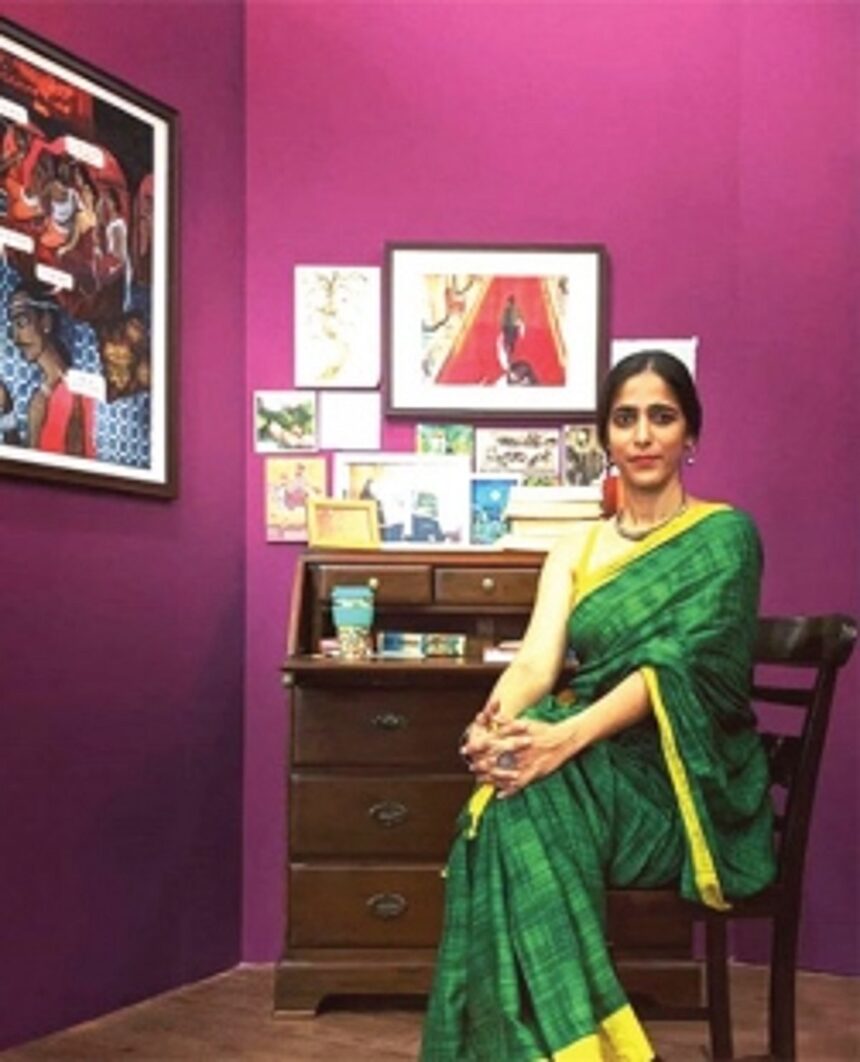
At Amruta Patil’s alter there is a lingering sense of the
feminine, as you wander through the labyrinthine mazes of her sanctorum,
tracing the sources, altering identities and rummaging through her poetic
processes. There is a kind of instinctive claiming of the space there, without
having to reiterate the obvious. Female protagonists form the core of her works
– from her queer, melancholic protagonist ‘Kari’ looking for the 2mm buzzcut to
the female rishikas whose lives and narratives form the core of her most recent
work, Aranyaka, women in her stories exist as people, beyond gender confines.
Without having to make a loud proclamation about its gender politics, her works
seamlessly find the voice in roles and irregularities that otherwise are filled
by men.
Yet some others, like Diya Naidu’s performance piece – the Red
Dress Waali Ladki, hold up a much needed looking glass, visceral as it might
be, to the atrocities and assaults towards women that pepper our daily
headlines. The clichés she creates and dismantles find empathy in and hope in
the existence of ‘the other’. In yet another piece of theatre, ‘Photocopy’,
written and directed by Niketan Sharma, the ‘male protagonist’ battles
questions of identity, in the face of fading memories of his dead father. The
play, while being so poignantly humorous and on point about the trials and
tribulations of a small-town family in India, led by a matriarch played
excellently by Rashika Aghase, also depicts the ‘male’ beyond the crutches of
the masculine.
This thematic subversion remains incomplete without a mention of
‘Aurat, Aurat, Aurat’ – an autobiographical piece about Ismat Chugtai, where an
all female cast enacts rhymes and ruminations from her life. A play directed by
Naseeruddin Shah, this 2-hour play traverses through her sometimes momentous,
sometimes mundane episodes of ‘Ismat apa’s’ life, chronicling her
contemplations on the state of ‘conditioned womanhood’. Poignantly told, with a
tone of amused fondness at the follies of perfunctory manhood, the piece finds
resonance in its feminist core through the lived experiences of ‘apa’, and her
chatty demeanour just as much as in its melifluous writing.
From
the arts to the streets, a sense of revolution is palpable in the air these
days. It indeed takes all kinds to change the narrative. Perhaps, we are
getting there.