Few would have thought that Prime Minister Narendra Modi’s visit to Lakshadweep would kick up a tsunami of controversy engulfing relations between India and Maldives, which is already under considerable strain since Mohamed Muizzu’s government took charge after winning the general elections last year riding on the “India Out” campaign.
The new government of Maldives has wasted no time in asking Indian military personnel to leave the country and ending the agreement with the Indian navy for a hydrographic survey of its waters.
Instead of the long-standing tradition of a newly elected Maldivian President visiting India first, Muizzu chose to travel to Turkey on his first official visit late last year and last week he was on a state visit to China.
Maldives is located south of India’s Lakshadweep Islands in the Indian Ocean. Both nations established diplomatic relations after the independence of Maldives from British rule in 1966. India was one of the first nations to recognise Maldives’ independence. Since then, India and Maldives have developed close strategic, military, economic and cultural relations.
In 1988, under Operation Cactus, the Indian Armed Forces helped the government of Maldives in thwarting a coup attempt.
The current political dispensation of Maldives has conveniently forgotten all this and is now cosying up to China. In fact, China has been making significant inroads into Maldives for quite some time.
This is because the geo-strategic importance of Maldives is far beyond its physical size. Despite being the smallest Asian country, Maldives is one of the world’s most geographically dispersed countries, straddling a 960-km-long submarine ridge running north to south, which forms a wall in the middle of the Indian Ocean.
Located at the southern and northern parts of this island chain are the only two passages through which ships can pass safely. Both these sea lanes of communication are critical for maritime trade flow between the Gulf of Aden and Gulf of Hormuz in West Asia and the Strait of Malacca in Southeast Asia.
While the Indian Ocean is considered as the key highway for global trade and energy flow, Maldives virtually stands as a toll gate. Maldives plays a key role in this geopolitical competition due to her strategic maritime geography.
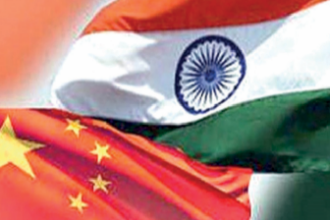
That is why it is no wonder that China with her hegemonistic plan is trying to get Maldives on her side to enable successful employment of Belt and Road Initiative to link all the countries that are part of it and make String of Pearls more effective to isolate India.
Perhaps, sensing the growing influence of the Dragon in its backyard, PM Modi decided to promote Lakshwadeep islands, which is merely 800 km from the island nation. His appeal to visit Lakshwadeep catapulted the island’s popularity on online travel aggregators by nearly 3000%.
A few political leaders of the island nation suspected that PM Modi’s promotion of Lakshadweep was an attempt to project the Union Territory as an alternative tourist destination to the Maldives. This perhaps triggered extremely derogatory anti-Modi and anti-India posts on social media by three Maldivian deputy ministers.
This led to the “#BoycottMaldives” campaign on social media by Indians. There has been a flurry of booking cancellations for Maldives by Indian tourists. While Indians have every right to feel offended and express their anger, we have to be careful before taking our new-found hyper nationalism too far.
Attacking Maldives like this too much can give China the much needed space to encircle India. India must tackle the issue diplomatically, as the situation is in our favour. The country’s opposition is already gunning for President Muizzu’s head for his government’s anti-India stand and the derogatory remarks against PM Modi and Indians.
Maldives should be also wary of Chinese debt trap that could destroy its economy. Debt-trap policy refers to a lending practice with opaque terms and higher interest rates, which makes it almost impossible for the borrowing country to pay back the loans.
The debt-trap warning for Maldives has grown as it has taken massive loans from China. The China Development Bank, the Industrial and Commercial Bank of China, and the Export-Import Bank of China hold over 60 per cent of Maldives’ sovereign debt, said the Observer Research Foundation (ORF) published in November 2023.
With Chinese chequers being played in our backyard, we have to engage all our neighbours and find ways to keep our economic and strategic interests alive. Too much aggression is not good for bilateral relations, as it has been in the case of Maldives.
Despite whatever is going on, Maldivians generally regard India as a friend and trusted neighbour. We should leverage this for having the island nation on our side and refrain from arm-twisting tactics. We should temper our hyper-nationalism and wait for their leaders to realise the folly of dancing with the Dragon, which they will realise sooner than later.