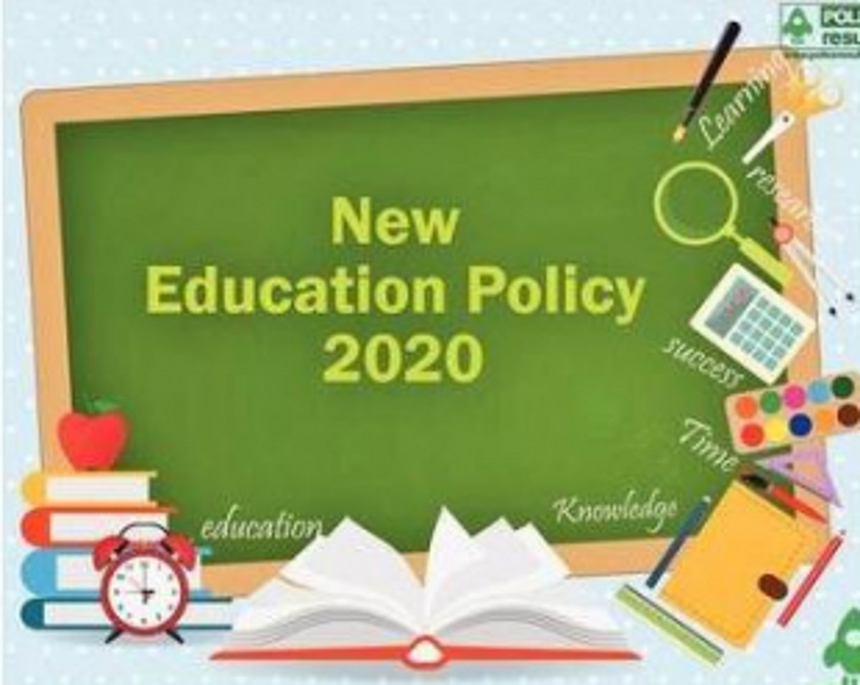
The New policy of education of 1986 was modified in 1992 and now we have the third NEP 2020. This aims to help students learn about the world around them and contribute to it in various ways by focusing on learning by doing, by developing critical thinking and problem-solving skills along with other 21st century literacies, competencies and personality traits.
According to NEP20 Universal high quality of education is the best way forward to develop and maximise our rich talents and resources for the good of the individual, the society, the country and the whole world.

There is no suggestion for basic change as far as the years of total school learning as compared to our existing school learning. The only change is that it lays importance on pre-school learning and some other aspects. At present in Goa pre-school is not recognised and considered not necessary. Whereas NEP20 lays importance on this part of education.
In the changing world scenario it is essential that children “learn how to learn”. Therefore it is learning less about content and rote memory but learning to think critically and solve problems. To learn to be creative, innovative, adapt and absorb new material with the changes. For this our curriculum, methods of teaching and learning will have to be totally overhauled to develop all aspects and capabilities of the learner.
It says that education must build character besides developing ethical, compassionate behavior and prepare them not only for gainful but fulfilling employment.
NEP 20 specifies a number of changes in order to overcome our deficiencies in the present system of education:
1. Recognising, identifying and fostering unique capabilities of each student.
2. To achieve fundamental literacy and Numeracy by grade 3, which is lacking at present
3. Flexibility for learners to chose their own paths according to their ability, talents and interest.
4. No hard separation in arts & science, curricular & extra curricular activities, vocational & academic streams.
5. Multi disciplinary and holistic education with emphasis on conceptual understanding rather than rote learning for exams.
6. Promotion of multi-lingualism, creativity and critical thinking, ethics and human values like empathy, respect for others, cleanliness, courtesy, democratic spirit of service, respect for private property scientific remper, liberty, responsibility, pluralism, equality and justice.
According to NEP 20 the schooling years are divided as follows
(1) (ECCE) from age 3 to 6, which is promoting better overall learning, development and well being. This is because it is believed that 85% cumulative brain development occurs prior to the age of 6, indicating critical importance of appropriate care and stimulation of the brain in early years.
This foundational education is for 5 years i.e. pre-school 3 years and class 1 and 2. In Goa we do not lay importance in pre-school learning and it is not recognized by the Government. The regular school at present school starts from Class 1.
(2) PREPARATORY is for 3 years from Classes 3, 4 and 5. In Goa we have primary till Class 4. Class 5 is linked with the middle section. To take this step in Goa there are lot of ramifications with respect to teachers, Goa Education Act and Rules, etc. Considering that from Std. V there are more aided schools all these will need a lot of debate and change.
(3) MIDDLE 3 years from classes 6,7 and 8. All these classes are in our High school sections and as such it can be easily adapted. However certain changes may be envisaged in subjects and languages, etc.
(4) SECONDARY – 4 years from classes 9, 10, 11, 12. We have in Goa High school with classes 9 and 10 followed by Higher Secondary School with 11 and 12. This will be another major problem as in most cases they are separate entities in existence. In this changes regarding teachers, rules and regulations, etc. Easy way out of this would be to keep 9/10 with High School and 11/12 with Higher secondary school.
But this will not allow the synergy in curriculum across all levels of education as envisaged in the NEP20 besides many other positive changes like reducing public exams etc.
Another aspect that we have to take care in Goa is the language i.e. medium of instruction, which has been a debatable issue in Goa for the last 3 decades. NEP20 envisages mother tongue as the medium of instruction but promotes multi-lingualism.
It is true that a child can understand and respond better with a home spoken language or mother tongue as we may call it. At the same time we must not deny the children the advantage of knowing English. However in many households in urban areas English is more widely used as a home language. This conflict can be resolved by a bilingual method of teaching allowing the learner the freedom of expression in any one language so that the children can learn both the languages. Learning of languages should not be confused with the medium of instruction.
NEP20 emphasis of fundamental literacy and numeracy i.e. the ability to read and write and perform basic operation with numbers. At present it is seen that many children lack this even in class 3 and 4. To achieve these aims we have to make drastic changes in the system, syllabus, activities, teaching, administration, evaluation, etc. We have been demanding these changes for decades. Let’s hope that NEP20 helps us in bringing in new ideas for a new era of education for a brighter future of the generation.
(Celso Dias is the former president of GHA and Vice Chairman of Goa Board).