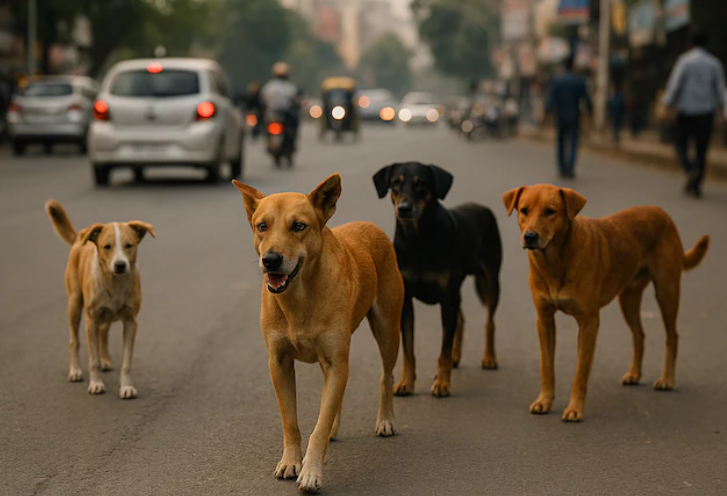
The Supreme Court was informed on Wednesday that removing stray dogs from public spaces could impose a massive financial burden on the government, with estimated costs running as high as ₹26,800 crore annually.
Senior advocate Krishnan Venugopal, appearing on behalf of animal welfare expert Gauri Mulekhi, presented detailed cost estimates based on government data before the apex court. Mulekhi, regarded as one of the country’s leading experts on stray dog management, has worked extensively with four states, including Uttar Pradesh.

Venugopal highlighted the success of the “Lucknow Model,” which has reportedly led to a significant reduction in the stray dog population through systematic sterilisation and vaccination. He urged the court to reconsider its November 7 order in light of the practical and financial challenges involved in its implementation.
According to the submissions, India’s stray dog population is estimated at around 5.25 crore. To effectively reduce this number, nearly 1.84 crore dogs would need to be captured and housed in shelters. The daily cost of feeding these dogs, calculated at ₹40 per animal, would amount to approximately ₹73.6 crore per day, translating to nearly ₹26,800 crore annually.
In addition, accommodating such a large number of animals would require the construction of about 91,800 new shelters across the country, spanning nearly 16,863 acres of land. The estimates also factor in expenses related to infrastructure development, manpower training, staff salaries and ongoing operational costs.
Venugopal told the court that given the sheer scale of the financial and logistical burden, even the initial steps mandated by the November 7 order—capturing, sterilising and vaccinating stray dogs—have yet to commence.
The matter remains under consideration as the court weighs public safety concerns against feasibility and resource constraints.
(This story is published from a syndicated feed)