AUGUSTO RODRIGUES
Goa’s coastline is no longer clean and hence not safe to swim because the State’s waters in the beaches and rivers “do not comply with Central Pollution Control Board (CPCB) criteria for bathing and commercial fishing.” This shocking fact was disclosed in Unstarred LAQ No 154 tabled by leader of Opposition (LoP) Yuri Ale mao on the first day of the Thirteenth Session of the Eight Legislative Assembly 2022. To the question: “Wheth er survey of River water and Beach water was conducted by the Government; if so, provide copies of reports and whether the water of rivers across the State and sea water of Goa is safe for bathing and fishing.” The answer is: “The Goa State Pollution Control Board is monitoring wa ter quality every month of rivers and beaches in Goa under the NWMP (Nation al Water Quality Monitor ing) sponsored by CPCB (Central Pollution Control Board). Based on data in terpretation, it is informed that coastal waters do not comply with the CPCB’s cri teria of SW-II categorisation for bathing and commercial fishing in respect of faecal coliform parameters.” “In short,” as a senior sci entist based at the National Institute of Oceanography (NIO) said on condition of anonymity, “what it means is that when we go for a swim, we are consuming dirt and the fish we eat is contaminat ed.” Despite Goa having over 30 distinct beaches, the GSPCB presented a CPCB study of 19 beaches in Goa – eight in the north and 11 in the south.

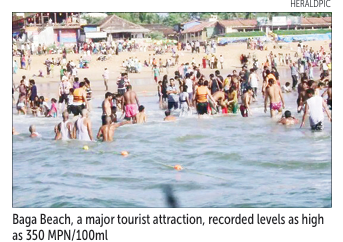
From among them Varca beach was the only one with, “ all parameters within the permissible limits of SW-II as per CPCB classification based on the designated best use of rivers.” While 100 or less MPN/100ml is the limit for SWII riv er (applicable for the coast too) as per CPCB classification based on designated best use of river all the eight beaches in North Goa shortlisted by GSPCB crossed the limits with 350 being the highest recorded at Baga, Palolem and Baina beach in February 2025, December 2024 and September 2024 respectively. The LAQ presented in the Assembly states that nine beaches in Goa – Calangute (6),Vagator (5), Baga (6), Bam bolim (8), Velsao (5), Bogmalo (5), Palolem (5), Baina (10) and Colva (6)- the number in parenthesis indicates the number of months limits were crossed – crossed the limits during the 12-month study conducted by GSPCB . “Our beaches are spoilt because of the casinos in the Riv er Mandovi. The whole North Goa belt and a great number of beaches in the south are contaminated because there is no way the casinos have to release their sewerage,” argued Dr Bossuet Afonso, director of one of Goa’s private hospital. “The water of river Mandovi merges into the Arabian Sea and from there on the waters shifts north and south. The pollution we are seeing today is because the sewage of the casinos is being discharged without being processed,” al leged Dr Afonso. If the readings of water samples from beaches are alarm ing, those taken from the various rivers are frightening. Most rivers had crossed the permissible limits during 10 of the 12 months with the interior rivers having readings crossing the 1,000-mark. The samples taken at River ‘Mandovi near the Mando vi Bridge’ exceeded permissible limits during 10 of the 12 months along with the samples taken at ‘River Mandovi at the IFFI jetty’. The highest reading at both places was 350 in March 2025. The reading of ‘Mandovi River near Hotel Marriot’ in March 2025 was 540. ‘River Sal at Panzarconi , Cuncolim’, ‘River Sal at Mobor’, had touched 3,300 during the 12-month period with ‘River Sal at Khareband, Margao,’ being the worst with reading in July 2024 being as high as 130×10 square, 24,000 in Janu ary 2025 and coming down to 540 in the last reading. “It is expected that O CFU /100 ml be the reading where humans and animals deal with the water, 1-10 MPN /100 ml is considered low risk and 11-100 is considered medi um risk. Over 100 is high risk,” explained the NIO scientist. “Faecal coliform tends to rise in waterways when human and animal waste enters waterways when there are no septic systems in place or those that are, have failed. It also happens when sewage overflows during the monsoons during heavy rains,” explained the NIO scientist while try ing to explain how 10 of the 11 beaches had exceeded the permissible limits during the monsoons. “Goa was once a beautiful place. I have seen it disinte grate since the last many years. I have moved from the north to the south and am now thinking of never coming back. It is hurting me because I love Goa but there is noth ing I can do if the people who own it do not care about it. My health is more important,” said Andrew from the UK, who claims to have first come to Goa in 1990. For the locals though and specially those living in the vi cinity of the casinos, “this water pollution is no surprise.”