ANIL KUMAR MISHRA & SHYAM ZAMBAULIKER
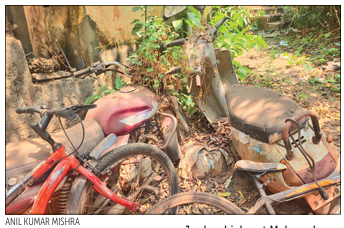
From Panjim’s congested streets to Margao’s busy commer cial corridors, abandoned vehicles have quietly colo nised public spaces, turning parking bays into grave yards of neglect, squeezing commuters onto narrow er and narrower stretch es of road. The result is a slow-burning crisis which authorities have repeatedly failed to diffuse. Walk along the stretch from Shree Maruti Mandir to the Gogol traffic signal in Margao, or past the areas near Aquem and Davorlim, or even bang opposite the Panjim police station and the evidence is hard to miss — two-wheelers with flat tyres, cars blanketed in grime, buses commandeer ing road space that was nev er theirs to take. These are not vehicles waiting to be collected. They have been left behind — by owners, by repair garages, and, res idents argue, by the very authorities tasked with clearing them. “These vehicles are illegally parked for months, causing traffic bottlenecks and frequent minor accidents,” says sen ior citizen Vinod Naik, who has watched the situation in Margao worsen with each passing season. “Many of these wrecks have effectively become dumping grounds — re positories of litter and decay parked in plain sight,” he adds.

The menace is more than a matter of inconvenience. In Goa’s coastal climate, stagnant rainwater pools inside abandoned vehicles during the monsoon, turning them into mosquito breeding grounds and raising the spectre of vector-borne disease. Rust eats through chassis and body work, creating structural hazards for pedestrians, animals and neighbouring property. Beneath the surface, leaking engine oil, brake fluid and other automotive chemicals seep silently into the soil, leaving ecological damage that will outlast the vehicles themselves. And yet, the response from authorities has been — at best — sporadic. Periodic drives by the Corporation of the City of Pana ji, the Margao Municipal Council, and the Goa Police have made dents, but not lasting impressions. “In a recent op eration we identified 43 abandoned vehicles, of which 35 were removed. The remaining eight could not be cleared due to incomplete ownership details. We are coordinating with the RTO to trace the owners and necessary action will follow,” a senior traffic cell official said. Meanwhile, resi dents report that cleared stretches are re-occupied within months — the problem not solved, merely repeated.
What residents want is a sustained, systematic response. “A one-time exercise does not serve the purpose. There has to be periodic monitoring and continuous drives — per haps every three to six months,” a Panjim resident said pointedly — a sentiment that echoes across both cities. The legal framework to act exists. Sections 122, 127, and 201 of the Motor Vehicles Act, 1988 empower authorities to remove vehicles obstructing traffic or left unattended in public spaces. Advocate Sanjit Dessai has urged stricter en forcement, warning that haphazardly parked vehicles have already contributed to self-accidents and fatalities. The tools are there. The will, residents say, is not. The crisis has even crept into organised spaces. The Goa Civic Action and Consumer Network, GOACAN, has flagged a particularly galling instance — abandoned vehicles oc cupying prime spots in the pay-parking area of the Panjim bus terminus, managed by the Kadamba Transport Cor poration Limited.
In a letter to the KTCL General Manager, GOACAN pointed to the absence of any formal mechanism for the parking contractor to report abandoned vehicles, and the failure to alert traffic police, district police, and the Directorate of Transport in a timely manner. GOACAN Coordinator Roland Martins said, “We are of the firm opinion that if the abandoned cars are removed from Panjim, the city will see a lot more available parking slots. For this to happen the Pay Parking Contractor must give feedback to CCP on a Weekly basis.” The group has called for a joint meeting of all concerned agencies — Transport, Police, Health Services, Fire and Emergency Services — to build a coordinated response, and has urged that abandoned vehicle reporting be made a mandatory condition in the upcoming parking contractor appointment.
There is also an opportunity being squandered. Ex perts note that abandoned vehicles need not simply rot — headlights, speakers, metal components and more can be salvaged, reused, or recycled. What is currently a public hazard could, with the right systems, become a managed resource. Chief Minister Pramod Sawant drew a clear line last year – any vehicle left at the same spot on a public road for more than eight days would be deemed abandoned and sent for scrapping. It was a firm warning. Whether it will be followed is the question Goa’s long-suffering residents are still waiting to have answered.