SHASHWAT GUPTA RAY
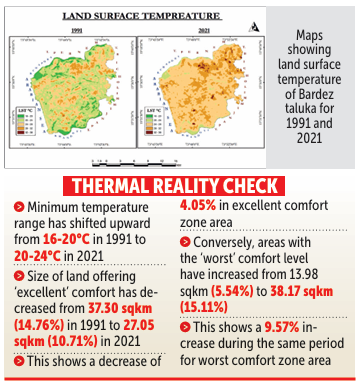
Rapid urbanisa tion, tourism expansion and sweeping land-use changes have significantly increased land surface temperature (LST) and reduced thermal comfort across Bardez talu ka over the past three dec ades, a new study has found. Titled ‘Decoding Urban Heat: A Decadal Analysis (1991–2021) of Land Sur face Temperature and Ther mal Comfort Dynamics in Coastal Taluka of Bardez, Goa, India’, the research by Dr Venkatesh Prabhugaon kar, Assistant Professor of Geoinformatics at the Goa government’s Autonomous College of Multidisciplinary Studies and Research, Bor da, has been published in the peer-reviewed journal Disaster Advances. Using satellite imagery and geospatial analysis, the study maps the steady replacement of natural landscapes — in cluding vegetation, agricul tural land, and wetlands — with built-up zones such as residential, commercial, and infrastructure areas. This transition has intensified heat absorption and re tention, accelerating the urban heat island effect. “The findings clearly indicate a rise in temperature and a decline in thermal comfort. Minimum temperatures have shifted upward from 16-20°C in 1991 to 20-24°C in 2021, indicating an overall warming of the region,” Prabhugaon kar said. Areas offering “excellent thermal comfort” shrank from 37.30 sqkm (14.76%) in 1991 to 27.05 sqkm (10.71%) in 2021 — a decline of 4.05%. In contrast, areas classified un der the “worst” thermal comfort category increased sharp ly from 13.98 sq km (5.54%) to 38.17 sq km (15.11%), marking a 9.57% rise over the same period. “The urban heat island effect has intensified, with urban areas recording higher temperatures than surrounding ru ral regions. Overall, the study establishes a strong relation ship between land-use change and rising temperatures, highlighting the environmental cost of unplanned develop ment,” he said. The study also notes a steady increase in the Urban Ther mal Field Variance Index, indicating growing temperature fluctuations in urban zones. These shifts are linked to ex panding built-up areas, impervious surfaces such as as phalt and concrete, dense infrastructure, shrinking green cover, and human activities including transportation, in dustry, and energy consumption. “These factors contribute to altered microclimates and intensify urban heat islands, raising overall temperatures in cities. The findings have significant implications for urban planning, policy-making, and sustainable develop ment,” Prabhugaonkar said. He warned that rising temperatures could adversely af fect public health by increasing heat stress and discomfort, particularly in densely populated areas. “Reduced vegetation weakens natural cooling mecha nisms, leading to persistently high temperatures. There is an urgent need for climate-sensitive urban planning, es pecially in rapidly developing regions like Goa. If current trends continue, the region could face serious ecological and temperature-related challenges, impacting both resi dents and the tourism sector,” he added.