Aman Verma
PANJIM: As Class XII results bring relief and celebration, experts urge students and parents to look beyond traditional choices and explore a wider world of opportunities.

The Goa Board of Secondary and Higher Secondary Education’s announcement of results for the February 2026 examination is an occasion of relief and joy for most of the student community. With an overall pass percentage of 92.96%, many have crossed a crucial milestone in their academic journey.
So, what’s next now that the results are out? Most homes will be abuzz with this question, and the familiar options—engineering or medicine—will inevitably come up.
But are these really the only two paths? Experts say there is a whole world of possibilities waiting, and marks alone do not determine the future—they are just one part of the story. Gone are the days when students had very few options to explore and build a career.
Career counsellor Abhishek Karmali believes the problem begins much earlier than Class XII. “The smart students are expected to opt for science, commerce is seen as the choice for mid-range scores, and humanities for lower scores. That’s where the first problem lies,” he says.
Karmali stresses that career planning today needs to be structured and informed. “Psychometric assessments can help students identify their strengths early on. Ultimately, if you want to build a career in any field, there must be market demand for that skillset.” He also points out that internships, free learning opportunities, and global certifications can help bridge gaps, especially for students from tier-2 colleges or those facing financial constraints.
Dr Ravindra Agrawal, a psychiatrist, highlights the emotional burden students often carry. “The three hours of your exam should not decide your entire career—it never really does,” he says, urging students not to equate board results with life outcomes. He explains that entrance exams often carry more weight in securing professional courses: “A student who may not have high board marks can still crack entrance exams and secure a seat in their desired field.”
Dr Agrawal also points to the societal pressures students face. “Parental aspirations sometimes place undue stress, especially when families invest heavily in careers like medicine or engineering.” He advises students to avoid impulsive decisions and seek support when needed, mentioning services like Tele-MANAS as a helpful resource.
Adding a grassroots perspective, a Goa-based school teacher observes, “We need to engage parents more than students, because many are still unaware of the wide range of options available beyond medicine or engineering.” While initiatives under the National Education Policy are introducing skill-based learning, changing mindsets will take time. Students are increasingly drawn to creative and vocational fields such as theatre, music, and hands-on skills, but parental approval often determines whether these interests can become careers.
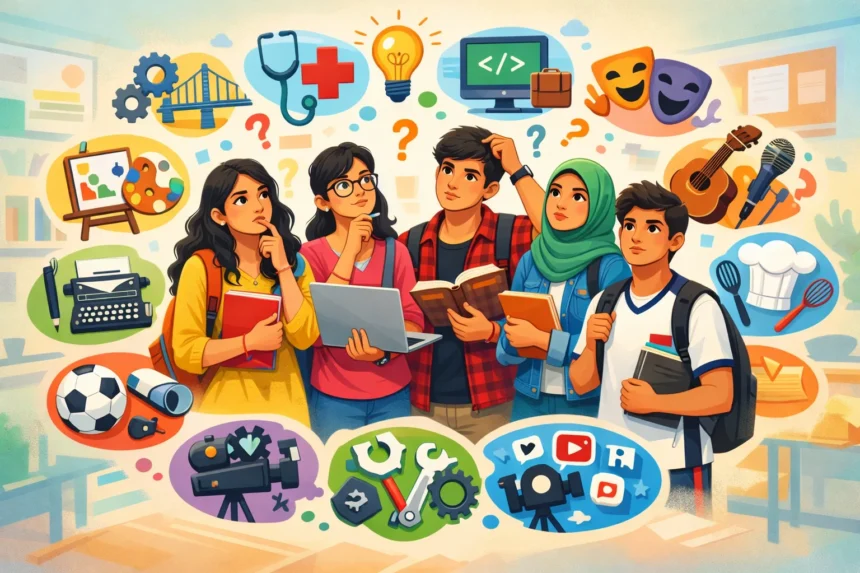
Experts note that there are numerous new-age subjects and courses now available: UX/UI design, app development, AI and machine learning, game design, ethical hacking, robotics, sports science, drone technology, sustainable architecture, e-sports, animation and VFX, blockchain, environmental management, bioinformatics, podcasting and content creation, social entrepreneurship, event management, adventure tourism, and metaverse and AR/VR development. Many of these fields are in high demand and offer promising career prospects.
Colleges across India now offer such programmes, enabling students and parents to explore options and plan accordingly.
As all the experts emphasise, it is important to give students the freedom to explore and discover what they truly enjoy. While factors like finances and personal passion play a role, the key takeaway is clear: engineering and medicine are no longer the only paths to success. There are many ways to excel, and what truly matters is finding a career that aligns with a student’s strengths, interests, and the opportunities the world offers. Marks alone do not define the future—choices and dedication do.