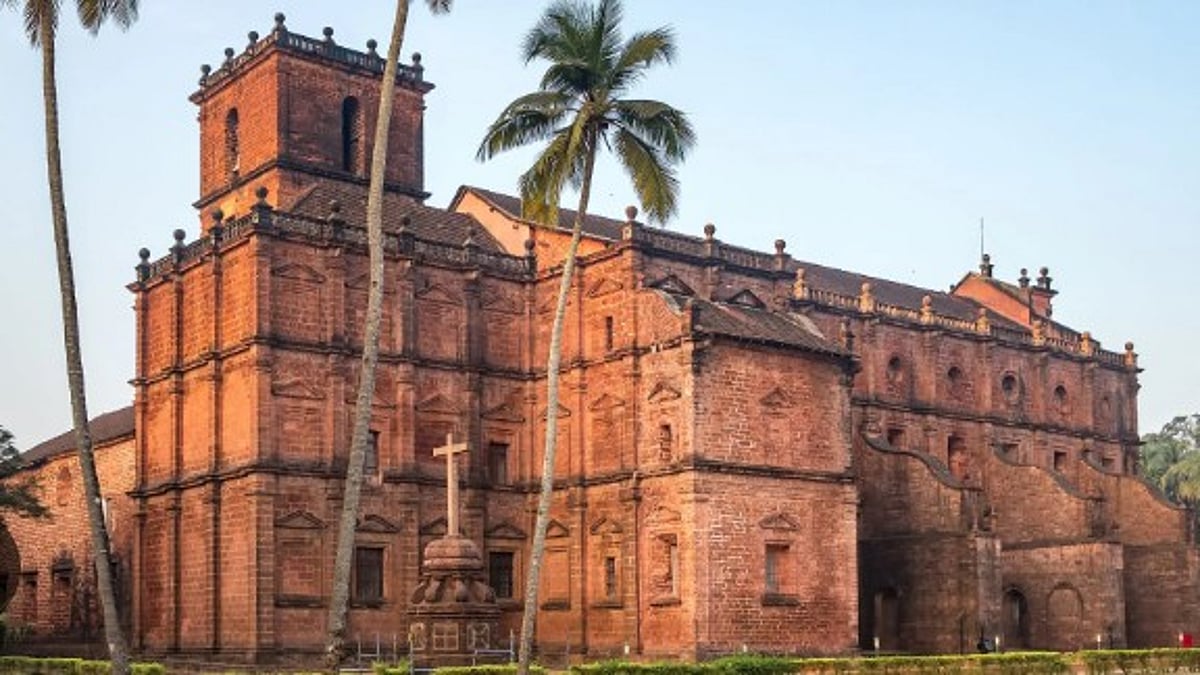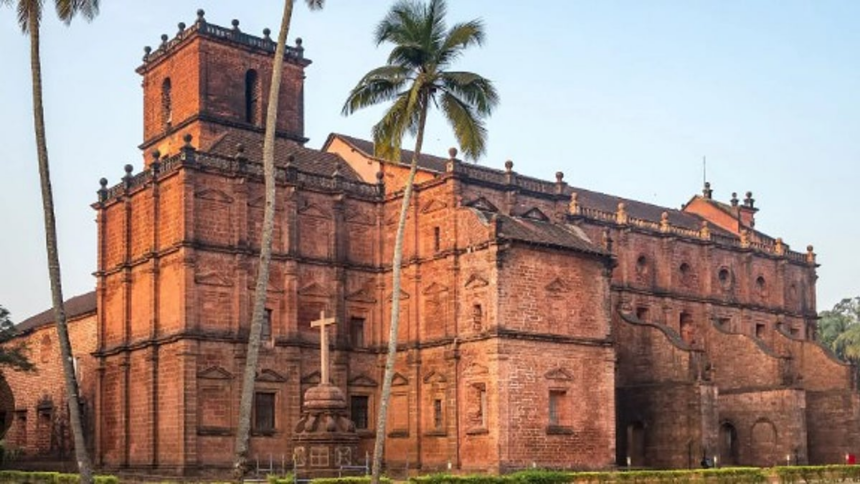
The State government may relocate or drop the beautification plans near Basilica of Bom Jesus at Old Goa following a report by the Archaeological Survey of India (ASI) hinting at discovery of more cultural vestiges if excavation continues.
In order to enhance visitor facilities at Old Goa, the State government had taken up the work of improving lighting for the monument, development of a parking area for 100 cars and 200 two-wheelers and an information centre under the Centrally-sponsored PRASAD (Pilgrimage Rejuvenation And Spiritual Augmentation Drive) Scheme. The work lighting had already been completed.

It is learnt that the State government has conveyed the developments at Old Goa to the Union Ministry of Tourism. The State government has two options either to identify alternate site near Old Goa or to drop the project, an official toldO Heraldo.
The residents of Old Goa had alleged that the mall is being constructed by the State government in spite of the fact that construction cannot be permitted within 100 metres of the historic church.
But on March 22 this year, the ongoing work was kept on hold following recovery of cannonballs at the site.
The ASI had instructed the Department of Tourism to stop the work to allow proper documentation through photography, drawings and reports.
The work was undertaken through the Goa Tourism Development Corporation (GTDC), who had also denied a mall project at the heritage site.
In the report submitted to the GTDC, the ASI has concluded that if any future work in the area is carried out then it may bring to light more cultural vestiges. In such a case, a fresh examination of the proximity of findings will be required, it stated.
The ASI report states that the arsenal area lies within the city walls of Old Goa, which was the first capital of Portuguese Estado da India.
It said that this area bears significant archaeological potential which was testified by the spade work carried out in the area from April 7 to May 14 by the ASI Goa Circle.
The archaeological profile of the area is marked by the presence of cannonballs of various sizes, weights and material in addition to its types, various kinds of pottery and porcelain sherds of distinct ceramic traditions.
The report further states that the arsenal in Goa consisted of a gun foundry, mint, naval dockyard, offices and an elephant stable. It served as a centre of minting coins, casting cannons and constructing warships (Pereira 2006). European weaponry and naval equipment were either stored or manufactured on site.
Afonso de Albuquerque initiated the complex’s development and its grandeur was documented by European travellers such as Ian Huyghen van Linschoten and Francois Purard (Boxer 1965; Pyrard 1887). Sources suggest that the Arsenal may have predated Portuguese conquest and existed during the Adil Shahi period, implying it was a prominent edifice even before Albuquerque’s arrival (Souza 1979).
When Albuquerque entered Goa, he found at the dock 40 large ships, 26 brigs, numerous fustas and other materials related to warfare (Danvers 1894). He appointed Francisco Corvinel, a Florentine, as superintendent and restructured the arsenal accordingly. By 1540, about 700 workers were employed and the arsenal reached its zenith by the late 16th century (Boxer 1965).
Pyrard during his 1608 visit, described it as well-fortified and equipped with stone-built rooms for artisans to reduce fire hazards. (Pyrard 1887). Despite precautions a major fire broke out on June 9, 1753, damaging part of the arsenal. It was renovated and expanded in 1773. However, with the decline of Portuguese influence, the arsenal lost its importance and was closed in 1856 (Souza 1979).
It said that this area bears significant archaeological potential which was testified by the spade work carried out in the area from April 7 to May 14 by the ASI Goa Circle.
The archaeological profile of the area is marked by the presence of cannonballs of various sizes, weights and material in addition to its types, various kinds of pottery and porcelain sherds of distinct ceramic traditions.
The report further states that the arsenal in Goa consisted of a gun foundry, mint, naval dockyard, offices and an elephant stable. It served as a centre of minting coins, casting cannons and constructing warships (Pereira 2006). European weaponry and naval equipment were either stored or manufactured on site.