MARGAO: The coconut journey in Goa is swinging from tender coconuts and nuts to productively experimenting with high yielding hybrid trees and improved quality nuts to ‘Value Added Products’ (VAP) like virgin coconut oil. Intercropping with coconut plantations in farms and back yards has also been taking coconut driven agriculture to a diverse higher levels,” said Chandrahas Dessai, programme coordinator (PC) and in-charge of the Krishi Vigyan Kendra (KVK), Margao.
Dessai has been working closely with paddy farmers, taking a keen interest to develop paddy cultivation, add value added services and empower farmers to enhance paddy cultivation through robust methods that KVK is initiating for farming through the recently commissioned South Goa unit at Margao; and has been interacting with enthusiastic Xaxti farmers and backyard home growers.

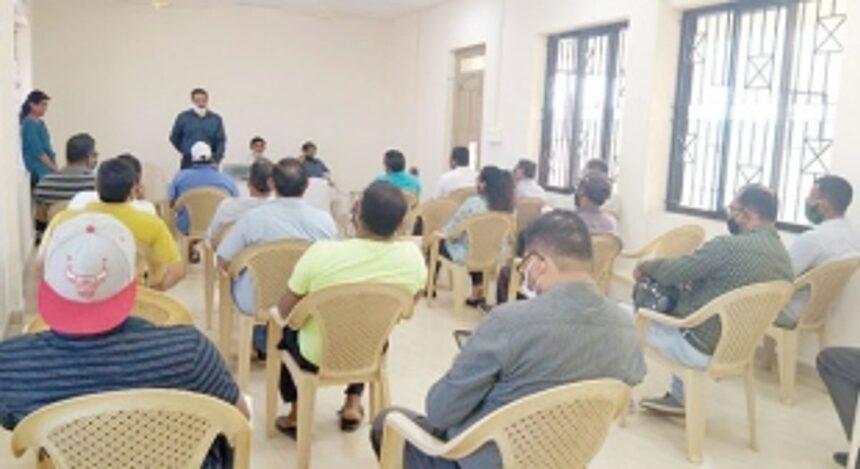
Around 25-odd coconut enthusiasts including a lone lady participant from Navelim-Salcete, who, after following strict social distancing norms and maintaining pandemic restrictions, attended the day-long ‘Farmers Training on Product Technology of Coconut’, organised by Agriculture Technology Management Agency (ATMA), South Goa and Zonal Agricultural Office (ZAO), Margao at the KVK farmers training complex, at Margao.
While speaking to them, Dessai mentioned that success stories are coming from Goan farmers who have been successfully growing and yielding Goan spices through inter-cropping long with coconuts.
“Pineapples, suran, ginger, nutmeg, turmeric and other traditional and seasonal fruits and vegetables are being successfully inter-cropped, specially using drip irrigation techniques and utilising the natural advantages of Goa’s climate, rainfall and soil,” he added.
He also informed the gathering that a healthy coconut yield can be achieved if the saplings are planted eight metres distance apart as the coconut tree needs lots of sunlight, water and air, and that the distance also helps in preventing rats from travelling from tree-to-tree and causing damage to the yielding nuts.
The KVK branch at Margao is also experimenting on drip irrigation systems for vegetables and non monsoon crops. Commissioned to reach out to more farmers and individual growers in South Goa, the KVK programme coordinator welcomed more interest from individual growers and farmers while informing that this KVK office is there to serve the people of South Goa towards their agricultural needs and have a lot of grower-related programmes in future.
He however rued the time lost this year due to the pandemic and situations beyond their control.
Individual growers and coconut farmers brought up the inconveniences faced from pests and other insect borne disease that have hit the local coconut production of late especially in south Goa and poses to be a bigger problem in future if left untackled.
They also requested the governmental agricultural agencies to initiate steps to control the pests, mites and insects that spread coconut diseases.
Girish Kenkre, Subject Matter Specialist (SMS), KVK, South Goa, discussed at length various methods to counter attack the advent of the Rhinoceros Beetles, Bud Rot, and the Red Palm Weevil, as the main invader of the coconut plant, mostly along the southern coastal belt.
“The coconut tree is called Kalpavrksha or ‘Tree of Heaven’ or ‘Laxmi Foll’ and its uses are ample and nothing goes waste. It is valuable and important and hence proper care has to be taken. The pests attacking the coconut can be controlled by placing proper traps and preventive measures taken in advance to thwart the pests and keeping the tree, specially the trunk and crown along with the root base clean. Coconut tree commands clean environments for it to grow, bloom and yield to its best,” said Kenkre.
“For good growth, early bearing and good yield, it is mandatory to give regular fertiliser right from the first year onwards, as a healthy plant repels diseases,” added Kenkre.
“Do not give fertiliser during heavy rains and hot weathers, distributing the doses in two splits,” he stated further.
According to the coconut farmers, In South Goa, coconuts like Benaulim, Dwarf, tall varieties, Sampurna — a cross of Benaulim variety is more in demand, while the Calangute variety is preferred in the north.
Sheriff Furtado, ZAO, Margao spoke about the government’s subsidy schemes for coconut farmers in South Goa. He informed that for the indigenous Benaulim and Calangute variety, Rs 50, 000 per hectare in two installments was allotted for minimum areas up to 1,000 sq mtr (16 saplings) and maximum area 20,000 sq mtr (320 saplings) could be provided.
“For Hybrid and Benaulim Hybrid, the minimum area of 500 sq mts (eight saplings) the subsidy is Rs 150 per plant,” he added.
Richa Dessai, Block Technology Manager, (BTM), ATMA, Margao, in her introductory and welcome speech set the tone for the training programme.
She expressed her satisfaction that more coconut enthusiasts, growers and farmers are taking a keen interest in coconut growing technologies as noticed by the amount of queries and expression of interest in coconut growing.
Richa highlighted the need to enhance coconut production and yield in Goa, irrigation of crops through various available irrigation methods and also the need to enhance the production of other associate by-products of coconut crop in Goa through successful technologies available to coconut growers in Goa.
Later, while explaining his journey from a backyard coconut grower to taking post production of coconut to another level through the extraction of virgin coconut oils, Joseph Vaz, of Coco Goa, producers of organic pure coconut oil, highlighted the value added products detailing that smaller countries compared to India like neighbouring Sri Lanka and Combodia are surging ahead in coconut production and by-products exports.
He added that although India produces a lot of coconut, the post production of coconut products has somehow lagged behind and can be improved to meet international demands.
He recalled how due to certain factors Goan coconut oil has had a lot of negative or adverse publicity but slowly like the Western countries, coconut oil is retaining its lost ground and the newer generation is adopting a lot of use of coconut oils even for moisturising and hair nourishment.
A value addition to the training programme was the knowledge imparted of hybrid dwarf coconut trees which is of late picking up in Goa.
As a further insight for the farmers in this section, Prashant Naik of Deejay Farms, Quepem, presented a short introduction to dwarf variety pioneered by the private farm and its value towards improved yielding coconuts in future in Goa.
As Goa has different type of soil from rocky, clay based and sandy, watering of coconut trees takes various dimensions, irrigating areas where coconuts are grown is very essential; Vishwajeet Nikam of Jain Irrigation Systems, discussed various aspects of micro-irrigation like sprinkler, drip irrigation and solar powered pumps undertaken by the firm to coconut farmers in Goa.
The south Goa governmental agricultural agencies like ATMA, KVK and ZAO will conduct such special training programmes in future on various topics and crops related to farming in Goa while those interested can contact the local office on phone to register for such programmes.
Ajay Gaonkar, the Assistant Technology Manager at ATMA, Margao coordinated the training programme.