TEAM HERALD
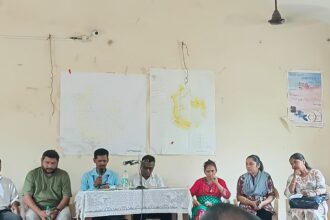
MARGAO: After a marathon three-hour meeting at the Margao police headquarters, the fishing communities from Maharashtra and Goa agreed to set aside their differences and established rules to ensure peace between their groups.
The main agreements were that no member of the fishing community on either side would take the law into their own hands, disputes in the deep sea would be solved amicably, and that the fisheries and police departments of both governments would intervene in such cases.
It was agreed that Goan trawlers would not be allowed beyond 12 nautical miles from the border, and in case boats did stray far, no violent action would be taken. Instead, the boats would be handed over to the Fisheries Department and the Goan trawler owners would be contacted. It was pointed out that such incidents happen due to the conditions of the water.
South Goa Superintendent of Police Shekhar Prabhudesai moderated the meeting while the deputy superintendents of police from Margao and Malvan kept the minutes. Fisheries Minister Avertano Furtado – the meeting’s convener – and Velim MLA Benjamin Silva, who is closely associated with the trawler community, were also present, as were officials from the Maharashtra Fisheries Department and National Fishworkers Forum.
The delegations of both sides comprised trawler owners and Ramponkar associations. The conference hall in which the meeting took place was packed; some trawler owners had to watch the proceedings from outside.
Avertano, after summing up the incident, hoped that better sense would prevail in the future and that the two groups would come to a solution.
Coming to an agreement was not easy as both groups were bitter over the recent events that saw Goan trawlers getting damaged and personnel beaten up in Malvan, followed by the ban on fish coming from Malvan to Goa.
Both groups took two hours to express their opinions. They each defended their actions and informed how their livelihoods were at stake; that they had been in the fishing business for generations, be it traditional ramponkars or mechanised trawlers owners.
“There has never been trouble from us Goans. There are many things that trouble us, but you never see us taking action like what happened to our boats and people in Malvan,” said Elvis Gomes on behalf of the Goan community.
However, Dilip Ghare from the Sindhudurg Ramponkar Association insisted that Maharashtra had clearly laid down rules as per the law. He disagreed that the Goan trawlers had just ventured near the border and insisted they were deep into their territory.
Minguel Rodrigues, who was part of the team that travelled to Malvan recently to retrieve the Goan trawlers, appealed to the Sindhurdurg delegation to not get fixated on the rules and regulations as it was common for boats to venture into other state’s waters. He also reiterated they were there to find a solution and not fight.
Ravi Torascar of the National Fishworkers Forum stated that the Sindudurg’s waters were important as 21,000 families depended on it. A large number of boats in their territory was a big cause of concern.
Rodrigues countered that their boats did not venture into their waters everyday. He also raised the issue of anti-social elements who stole or pirated from Goan trawlers. He added that on Thursday morning a fishing vessel called Vailankanni had received such a threat.
As it turned out, the fishing community from Malvan too was facing the same problem, and it even had boats robbed by those same people.
The common demand for apprehending the pirates was the first breakthrough in the discussions. The Malvan Dy SP urged the Goan trawler owners to contact them and the coastal police, and that they would book cases accordingly. The South Goa SP advised Goan fishermen to carry cameras to record such incidents.
To the Malvan delegation’s shock, it was revealed that Goan fishermen get phones calls from Malvan informing them of a good catch in area. After the fishermen travel and fish there, an unknown group of pirates steal their catch. Such kind of cases, they stated, could be aimed at disrupting the peace between the two communities.
This was significant given that the team of Goan trawler owners who had travelled to Malvan earlier this month were assured that Goan trawlers would not be accosted. Thus, it was important that the authorities look into the matter.
Furthermore, the Goan delegation impressed on their counterparts the need to remove middlemen and agents who control the rates of the Margao fish market. It also offered support to the Sindhudurg fishing community if it were to start selling their fish directly at the Margao market.
Gomes explained that the trawler owner’s act of blocking fish transport vehicles from Malvan was a sore issue, but they had asked the transporters politely to not sell fish until the matter was resolved. The agents were also informed in advance.
While the Maharashtra delegation was advised to think about this proposal of selling fish directly at the Margao market, Toraskar said that these were two separate issues and their main agenda was to stop the issues at the border.
Gomes pointed out that they had reacted only after the incident at the border and that they hadn’t claimed Malvan fish will not be allowed to enter the Margao fish market. He stated the Goan market was originally created to sell the fish caught by Goan trawler owners only.
At the end, both groups agreed to stick to what had been discussed regarding the border dispute. The Goan delegation requested its Maharashtra counterpart to keep their common interests in mind and look at the meeting as an informal agreement, rather than stick to the law. The Maharashtra delegation also asked the Goan delegation to hold a meeting with the Goan fishing community and ensure that the rules were followed.