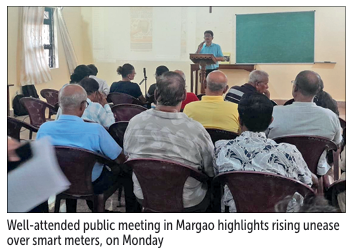
The State gov ernment’s aggressive roll out of smart electricity meters is facing mount ing resistance, with civil society groups warning that the programme risks eroding public trust. At a public meeting held on Monday at the Clergy Home in Margao, speakers and citizens questioned the ‘forced implementation’ of smart meters without adequate consultation, transparen cy or safeguards. The gathering, or ganised by the Social Collective – Citizens for Democracy Goa in asso ciation with the Awaken India Movement, under scored a growing demand for checks and balances before any large-scale transition is imposed on consumers.
Far from outright rejecting the technology, participants repeatedly stressed that their opposition stems from the government’s approach rather than the concept itself. The central demand – prove that smart meters are safe, secure and beneficial — and do so through an open, consultative process. Addressing the gathering, Dr Darell D’Souza raised se rious health concerns, claiming that research dating back to 2011 suggests radiation exposure can adversely affect human health. “Radiation from smart meters is believed to be higher than that of smartphones. People need clarity on the health risks before such devices are installed,” he said. He further alleged that the technology could displace workers. “Once installed, there will be no requirement for manual readings. This will directly impact employment,” he said, flagging the absence of any discussion on mitigat ing job losses. More fundamentally, Dr D’Souza questioned the legal and procedural basis of the rollout. “Public consultation is a must before installation. Which law has changed to make smart meters mandatory?” he asked, highlighting what many at the meeting described as a democratic deficit in decision-making.

Privacy and surveillance concerns also featured prom inently. Warning of potential misuse of personal data, he said, “There are provisions in the Constitution safeguard ing the right to privacy and health. These could be violated. The system can also be hacked, allowing tracking and mon itoring of individuals.” He cautioned that the technology could become punitive in nature. “If this is meant to penalise people, how can it be beneficial? It will be like penalising people for simply living in their homes,” he added. Echoing these concerns, Elvis Gomes alleged that the rollout is being pushed without informed public consent. “We are not against smart meters, but their installation should not be forced. The key issue is the lack of public con sultation,” he said, reinforcing the broader sentiment that the government has failed to carry people along.
Gomes pointed to the scale and cost of the project as a possible driver behind the urgency. “Around 7.5 lakh smart meters have already been procured under a contract worth approximately Rs 899 crore, creating pressure on the gov ernment to proceed with installations,” he said, question ing the rationale for replacing existing meters. “There have been no major complaints about existing meters. So why the urgency to replace them?” Concerns over privatisation and cost escalation were also raised. “Personal data is being collected during instal lation, and there is no clarity on how it will be used or safe guarded,” Gomes said, adding, “When the contract is being handed over to a private player, there is no stopping them from increasing the cost per unit as they please.” He further noted that activists have yet to receive clear answers from authorities.
Referring to a meeting with of ficials on February 25, Gomes said, “We have not received a clear answer yet” on whether installation is legally man datory. Speakers warned that bypassing consent and due pro cess could invite legal challenges, with several asserting that any attempt to compel installation without addressing safety, privacy and cost concerns would be contested. The meeting concluded with a unified call for transpar ency and accountability – halt the rollout, place all safety and test data in the public domain, clearly define data pro tection mechanisms, and initiate genuine public consultation.