Nestled in Goa, India’s smallest state, a profound Latin heritage endures from over four centuries of Portuguese rule beginning in 1510. During Lent, vibrant traditions once immersed the faithful in spiritual depth, transforming enchanting church spaces into sacred havens. Among these, one ritual has vanished: Tenebrae, the “liturgy of darkness” (from Latin for ‘darkness’ or ‘shadows’), a morning prayer service held on Holy Thursday, Good Friday, and Holy Saturday. In Konkani, it was tenderly called Treve or Tireo. This haunting ceremony symbolically extinguished candles one by one, mirroring Christ’s Passion and abandonment.
As late Rev. Fr. Conçeicão D’Silva explained, Tenebrae fused Matins and Lauds during the Sacred Triduum, the three holiest days before Easter, following ancient rubrics. Historically, it unfolded not in the morning but in the evening beforehand, in anticipation of the coming day. Old guidelines simply specified “after the hour of Vespers,” with the service traditionally sung to conclude near midnight in total darkness. This created an immersive descent into shadow, evoking the solitude of the cross.

However, Pope Pius XII’s 1955 reform of Holy Week ceremonies reshaped this. Previously, the Triduum’s major liturgies occurred in the morning. Post-reform, Maundy Thursday shifted to evening (around 6 p.m.), Good Friday’s to the hour of Christ’s death (3 p.m.), and the Easter Vigil from Holy Saturday morning to nighttime before midnight Mass. As late Rev. Fr. Carmo Martins noted, this timing change relegated Tenebrae to early morning or erased it altogether, thus completely sealing its fate in Goa.
The Ritual’s Poignant Structure
Tenebrae’s format remained consistent across the three days. The first part, Matins, featured three nocturnes, each comprising three Psalms, a versicle and response, the Pater Noster, and readings. Lauds followed with five Psalms, another versicle and response, and the Benedictus Canticle , Zachary’s song of thanksgiving at his son John the Baptist’s circumcision. A final Pater Noster and the poignant reflection Respice quaesumus on Our Lord’s death closed the prayer.
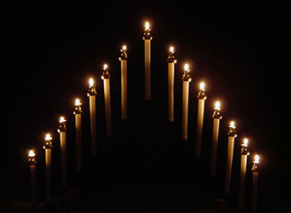
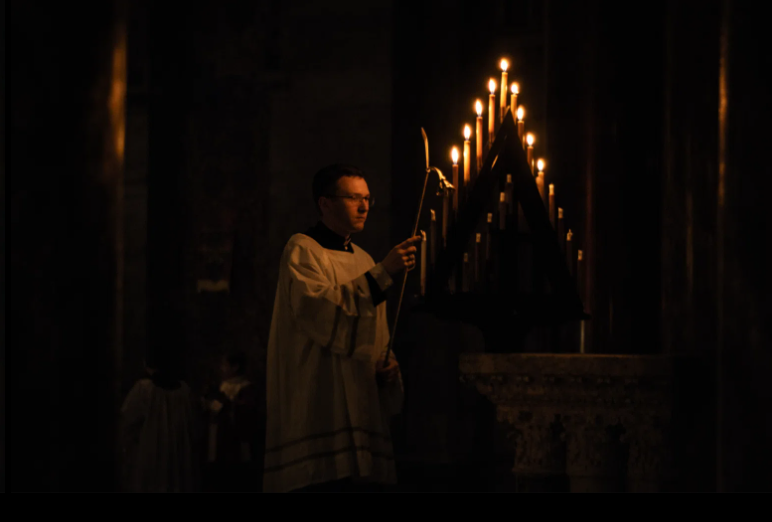
The rubrics were mesmerizing, especially in churches starting near-dark around 9 p.m. Sole illumination came from the Tenebrae hearse, a towering triangular cande stand holding fifteen candles one for each of Matins’ nine Psalms and Lauds’ five. In some traditions, beige candles flanked a central top one which symbolized Christ. After every Psalm, a server extinguished the bottom-most candle, alternating sides. This gradual dimming mirrored Christ’s isolation in a sin-darkened world, building to utter gloom at His death’s commemoration.
The Dramatic Climax and Silence
At the final lesson’s end, the last candle, Christ’s, was removed by a server or cleric and veiled behind a curtain or altar, evoking His burial in the tomb. A sudden noise erupted: an earthquake’s rumble, evoked by the celebrant slamming his book shut or clergy and faithful knocking on pews. The candle was then extinguished and returned to the hearse. Without blessing or hymn, the Office ended abruptly. Clergy and congregation departed in profound silence, hearts heavy with sorrow.
A Stark Contrast in Catholic Worship
As Mr. Ashburn Lyndon Pereira, late sacristan of Goa’s Basilica de Bom Jesus in Old Goa, reflected, Tenebrae stands apart in the Church’s repertoire of joyous rites. Holy Thursday offers consolation at the decorated altar of repose, where the faithful keep vigil. Good Friday unveils crucifixes for veneration and Holy Communion. But Tenebrae is unyieldingly mournful darkness, quake, and Christ’s symbolic seclusion evoking raw abandonment. In Goa’s sun-kissed churches, this extinct rite once pierced the soul, a poignant reminder of sacrifice amid the state’s enduring Indo-Portuguese tapestry.