VITHALDAS HEGDE
At a time when courts across the country continue to struggle un-der the crushing burden of mounting pendency, the Goa Bench of the High Court of Bombay is preparing a major technology-driven overhaul aimed at making justice delivery faster, more accessible and less depend-ent on paperwork and phys-ical movement.

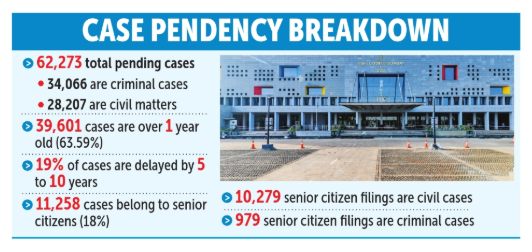
With more than 62,273 cases currently pending before the Goa Bench in cluding nearly 40,000 mat-ters pending for over a year -the judiciary is now look ing at Artificial Intelligence and integrated digital sys tems as a possible turning point in tackling delays that have plagued the justice sys tem for decades.
According to official sources, an Artificial Intel ligence (Al) system has al ready been developed and is awaiting the required server infrastructure before roll out. Once introduced, the technology is expected toassist judges and court staff in legal research, document management, translation services and case schedul ing, helping reduce proce-dural delays and improve efficiency in courts.
The move comes amid growing concern over pro longed litigation, especially with nearly 19 per cent of pending cases in Goa being between five and 10 years old. More significantly, over 11,000 pending matters in volve senior citizens, many of whom spend years wait ing for resolution of dis putes.
Against this backdrop,
judicial authorities believe technology can ease pres sure on courts while making the process smoother for lit-igants and lawyers alike.
Since January 2023, e-fil-ing has been made manda tory in the High Court as part of efforts to modern-ise judicial administration and reduce dependency on physical documentation The process has now also begun in district and trial courts.
Although e-filing was in-itially introduced without a payment gateway integra-tion, officials said the fea ture is expected to go liveshortly, further streamlining the filing process.
The High Court has simul-tanecusly expanded hybrid video conferencing facilities, enabling advocates to appear remotely while also allowing physical hearings to contin ue. Live streaming of pro-ceedings has also been in troduced in a push towards greater transparency.
Officials said several cat-egories of matters in cluding criminal appeals, criminal writ petitions, arbi-tration petitions, contempt petitions and miscellane ous applications are now compulsorily filed online,
along with replies, rejoin-ders and supporting docu ments.
Digitisation of pending case records in the High Court has already been completed, allowing judges to access files electronical-ly from anywhere. Work is now underway to digitise disposed records, while district courts are expected to begin a similar exercise shortly.
The reforms extend be-yond courtroom adminis-tration and into the criminal justice system itself.
Under the Inter-Opera-ble Criminal Justice System (ICIS), courts, police sta tions, prisons, forensic lab-oratories and prosecution departments are being dig itally connected to enable seamless exchange of infor mation and faster coordina-tion between agencies.
As part of this integra-tion, Goa has implemented systems such as eSummons, eSakhya and Nyay Shruti under the new criminal laws framework.
Through eSummons, notices and summons are served digitally, reducing paperwork and improving coordination between courts and police authorities.
The eSakhya platform allows investigating agencies to upload video-recorded evidence directly onto the portal, making it instantly accessible within the digital charge-sheet system.
Meanwhile, the Nyay Shruti initiative is expected to sig-nificantly reduce delays caused by repeated physical pro-duction of accused persons before courts.
“The prisoner need not be produced a second time be-fore the courts, as the prosecution and defence lawyers can join the proceedings online through video conferenc-ing facilities provided at the offices of the district collector-ate, trial courts, jails, police stations, the RTO and the Goa Medical College,” an official said, adding that the Forensic Science Laboratory at Verna has also been integrated into the system.
Authorities said witnesses can also depose virtually, helping avoid adjournments caused by logistical difficul-ties and transportation delays.
In another significant reform, doctors can now upload medico-legal and post-mortem reports digitally through the MedleaPR app, eliminating the earlier practice of phys-ically submitting documents to police stations.
Since courts are integrated into the digital network, FIRS and chargesheets can now move electronically through the system, reducing administrative lag in criminal proceed-ings.
Officials maintain that Goa is currently among the lead-ing states in implementing the new criminal laws and inte-grated digital judicial infrastructure.
In a symbolic move aimed at improving accessibility, the High Court has also begun translating landmark judg-ments into Konkani, bringing legal discourse closer to or-dinary citizens.