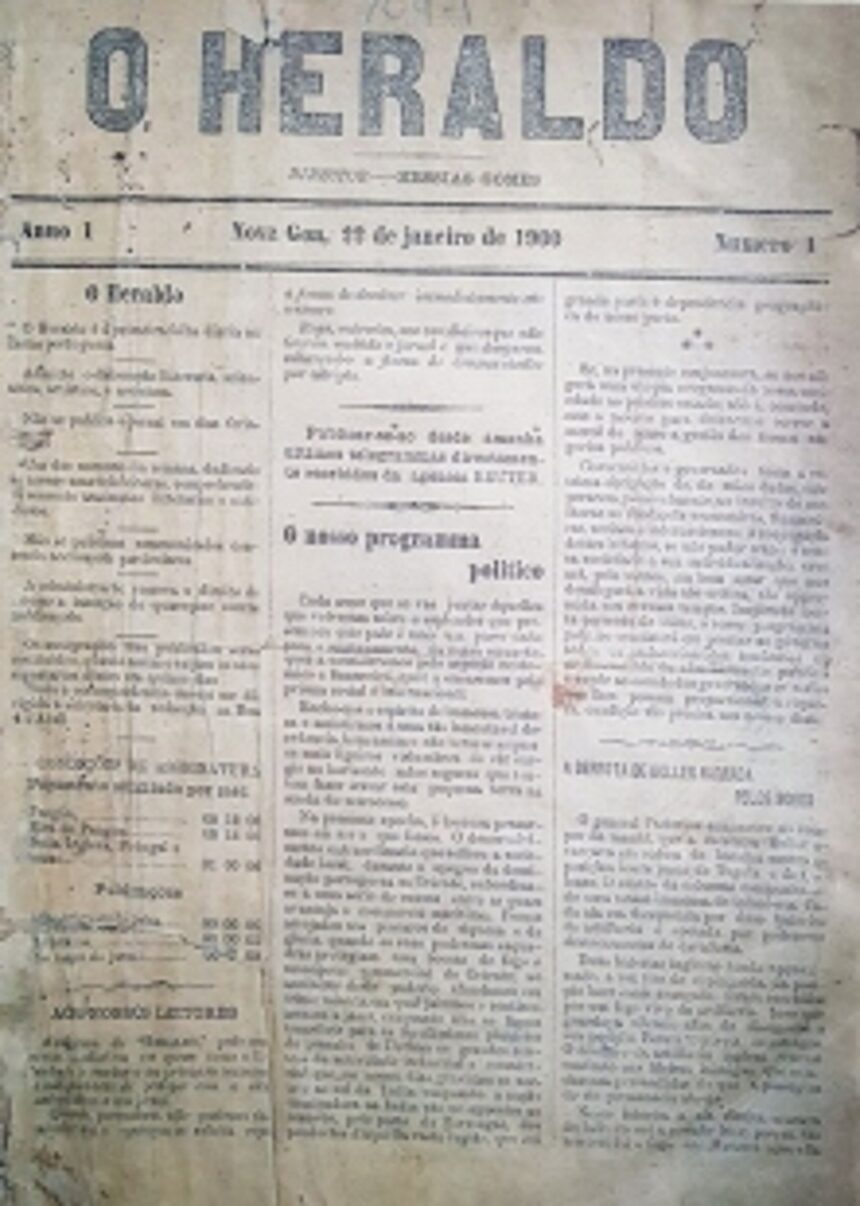
It was on the night shift on February 4, 1986, after being brought on the Herald Desk from Margao where I worked as a Correspondent for almost two years.
We had learnt during the day that a decision had been taken by the Goa Legislative Assembly, which had enacted the Official Language Act, making Konkani in Devanagri script the official language of Goa, with a rider that Marathi may also be used for official purposes.
Having started my journalism as a mofussil correspondent with another paper, I always had a wish to join Goa’s oldest daily. I got the chance and jumped for it. I was appointed Herald correspondent of Margao, to cover all aspects, including sports.
Hoping to break this good news to our readers early the next day, our Editor Rajan Narayan had asked us to finish the edition early. Ask any Sub Editor on the desk what it means to finish before the deadline. The Chief Sub Editor had left the office, so also the compositors. The plates were being given final touches on the third floor of our Old office at Sao Tome Street. As a precaution, we used to keep our shutter half closed after the edition was put to bed. Since I would go home next morning, I was looking at the news ticker for any earth-shaking news.
All of a sudden, the half-shutter was lifted and walked in the Robin Hood of the South, Churchill Alemao. When he saw me, he asked me in a loud voice, “Willy I want to know tomorrow’s headline”. I kept my calm and asked him, “Churchill after fighting gallantly for Konkani and having seen so many lives laid down for our Mother Tongue, do you think we will give a wrong heading?”
I told him that it was already sent for printing and that everyone had left. He insisted on knowing the heading but after I convinced him he would read it in another few hours, he and his supporters were pacified. He left quietly, not the way they had walked in vociferously. He was one of the stalwarts in the South who had fought for our Mother Tongue; so had many others; some even laying down their lives for Konkani.
We cannot forget Floriano Vaz, then only 22 years old, who was shot dead point blank on December 20, 1985 and was a martyr for Konkani. So were others in Mandur. The agitation for Konkani language was not very evident in the North, but the South was paralysed. Konkani lovers had dug trenches on the roads, erected stones barricades, blocked village roads by felling trees and placing them across the roads. Herald, however, gained importance in the South and held sort of a hold, which is evident till today.
I could not go home to Sirlim after my desk duty and was forced to stay at Rajan’s place when the agitation was at its prime in December 1985. We used to sleep at his house at Dona Paula and return for work in the evening. But after a few days I mentioned it to the Editor that I wanted to somehow make it home for Christmas.
I will come back to that epic journey home later. But first a little incident we experienced during the agitation. Herald had a brilliant photographer then in Lui Godinho, who had a knack, if I can call it ESP, for photographs. Famous for flying on the Queen’s helicopter during the CHOGM and get photographs of the heads of state, he even managed to get a picture of the golden canon inside the MPT premises. Once during the agitation, our Editor asked both of us to go down South and get some photographs and dig up the mood of the people in the South. Knowing very well that journalists were targeted, we were given ‘PRESS’ bands to be used on our arms. We hesitatingly put them on by covering them with our sleeves.
Knowing very well that the main road from Cortalim to Margao was blocked and no vehicle (not even a scooter) would be allowed to pass, we decided to take the Cansaulim-Utorda-Betalbatim road. We were blocked in many places but Lui had a very nice way of saying, “Arre ami Herald mure, ami tumkam sohokar ditai” (We are from the Herald and we are helping you)…when they heard the name of Herald they would let us go. We were even helped to lift our bike and put in on the other side of the road.
But we came across the biggest hurdle when we reached Majorda. There were no men guarding the blockade. Only ladies and mind you they all had the toddy tappers ‘katti’ (sickle) with them. I had butterflies in my stomach because as a youngster I had checked the sharpness on the ‘katti’ when I followed a toddy taper for ‘sur’ (toddy) which my mom wanted me to fetch for making ‘san’nam’ (you rarely get to taste those nowadays).
As usual Lui tried his polite conversation. But the ladies would not budge an inch. I was slowly trying to lower my sleeve trying to show my “PRESS” band, which caught a lady’s attention. “Press tumi….khuichem press?” she asked with a stern voice. When we said HERALD, their voices melted down and said, “HERALD! Baba, tumi amghe mure, cholai, cholai.” (HERALD sons, you are for us, proceed). We reached Margao somehow, often wading through water-logged fields, and lifting our bikes to cross over the electricity poles and trees. We returned to the Panjim office after dusk but had enough material and photos for HERALD edition the following day.
Going back to the Christmas Eve, Rajan told me that I could start early because the only way to reach Margao was to proceed via Ponda and catch a mini bus, which would take you to Borim and hire another motorcycle ride from Borim to Margao. I had started at 10.30 am from Panjim and reached Margao at around 8 pm. I went to my brother-in-law house at Fatorda and borrowed his cycle to go home. He was kind enough to lend me a torch because it was pitch-dark everywhere. All the streetlights were missing because the poles were brought down to block the streets. Although I had to manage my way home in darkness, my brothers and sisters along with my parents were ready to go for the midnight Mass as I knocked on the door. They were delighted to see me since we as a family had a habit of celebrating the Mass at night, I knelt down and thanked God for bringing me home safely.
We, in the media, suffered mental torture and agony those days, because we had to be alert round-the-clock and we were so conscious of missing any small news.
Returning to Herald after a long stint with a UAE English daily, I was readily employed on January 1, 2015. The camaraderie, connection with our colleagues on the desk and lot more things which I could reminisce in a book, is what I enjoy till date. The St Inez Creek may have lost its purity, but the family attitude in the office always reminds us why Herald was then called the “Mother of All Journalists”.