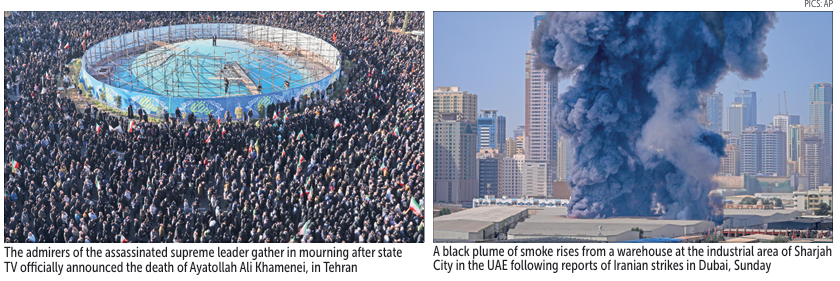
TEHRAN/TEL AVIV/WASH INGTON: Hours after news broke early Sunday that Su preme Leader Ali Khame nei had been killed in a joint US-Israeli bombardment, Iran moved swiftly to activate its constitutional succession mechanism, even as missile exchanges signalled a widen ing regional war. Under Article 111 of the Iranian Constitution, a three-member transitional council assumes the supreme leader’s duties until a perma nent successor is chosen by the 88-member Assembly of Experts. By Sunday after noon, Tehran announced that cleric Alireza Arafi, President Masoud Pezeshkian and Chief Justice Gholam-Hossein Mohseni-Ejei would serve on the interim body. Arafi, 67, is a member of the powerful Guardian Coun cil and was confirmed to the temporary leadership coun cil by the Expediency Council. The arrangement is designed to function only until the As sembly of Experts appoints a new supreme leader. The constitution states the body “must, as soon as possible,” select Khamenei’s successor, ending nearly 37 years of his rule. Though the interim council formally governs, the balance of power re mains uncertain. The Is lamic Revolutionary Guard Corps (IRGC) — long a central pillar of the Islamic Republic — is expected to wield decisive influence. Its commander-in-chief was also killed in Saturday’s strikes, the second such assassination in less than a year. IRGC-linked channels have cited deputy chief Ah mad Vahidi, appointed two months ago by Khamenei, as a possible successor. Senior security offi cial Ali Larijani accused Washington and Tel Aviv of seeking to fracture Iran and warned internal “se cessionist groups” against exploiting the moment. “The brave soldiers and the great nation of Iran will teach an unforgettable lesson to the international oppressors,” he said. As Tehran consolidated authority at home, retalia tion followed abroad. Iran fired missiles at an expanding list of targets in Israel and Gulf Arab states hosting US forces. In Israel, explosions were heard over Tel Aviv, while a strike on a synagogue in Beit Shemesh killed eight people and wounded 28, raising the country’s toll to 10. Israel’s Defence Minister Israel Katz said there would be “a non-stop air train” of strikes against Iranian military and leadership targets. Iran’s parliamentary speaker Mohammad Bagher Qalibaf struck a defiant tone in a televised address. “You have crossed our red line and must pay the price,” he said. “We will deliver such devastating blows that you yourselves will be driven to beg.” US President Donald Trump warned against escalation. “THEY BETTER NOT DO THAT,” Trump fired back in a so cial media post. “IF THEY DO, WE WILL HIT THEM WITH A FORCE THAT HAS NEVER BEEN SEEN BEFORE!” The US military confirmed three American service mem bers were killed and five seriously wounded — the first known US casualties since operations began. Inside Iran, blasts shook parts of Tehran near govern ment buildings as smoke rose over the capital. Authorities said more than 200 people had been killed since the US-Is raeli assault that eliminated Khamenei and other senior leaders. In southern Iran, at least 115 people were report ed killed when a girls’ school was struck, according to lo cal officials. Israeli and US military spokespeople said they were looking into the reports. The fallout quickly spread across the region. Shrapnel from Iranian projectiles killed two people in Abu Dhabi and damaged port facilities and the facade of the Burj Al Arab in Dubai. Saudi Arabia, Jordan, Kuwait, Bahrain and Qatar said they intercepted drones and missiles. In Karachi, clashes erupted after protesters stormed the US Consulate, leaving at least nine dead. Despite Trump’s call for Iranians to “take over” their government, there were no immediate signs of organised unrest. State media showed mourners raising a black flag over the Imam Reza shrine in Mashhad as authorities de clared 40 days of public mourning and a seven-day nation wide holiday. Eyewitnesses, however, said some residents in Tehran cheered from rooftops as reports of Khamenei’s death spread. The killing of Khamenei — Iran’s ultimate decision-mak er since 1989 — removes the central figure balancing the clerical establishment and the Revolutionary Guard. While the transitional council has assumed formal control, the decisive test now lies with the Assembly of Experts and whether it can project stability quickly enough to prevent deeper internal fractures — even as the external war in tensifies.
IRAN ACTIVATES SUCCESSION PLAN AFTER KHAMENEI KILLING