LUIS DIAS
From the first time I heard and sang the beautiful tradition al Christian hymn ‘Shall We Gather at the River?’ to the present day, my mind’s eye pictures the “beautiful shining river” with its “silver spray” that is our Mandovi. Even now, when waiting at various ferry points and crossing the river, the hymn plays in my head. The Mandovi reminds me of the hymn, and vice versa. But the past tense is more accurate. I remem ber the Mandovi, its riv erbanks and indeed our beloved city Panjim as it was, as it used to be, not the ugly garish travesty it has become over the past few decades. Before you accuse me or wearing rose-tinted glasses when remembering the past, let me state that Panjim had its imperfections even then. But they were small compared to now; there still was beauty, charm, innocence, and compared to the ‘Satyaa naash’ of today, Panjim back then was indeed paradisical.

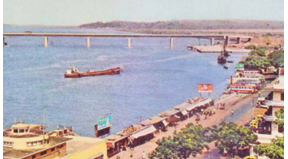
What we have today is the an tithesis of progress. It is erasure, regression, a shrinkage of public ac cess or involvement, and pollution, visual, audi tory, olfactory, aesthetic and moral. Pictured is the Mand ovi of my childhood that I knew and loved, and its Panjim Riviera or ‘Ribei ra’, presumably taken from the vantage point of the then ‘Tourist Hos tel’, one of Panjim’s early multi-storeyed buildings. Take a look at the ad jacent ‘Jardim da Sereia’ (Mermaid Garden); sad ly, the beautiful Mermaid herself is not in the frame. But notice the absence of concrete or cement paving, the greenery, ornamental and flower hedges, the user-friend ly park-benches, the in viting ambience overall minus any fences and forbidding gates. It was our playground, a safe haven for children and elderly, a public space for all ages to take a ‘passoi’ and unwind, the ‘heart of the city’ in the heart of the city. I’ve written before of the criminal neglect and abuse of the poor Mer maid, groped and mo lested by leery inebriated ‘packs’ of male tourists.
A line from Hans Christian Andersen’s famous fairy tale ‘The Little Mermaid’ comes to mind: “But a mermaid has no tears, and therefore she suf fers so much more.” The ‘bruises’ on her bosom are forensic evidence of the multiple assaults with impunity on her that she bears silently, sorrowfully, no-one to defend her honour. This indescribably beautiful sculptural jew el ought to have been our city’s pride, but her neglect is emblematic of the cavalier treatment and even erasure by our city fathers and ‘plan ners’ of all that is price less, uniquely charming and the soul of Panjim, all that defines our pock et-sized capital city. The hymn lyrics (something I learned it adulthood) are a refer ence to a quotation from the Book of Revelation 22:1-2, “a river of the water of life, as clear as crystal” flowing from a lofty source, down the middle of a great city. Our earthly Mandovi, known as the Mhadei earlier in its course, also arises from the giddying heights of the Western Ghats, and ends its jour ney 81 kilometres later, pouring into the Arabian Sea in our once-great city Panjim. It is Goa’s lifeline, our “river of life.” Yet we learned earlier this month, the alarm ing figures from the Goa State Pollution Control Board (GSPCB) that the water samples around the casinos in the Mando vi were over 200% high er than the permissible levels. 100 or less MPN /100 ml (most probable number per 100 ml) is the permissible limit for faecal coliforms.
Read ings at various points near the river-anchored casinos were as high as 350 to 540! One doesn’t even need laboratory results; the evidence is there to be seen and smelled, the sight and stench of hu man excrement. The river is sacred to my Hindu brethren too. Many have expressed their outrage that in the sightline of Lord Par shuram’s statue on Yog Sethu are the casinos, the embodiment of all that is sinful, polluting and soul-destroying. The avenue along the Panjim riverbank used to be called ‘Rua da Boa Vis ta’ (Street with a Beauti ful view). A walk along the promenade afforded an uninterrupted pan orama of the river and the opposite bank, with verdant hills in the back ground. The cursed advent of the casinos some dec ades ago has ruined all that. One sees instead ugly giant hoardings, humungous floating ‘dens of sin’ casino ves sels, all lit up after dusk in psychedelic colours like phantasmagorical ‘ladies of the night’, a Kaf kaesque nightmare. I was disappointed by both contesting panels in the recent CCP (Cor poration of the City of Panjim) elections; both pussy-footed around the issue of casinos, in effect expressing personal dis approval of casinos and gambling but not stating explicitly that Goa should be rid of them.
All across the city, road ‘barricades’ advertise this or that casino with impunity. Each civic au thority, like Pontius Pi late, has washed their hands off responsibility for them, yet they lie in plain sight ubiquitously, even near schools, nurs eries, colleges, places of worship, taunting those same authorities who don’t confiscate them. Could an ordinary citizen advertise publicly with out permission or fee? What values are we in culcating in our youth if we erase a public astro nomical observatory at Junta House and replace it with casinos? Raising gamblers instead of sci entists and thinkers? (Dr. Luis Dias is a physician, musician, writer and founder of Child’s Play India Foundation. He blogs at luisdias.wordpress. com)