ALBERTINA ALMEIDA
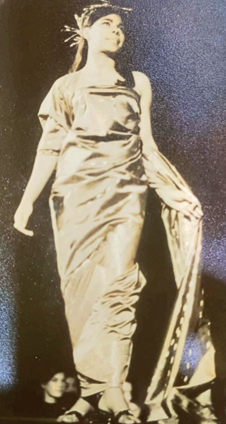
My Name is Melita Caia do Gonsalves! For those of you who recall the popular image of Amitabh Bachchan, popping out of an Easter Egg, singing the equally popular refrain of“My Name is Anthony Gonsalves, Main Dun iya Me Akela Hun”, there was in real life another person ac companying the Anthony Gon salves, who ploughed a lonely furrow, in terms of the how of her life. That was Melita Caiado Gonsalves, equally enamoured by her parental family — the Caidos hailing from Merces, as she was by her husband Antho ny Gonsalves. She breathed her last aweek ago. From a hockey player to swimmer, accomplished West ern dancer, model, artist, Mel ita Caiado Gonsalves had been all. As a school girl in Nairobi, she played hockey in tourna ments outside the city. Family photographs testify to her vi vacity, posing in school uni form outside the aircraft that wasto take them to another province. Her gracious danc ing feet were well known at the annual Goan balls in East Africa. So were her other skills like driving, swimming and an easy athletic grace.

While she did come from a position of privilege, what stands out is that her par ents valued education, above everything else, unlike many persons of privilege. Melita seized the support she got from them with both hands. She completed two graduate cours es at theUniversity of Edinburg, in Fine Arts and in English liter ature, and then went on to Syr acuse University in New York, for a double post-graduation in the same fields. At Syracuse, she held an ex hibition of her works and made her first mark as a fine artist. Fate, through a South Indian student, played match-makerin bringing her and her to-be life partner, the only two Goans at the SyracuseUniversity in New York, together. As a post graduate student, she listened with rapt attention to Anthony Gonsalves’ public lectures at the University. He was a music professor there. Her daughter Laxmi recalls her mother telling her how she was mesmerised by her father’s intellect and astounding store of knowledge.
The two then began their life at Hollywood in a mutually respectful part nership, he as a musician for Hollywood and she as an artist and part time teacher at an art company at Hollywood. There were many adjustments that they each duly made, especially after their children arrived, tak ing turns with child care. But the biggest challenge came when they had to make the shift to the Majorda Village in Goa. Relatives and neighbor surged Anthony to return, fear ing their house would go to ruins otherwise. Anthony Gon salves, who had otherwise left his home at a tender age in his teens to pursue a musical ca reer at Bombay, felt compelled to come back.
For Melita, this was a turning point. Till then, her adjusting nature and the cooperation she got from her husband had carried her far. But this was more than she had ever bargained for. She had to give up her job, as there were no such opportunities as there were in Hollywood. From mod ern amenities (as they were then) to a world of petromax lamps, and kerosene lanterns, it was a drastic change, and one that entailed a load of drudgery to someone who had lived in East Africa, Europe and Amer ica. It wasn’t easy, much as we may romanticize about those days, especially when systems to make such a lifestyle feasible are absent. It is a moment for reflection on what must change if we are to reproduce the past, without reproducing its ex ploitation and oppression. Also, back in Goa, her reper toire of clothes, which included flowing skirts andlong sleeved tops and a hat, drew discomfort for her children whose school mates were unused to this kind of attire.
They saw her, because she would carry the tiffin box es that her husband prepared, to school during recess. In that sense, she ploughed a lonely furrow.Their life was non-conven tional, and yet, it was apparent that there were a lot of adjust ments called for from her side.Over time, the other children in school grew accus tomed to her presence. But this notwith standing, there was another side that Melita, in her spirit of looking at the positive, found. Which is: the otherwise life of peace and the green that was soothing, and the quiet, despite the gos sip and the glare of a closeted village, which she was unaccustomed to. Her values of kind ness and compassion, which imparted to her children, alongside the discipline which her husband insist ed on, were visible in her children.Her daring nature – her instinct to just do it was something that got her far,and this trait too has been absorbed by her children. Laxmi, her daughter, for one, will not hes itate to speak out boldly, while at the same time, also being compassionate and forgiving to those who may have tried to hurt her.
Melita Caiado Gonsalves’ life did not follow the familiar script of the celebrity wife, in terms of ‘Behind every suc cessful man, there is a woman’. There was a mutually respect ful and complementary part nership. Yet, she undoubtedly contributed with all her moral support and was compelled to make great sacrifices in giving up her career and the use that she could put her degrees to, upon returning to Goa. Her life reminds us that migration, marriage, and partnership are not merely personal choices but are shaped by structures that enable some journeys and constrain others. Melita Caiado Gonsalves’ sacrifices, by way of her inter rupted career, her abrupt shift in living conditions, her quiet endurance, must be named, but not romanticised. Only then can we imagine a world where women’s mobility across geographies and cultures, as pirations, and dignity are not contingent on circumstance, but supported by systems that honour equality in practice. (Albertina Almeida is a lawyer and human rights activist)