By Karsten Miranda
MARGAO: A collective of esteemed scientists and researchers has written a formal letter to the Regional Empowered Committee (REC), urging it to uphold the Central Empowered Committee’s (CEC) strong recommendation to scrap the controversial double-tracking of the railway line from Castlerock (Karnataka) to Kulem (Goa).

The experts emphasize that the project poses a severe threat to the fragile ecosystem of the Western Ghats, a UNESCO World Heritage Site, and contradicts India’s environmental commitments.
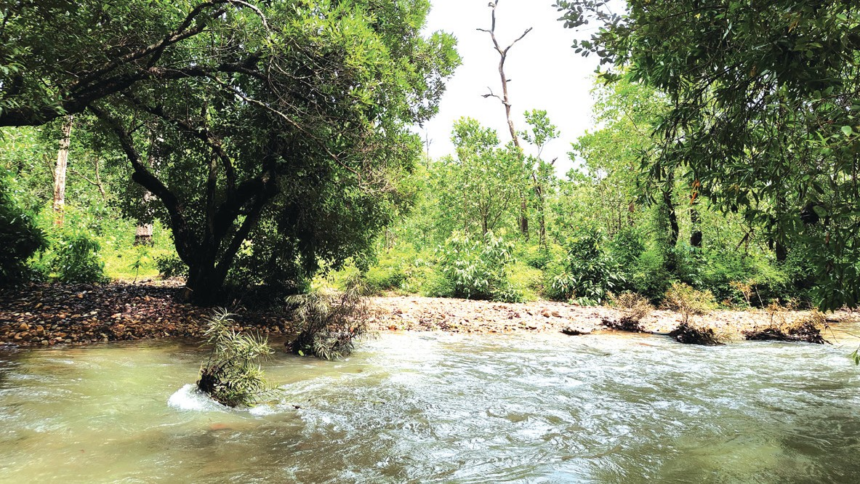
The letter, addressed to the REC at the Ministry of Environment, Forest, and Climate Change (MoEFCC), highlights the irreversible damage the double-tracking project would cause to the biodiversity-rich forests of the Bhagwan Mahavir Wildlife Sanctuary and Mollem National Park.
These protected areas serve as critical wildlife corridors, supporting endangered species such as the Bengal tiger, dhole, and Indian pangolin. If approved, the project would lead to large-scale deforestation, habitat fragmentation, and increased train-induced wildlife mortality.
The Western Ghats is one of the world’s eight ‘hottest biodiversity hotspots,’ home to approximately 325 globally threatened species.
The CEC report underscores the project’s severe ecological implications, including the diversion of 113.857 hectares within the Bhagwan Mahavir Wildlife Sanctuary.
Experts warn that railway expansion will exacerbate forest fragmentation, disrupt seed dispersal of key forest species, and significantly increase wildlife mortality due to train collisions.
The letter also highlights concerns over habitat destruction for cavity-nesting birds like the Great Hornbill, which play a crucial role in forest regeneration.
The loss of tree cover would further impact arboreal species, such as langurs, macaques, and civets, whose movement depends on canopy connectivity. Researchers argue that mitigation measures suggested in Environmental Impact Assessments (EIA) by the Wildlife Institute of India (WII) remain inadequate and fail to address broader ecological disruptions.