Karsten Miranda
[email protected]
MARGAO: A key hearing in the Velsao railway land dispute has been listed for today, April 12 — a Sunday — a non-working day, raising serious questions among petitioners who have been pursuing the matter for over a year even as double tracking work continues on the ground.

The date, displayed on an adjournment notice outside the Court of the Inspector of Survey and Land Records (ISLR), Margao, has been termed a “mockery” by those involved in the case, who say they are being asked to follow due process even as that process itself appears to be faltering.
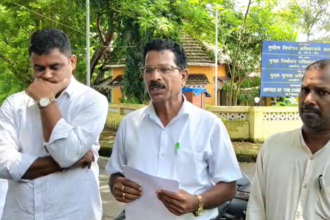
“They keep telling us to come to court. Now the court gives us a Sunday,” said Orville Dourado Rodrigues of Goencho Ekvott. “Is this serious or just for namesake?”
The case stems from a promulgation notice issued in late 2024 by the Office of the Superintendent of Survey and Land Records, Margao, concerning land along the existing South Western Railway (SWR) track in Velsao and neighbouring villages. In response, 46 respondents — including landowners from Velsao, Pale, Issorcim and Seraulim, village panchayats, and the Fabrica of the Igreja de Nossa Senhora Assunta — filed objections asserting ownership based on matriz and inscription/description records dating back to the Portuguese era. The land in question, they say, has for generations served as a right of way and the only access to several homes, even as double tracking work is now being carried out on the same disputed stretch.
From the outset, petitioners say the process has been marked by questionable scheduling. The first hearing itself was fixed on January 6, 2025 — the Feast of the Magi — and has since seen multiple adjournments.
Petitioners maintain that they have submitted complete ownership records before the ISLR, while alleging that the SWR has failed to produce documents establishing ownership over most of the disputed land, barring two small parcels under Survey Nos 69/2 and 69/4 acquired for a guardhouse at Level Crossing No 26.
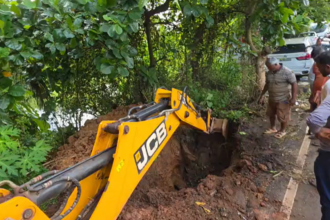
Despite the matter being under adjudication, work has continued on the ground.
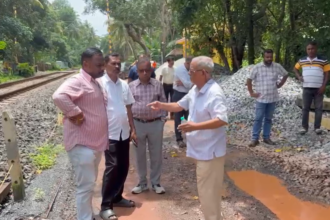
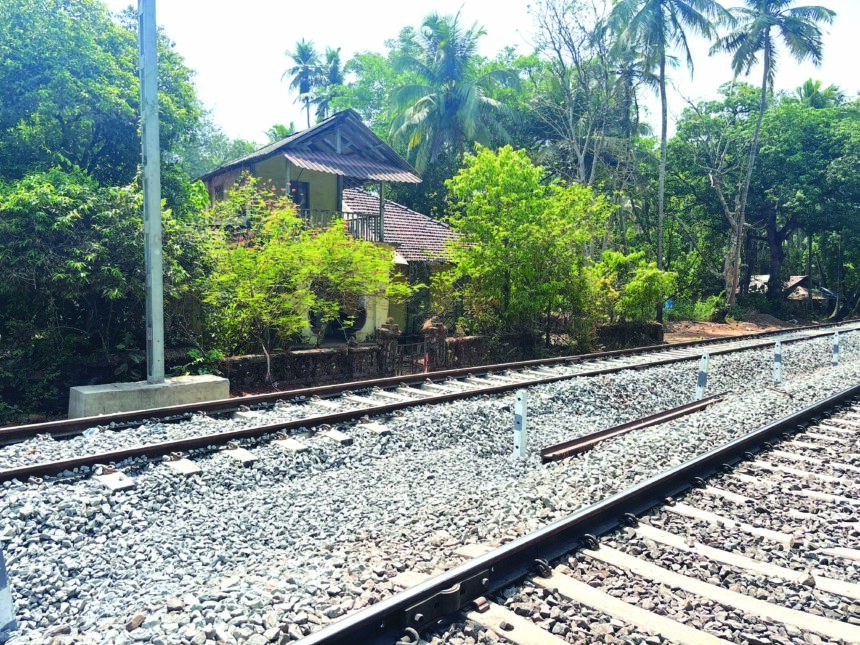
Residents say the SWR, through its contractor Railway Vikas Nigam Limited (RVNL), is proceeding with laying the second track along the same disputed stretch. What was once a traditional right of way — used for generations as access to homes and as a stormwater drain — has steadily been taken over, leaving stretches squeezed between two railway lines. In several locations, concrete work has come up right in front of homes, leaving no usable space for movement.
In several locations, construction has come up directly in front of homes, cutting off traditional access routes. What was already reduced has now, residents say, been choked further.
The consequences have already been seen — and residents say they are a warning of what lies ahead.
In a fire incident at a landlocked heritage home, fire tenders were unable to reach the site because there was no access route available along the railway alignment. Fire personnel were forced to remain on the other side of the track, watching as the blaze spread.
“The fire brigade could not even reach the house. They were standing on the other side and watching it burn,” a resident said.
By the time access was managed, significant damage had already been done.
At that time, residents say, there was still some space available for emergency response.
“Today even that space is gone. The place where the fire brigade stood earlier does not exist anymore,” a resident said.
“If something happens now, there is no way any vehicle can reach.”
Several families now say they have been left virtually trapped on their own land.
Residents said what is visible on the ground stands in direct contrast to the claim made on the floor of the House that no coal is passing through the Konkan Railway, with some alleging that the Chief Minister’s statement was misleading. They pointed to goods rakes along the route that do not carry a guard van at the tail end — a standard feature under normal operations. According to them, this indicates that the rake is being reversed at Majorda, where the SWR line meets the Konkan Railway, with an engine attached at the rear in place of the guard van to move the train in the opposite direction towards Maharashtra.
For residents, this is not just a technical detail but part of a larger concern — that even as they continue to pursue their case, the situation on the ground is being altered in ways that may soon become impossible to reverse.
With the hearing listed today, April 12, on a day when the court may not function, and work continuing on disputed land, residents say they are being left to deal with the consequences in real time — cut-off access, rising risk, and the prospect of being stranded in their own homes even as the legal process struggles to keep pace.