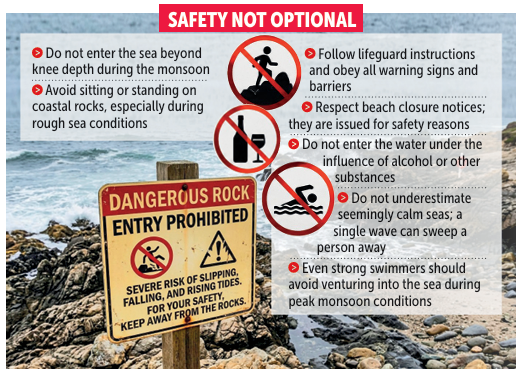
In the backdrop of a young Karnataka tour ist being swept away to his death at Baga beach on Wednesday, safety experts have pointed to a recurring and troubling pattern be hind many such incidents — the disregard of beach safety norms despite re peated warnings. According to lifeguards and marine experts, a significant number of ac cidents occur when vis itors venture into rough monsoon seas, climb onto rocks near the shoreline, enter the water while in toxicated or ignore restric tions in pursuit of photo graphs and social media content.
General Manager (Op erations) at Drishti Life saving Private Limited, Lt Col Austin Collaco (Retd), said it was concerning that many visitors continue to disregard safety protocols despite the presence of life guards, verbal warnings, physical barriers, warning markers and even police in tervention. “We have observed that the majority of tourists enter the water while in toxicated or under the influence of substances, which significantly com plicates safety efforts. Even strong swimmers are at risk during the monsoon because the waves are very rough from June to August,” Lt Col Collaco said.

He noted that many people underestimate the dangers posed by the sea during the monsoon, par ticularly around rocky stretches where wave and current behaviour can change rapidly. “It is often not realised how dangerous these conditions can be; while the tide may appear low or calm, a single un predictable wave can quickly sweep an individual away. The behaviour of water around rocks is highly complex and depends on numerous factors, including whether the tide is receding or rising, the specific slope of the seabed, sand erosion, and underwater depressions.
Because these currents are unpredictable and possess immense power when pulling back to sea, it is vital that tourists and visitors strictly adhere to safety protocols,” he said. Experts say the danger is amplified during the monsoon months when sea conditions change dramatically. Explaining the science behind the rough seas, former Chief Scientist at CSIR-NIO, Dr Sanil Kumar VV, said wave heights that typically remain below one metre during fair-weather months rise sharply during the monsoon. “This increase in wave height is directly proportional to the strength of the longshore and cross-shore currents. Furthermore, strong monsoon winds lead to a storm surge, which further raises the overall water level.
The primary risk to individuals is the loss of stability,” Dr Sanil Kumar said. He explained that when waves exceed one metre, they can easily destabilise a person. As the large volume of wa ter recedes, it generates a powerful backward pull capable of dragging even a stable individual into deeper waters. “Individuals mustn’t venture into the water beyond knee depth during the monsoon period to avoid being swept away by the sea,” he said. Lt Col Collaco stressed that beach closures and restric tions are imposed solely for public safety and should not be ignored. “If a beach is marked as closed, it is imperative to honour this directive to prevent further incidents. It is vital that everyone listens attentively to lifeguard instructions and strictly follows all posted beach signage,” he said.