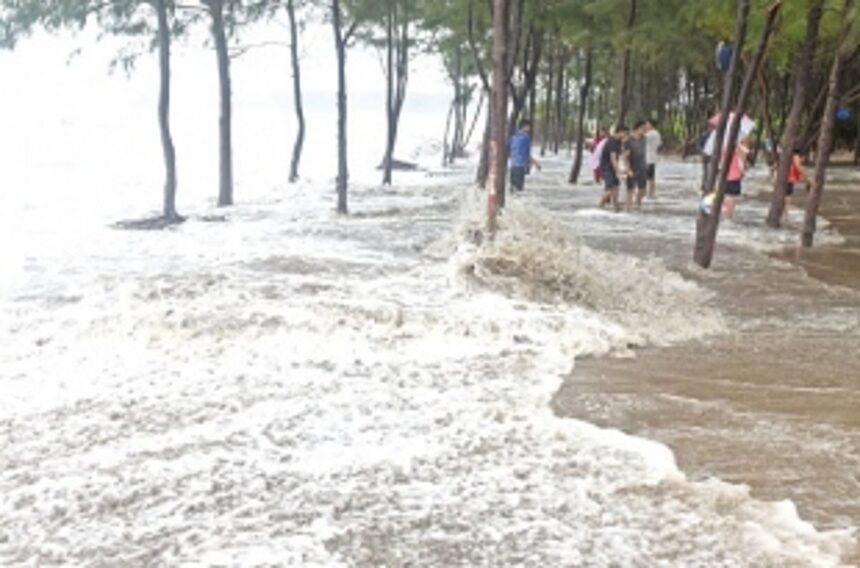
PANJIM: The State escaped major damage, as Cyclone Vayu moved across the Arabian Sea about 500 km away from Goa, but an angry sea lashed at the coast and the waters crossed the high tide line on the beaches and crept inland.
Goa stares at Cyclone Vayu, exactly a quarter of a century after the State was hit by a cyclone on June 6, 1994 which claimed eight lives and damaged property worth crores of rupees.
Cyclone Vayu is still moving across the Arabian Sea with its effects felt across the State in the last 48 hours and will continue to affect the State with gusty winds and heavy to very heavy showers.
The cyclone has been creating havoc in the sea and the Indian Meteorological Department (IMD) has issued a warning against any marine activity along the west coast for the next four days.
All water bodies witnessed a sudden rise in the levels and during the high tide, most of the water bodies crossed their normal levels, a clear indication of the rough weather conditions in the sea creating ripples towards the coast.
Vehicles parked near the Panjim ferry jetty surrounded by water and creeks and nullahs across the State reached their bream, which would begin overflowing if incessant rains hit the state. Water at Miramar beach covered the sands and reached the casuarina trees. Elsewhere across the State there were reports of high waves and rough seas.
IMD Goa Director Dr Krishnamurthy Padgalwar said the sea will be very rough and hence no fishing activity should be carried out and even tourists should not venture into the sea at the beaches.
However, compared to the 1994 cyclone that left Goa in a state of shock and dismay, this is mild. The devastating cyclonic winds 25 years ago had caused extensive damage to property including houses and agriculture. The sight of uprooted trees and broken electricity poles with cables strewn on the roads was common across the state on that fateful day.
Recalling the fateful day of 1994, Caranzalem resident Shaikh Hussein said, “The high speed winds blew away roof tiles and uprooted many trees in the Caranzalem area. Houses were damaged as a result of the falling trees. And electricity was hampered completely.”
A lady in her thirties recalled that based on the 1994 cyclone, the Hindi textbook of Grade 6 later adapted a lesson titled ‘Goa Ka Chakrawat’ (Goa’s Cyclone).
Asked about the progress in the last 25 years on the way weather forecast is issued, Padgalwar said that technology was not as advanced then as it is today and therefore warnings could not be issued, which saves lives and property from being damaged.
He said, “Technology was not so advanced then and Doppler Weather Radars (DWR) were not yet installed and IMD began installing them in July 2002 with Chennai having the first DWR. Subsequently, IMD has been installing DWRs in East as well as West coasts. The range of the DWR is upto 500 kms.”
Stating that any system can be monitored within the radius of 500 kms, Padgalwar further said, “The eye of cyclone Vayu is still not captured and visible in the DWR at Goa, which means it is beyond 500 kms off the coast. Therefore, we are certain that it will not hit the coast of Goa and all the movement will be in the deep sea. It will move towards the North and later towards North-East and will strike at Saurashtra in Gujarat.”