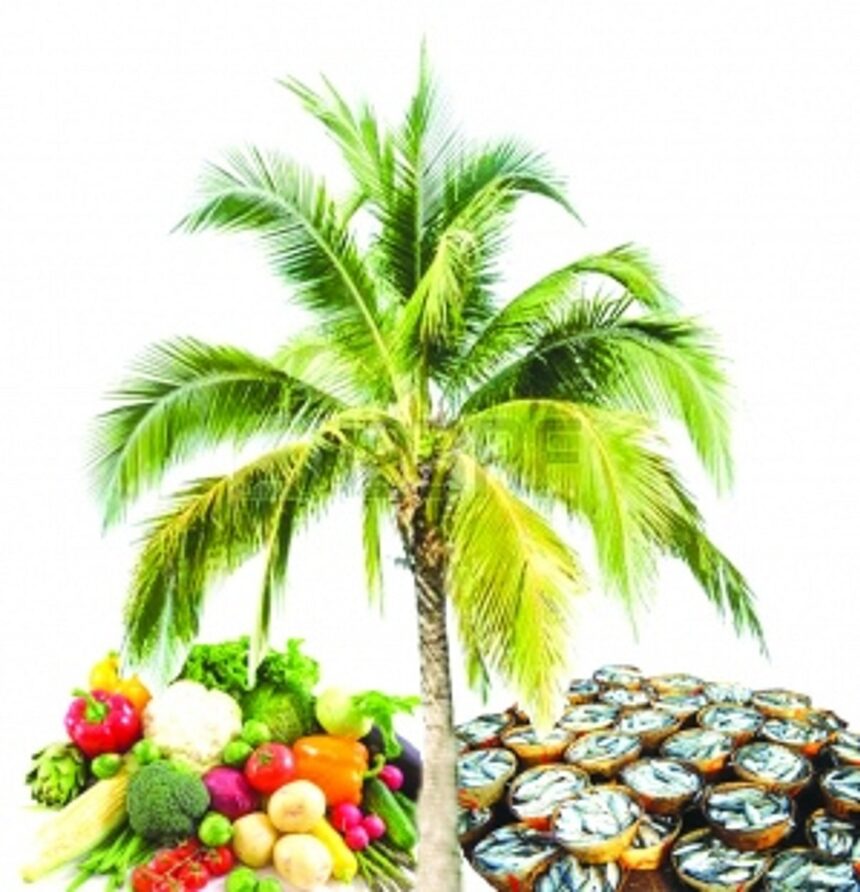
Coconut – hard nut to find
Coconut, which is one of the most important elements of Goan cooking, is at present in the limelight with the increasing prices in the market. Production of the nut has declined in the recent season from 2016-17 thus resulting in more demand while also forcing the state to depend on the neighbouring states for supply.
According to the experts, coconut produce is the only cultivation which has either been steady or declining in its output with the land area under cultivation for the fruit slowly vanishing. Also cultivators say the prices are to remain firm in the coming months with the production not expected to improve.
Speaking to Herald, Director of Agriculture, Nelson Figueredo, said, “There is some reduction but the department is not in a position to quantify the same because we compile the data annually. Some of the reason of the decline in production is the neglect of the cultivators in the past because low prices had hit the production”.
He added “In some areas production has suffered from animal attacks as monkeys destroyed the crops in several areas of Sattari and Sanguem and many other places. However, the production has remained stable in the coastal areas. Currently the price is high with the demand increasing and supply becoming less.”
The coconut vendors have also expressed difficulties saying that the increasing prices have led to a minor fall in their businesses.
Vikram Bajwa, a coconut vendor from Panjim, said that coconuts are regularly brought from Andhra Pradesh as local supply is not able to meet the demand.
“The fall in the production has led to more demand thus increasing prices. Goa has not been able to meet the demands thus forcing us to bring coconuts from the neighbouring states of Andhra Pradesh. Till the production increases, we will have to bring in from this state,” said Bajwa.
However, according to some agricultural zonal officers several factors have led to the decrease in production in Goa. Coconut harvesting requires labour and shortage of pluckers is an enduring problem faced by farmers and the rising fees they take have forced farmer not to venture in the cultivation.
Meanwhile, Agriculture Minister Vijai Sardesai was recently in a controversy for his statement wherein he said that his Department was thinking of importing coconuts from Sri Lanka, since the coconuts prices in Goa keep shooting up while the supply is depleting.
“The Agriculture Department procures large quantities from the coconut farmers and puts them into the market through the horticulture outlets, but it is not enough to fulfill the needs of the people,” said Sardesai.
The Minister further said the government was working on four options; the first was to buy directly from producers in Goa and distribute through the agriculture department, second, import coconuts from Sri Lanka or other places in India; Sri Lanka because of the advantage of the currency strength. While the third option was to wait and see the new production of the State, the fourth option was to take coconuts from various government agencies and distribute to the public through the horticulture stalls.
Meanwhile, in a mock sale in protest against soaring prices, Mahila Congress sold 300 coconuts at cheaper rates in just 10 minutes.
Fish aplenty, not for Goans
In a setback to the fishing industry, there has been a sharp decline in the marine fish catch. A shortfall has been observed from 2015 to 2017. However, what is surprising is that despite the decline in the fish catch, the export has significantly gone up while locals have to depend on fish from other states.
The state’s total fish production for 2015 was 108,240 tonnes which dropped to 101,053 tonnes in 2016. In 2017 (January to Setember) the marine fish catch stands at 86,799 tonnes. However, the Central Marine Fisheries Research Institute (CMFRI) is currently studying the impact of LED on the fisheries resources.
Against the fall in catch, the year-wise quantity of fish exported over the last two years reveals that there has been a slight increase. In 2015, Goa exported 34,814 tonnes from the MPT, which increased to 38,209 in 2016 leading to an increase in the exchange value.
Meanwhile, the fall in supply, coupled with the increasing demand in Goa and imports, has resulted in people shelling out more money to buy fish as compared to previous years.
“Goa has begun to receive fish from states of Andhra Pradesh and Tamil Nadu. The Eastern coast of India observes a fishing ban once Goan fishing ban (July 1 to Aug 1) comes to an end. Hence, fish from the Eastern side of the country comes into Goa. Even now most of the fish is imported from these states to the wholesale market in Margao to meet the demands”, said a trawler owner who did not want to reveal his identity.
Speaking to Herald, Deputy Director-Fisheries, C Velip said “There are fish imports from states like Karnataka, Kerala and Andhra Pradesh but we do not have any data in this aspect. I do not have information on this”.
Meanwhile, Fisheries Minister Vinod Palyekar had said that cheaper fish could also be ordered from neighbouring States through a proposed fisheries corporation but first the State will also put restrictions on export of fish from Goa to make it easily available in the local market.
“We will import cheap fish from other States and give it to people at a cheaper rate. If a Kingfish costs Rs 500 per kg, we will offer it at half the rate. A corporation will also be formed to sell the fish” said Palyekar.
He further said increase in exports, rising demand from the hospitality industry and rising pollution and sea temperature had resulted in a decline in fish production in the waters off Goa.
State ‘depends entirely on Belgaum for vegetables’
The shrinking acreage under paddy cultivation in the State and the staggering dependence on imported vegetables and other food items have put Goa at the bottom of the list of states on the basis of food security.
Today the major supply of vegetables into the state invariably comes from Belgaum; in fact Goa is entirely dependent on Belgaum for the procurement of their daily need of vegetables. The requirement of vegetables of the State is about 300-400 MT per day which is met totally by import from these neighbouring States.
The import of vegetables from Belgaum is on rise as the local production is not up to the mark. Crops like potato, tomato, cabbage, carrot, etc, cannot be grown in Goa due to its agro climatic conditions and hence have to be imported.
In Goa not many people adopt to farming business on the commercial scale due to hard work and manpower which Goa lacks. Besides, most of the land is being converted into a concrete jungle to make more money. Though the state still has dependency on Belgaum for their daily vegetable needs, the quantum of procurement has gone down with the local horticulture corporation encouraging the farmers with various schemes, says sources.
However, vegetable production has seen a slight increase. In 2015-16 there were 82,594 tonnes of produce over an area of 7,240 hectares while in 2016-17 vegetable production rose marginally to 84,823 tonnes cultivated on an area of 7,379 hectares.
“Goa totally depends on Belgaum for all the vegetables and we are the first ones to be affected if something happens in Karnataka. The corporation should come out with new methods to introduce these vegetables in Goa so that the state is self dependent,” said Hari Govekar, a vegetable vendor.
Interestingly, Goa still lacks a clearly stated agricultural policy which would seem like a necessary pre-requisite if a larger and more sustainable impetus is to be provided to agriculture. In the absence of this, and with a system that is only subsidy-focussed, it sometimes seems like the approach is to bribe people to continue farming.
Meanwhile, speaking to Herald, Goa State Horticulture Corporation Limited (GSHCL) Chairman, Pravin Zantye said “We are working on it so the state is not dependent on other neighbouring states for the supply of vegetables. The Horticulture Corporation has also come up with many schemes for the farmers which will benefit them a lot.”