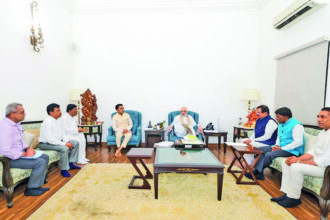
Herald: Hello and welcome. We are back with an extremely important topic that concerns the lives and livelihood of people in Goa. It also concerns the way of life and the future of mining, which is an extremely sensitive issue that plagues us all. Of late, we’ve been having a series of discussions with various experts on how to take the whole mining process forward, how to make it more sustainably, and more importantly, how to make it people-friendly. The relationship between people and mining so far has been people versus mining, but there can be another way. People can be stakeholders in the entire mining process and so can the government. The private players who enjoy most of the profits can play the role of contractors and nothing else. The panelists for this discussion include Rajendra Kakodkar, who has studied the whole mining issue and how resources of the state can be in the hands of the people; Haresh Melwani, who is technically a mine owner, but he’s much more than that. He’s someone who has deeply studied ways to make mining more sustainable and also ensured that the State’s resources are maximized; and Claude Alvares, the Goa Foundation director. He’s been the symbol of this entire movement against the manner in which the State’s resources have been looted, and more importantly, the manner in which 89 mining leases have been renewed in a hurry on the basis of a high court order.
Herald: The Supreme Court (SC) had given its order in April 2014, where they had laid down a roadmap for the restart of mining. One of the key parts of that roadmap was that mining leases had to be renewed under section A-3 of the MMDR Act only if that state was completely confident that these mining renewals were in the interest of mineral development. Sadly, that doesn’t seem to have been done. The conflict is basically between whether these renewals were justified or not, whether mining is going in the right direction or not, and more importantly, is there a way out? Let’s start with Claude, who will share with us the way mining can be more sustainable and be done in a way in which people are the biggest beneficiaries.
Alvares: One of the biggest things that has happened since the SC intervention is that they have sort of cleaned out past activity and tried to put it on a new footing altogether. It depends on the government whether it wants to go back to the old way of doing things or whether it is seriously interested in doing what the SC said. If the government followed what the SC said, the mining scenario would change in a radical way and it would never be the same as what it was before. More importantly, what the SC order would have done was ensure that mining would have been done properly and that all revenues from mining would not go to mine owners – because they don’t own the ore – but to the government and the public exchequer. It would eventually come back to the public in the form of subsidies to help youngsters set up economic units and so on. There’s a lot you can do if you have a lot of money. You can’t do that today because all of us are in debt. The State is in debt and Goans are in debt up to the extent of Rs 66,000 per citizen, which is the highest in the country at the moment. All that we are asking is: why is the government not doing what the SC said it should do. Don’t give the leases out the way it did in the past; don’t give them as free gifts; put a price on the oar and then give those leases out. If you charge for the ore that is on the lease, you charge an advance, you get more money, you protect yourself from being exploited by mining companies who can make windfall gains because of price differences in the international market, and so on. This is a very good mechanism. Auction is not the best, but compared to giving somebody these resources for free, it is certainly far superior to what has been done till now.
Herald: Haresh, taking off from what Claude said, maybe the mining owners take a stand saying that under the law, they are entitled to two renewals. The government has followed the rulebook completely and given them the second renewal. Since it is already mandated by land and they have been mining, they can very well take the stand that as far as the law is concerned, they are entitled to mine in this manner.
Melwani: The second renewal is subject to the A-3 condition which calls for a speaking order on mineral development being done by that leaseholder. Let us understand the concept of mineral development. Is mining merely mineral development or is the extreme valuation of all the extraction mineral development? That is the first thing that government should have defined. These renewals were not due now; they were due in 2007. The government went into a slumber without anticipating this problem. Then it has abrogated its responsibility to the public and the lease operators. They should have defined it because they knew a second renewal is due. Everybody had applied in 2006. The government had enough time to come up with a definition of mineral development rather than blindly banking on a rule that allowed the extension of mining operations. Today mining has stopped. Has the government realized even now what mineral development is? That Act itself has been amended to give a life of 50 years for every lease. Again, that loose wording will get us a spate of litigations and God knows where these litigations will end up, what decisions will come, and when mining will really resume. In the meantime, mining continues to be in a state of limbo. One side is saying this, another side is saying that and a third side is saying a third thing.
Herald: Rajendra, you have studied the whole issue and are aware of the new kind of mining that can take place. Can you tell me about your own experience along the same lines and how we can move forward?
Kakodkar: Between 2008 and 2010, I was doing a study on the telecom industry. The spectrum case was going on in the SC at that time. I had attended every hearing. Based on the questions asked by the judges and the discussion that went on, it became very clear that no public asset can be given free. No public asset, as per our constitution. At every stage this question was asked: how can a public asset be given for free? Minerals are also public assets and not own by the state. The government is only a custodian, and it was also made clear in the SC. In 2010, it was the first time I proposed that these minerals cannot be given free. At that time, the MMRD Act did not say it had to be auctioned. It also did not say that the price shouldn’t be taken. When the government is giving out flats in Goa Housing Board, it is not said that you have to charge for it or auction it – but it is being auctioned, a charge is being made. The charge is taken in addition to the stamp duty. Here is the only case where the price of the asset is not being charged. Stamp duty and or any other royalty are revenue items, not capital items. The price of the lease, which is the asset price, is that capital item that is not being charged. It is the biggest folly in this particular policy. MMRD Act doesn’t say that you should not charge a price. It doesn’t say you shouldn’t auction. It says you can auction and that it is the government’s decision. Whether the government goes on the people’s side or the mine owners’ side is their problem.
Herald: Claude, taking off from what Rajendra said. Can you just summarize the way forward? How do we go about it?
Alvares: In a certain sense, our hands are tied right now because the Goa government with great speed has renewed these 89 mining leases. They have given them in completely questionable circumstances and without charging any fee. They have taken stamp duty, but stamp duty is not the value of the ore. It is only an instrument for signing the lease deed. For example, when you buy a flat, you pay for stamp duty and also for the price of the flat. What we are saying is that the governments should admit it has granted these leases in error. We have given the case that 31 of these leases were given on January 12. Now the Comptroller Authority General has also written to the government asking how it had granted the leases.
Herald: For the benefit of our viewers, January 12 was the day the MMRD ordinance came into being. That ordinance specifically states that you cannot renew the leases in the manner it has been done. The concept of renewals was actually done away with.
Alvares: We are with that restriction. If the government wants to move forward, it has to cancel and review their decision. That is the first step they have to take. Otherwise, this is what will happen: those leases have been renewed in such suspicious circumstances that – forget about Goa Foundation – any person can move into a court and the court will have those leases cancelled. Let’s assume they are going to be cancelled. What will the government do? The government issues the leases though itself. It says that in this area, there is so much of oar; we’ll create a lease and give it either to Goa State Infrastructure Development Corporation (GSIDC) or Goa Industrial Development Corporation (GIDC) and they will become the owners of the lease. Then they see how much of oar is there, what types of oars are there, and what is the amount to be extracted, because it is not only iron ore. Many other minerals are there. You can tell them that this is the ore that we want to remove and we are getting the environment clearance for this amount. If the environment clearance is done by the government, it will become far easier. Once you get that, then you issue the tenders. You issue a tender stating that you want one million tons to be removed from this mining lease. You remove it and it to me. I don’t want to get involved because I don’t want employees. Once I make somebody a government employee, they don’t want to work. I don’t do that. I ask people who are interested in the job, who are doing contracting, and who have been running mining operations. You get into the act and then auction it to the person who will give you the best possible deal. If necessary, instead of taking 15 percent, you will give to a person who says he is going to do it for a 10 percent profit. However, it is restricted to just an economic operation in which he removes the ore, gives it to you, takes all his costs, and also takes a reasonable profit of not more than 15 percent.
Herald: Harish, suppose I am a mine leaseholder or a mine owner. I can very well turn around and say we have been mining for the last so many years. We have given so much back to the state. We have done so much of CSR. We have opened schools and colleges. We’ve been prominent members of civil society. We are doing legitimate business and are paying royalty. At this point of time, after doing so much for so many years, why are we being denied our profit maximization?
Melwani: The biggest devil in this is the State. The State has totally abrogated its responsibility. It does not know what the mineral inside is. In the last few years of the mining boom, the Centre took away Rs 30 – 35,000 crore from Goa by way of export duty. Correct me if I’m going wrong. The Goa government received around Rs 3,000 crore.
Herald: For our viewers, Mr Melwani is saying that every year, as far as Central taxes were concerned, almost Rs 16 – 19,000 crore went to the Centre.
Melwani: Absolutely. Do have they even have any inkling of what minerals are there in Goa? Somebody from Goa University is shouting that there are gold ores in Goa. Somebody is telling me that he made ferrites out of my ore. Somebody else is telling me that there are rare earth elements in my clays. Do we even know what we have? Can a person can come and say, “I don’t know what is there, but you extract it and pay me a certain fee”? Which sane person will agree to such a proposition?
Kakodkar: In short he’s saying that the Goa government is not able to duty its duty as custodian also.
Herald: If mining is under the control of the State, and if auctioned ore is given to a contractor who does it the best, how can we be sure that the government will carry out mining in a professional manner to oversee and ensure that there is profit maximization?
Kakodkar: The Goa government is completely incompetent. Even for e-auction – the SC said to e-auction it. Manohar Parrikar said that the price would rise and that was why he was waiting. The price has fallen by half. In fact, because of Parrikar’s short-sighted decision, the State has lost Rs 1,200 crore on the e-auctioned ore in the last one year. The government is totally incompetent. Mining has to be done with upfront fees.
Herald: Are you saying that mining companies can continue mining after paying heavy fees?
Kakodkar: No. It can be retained with the government for a few days. Goa government is spending so much on consultancies. They can use it to find out how much ore is there, what would the value be, what types of minerals are there and how much value can be accrued out of it. After that, based on the data, the mines can be given out. Even Russia is giving out.
Herald: Claude, this round will be about direct benefit to the people. You spoke about half of your plan. If your plan works, can you elaborate on how every individual will actually get money in their accounts? How will that happen?
Alvares: Kakodkar is saying that it is acceptable up to an extent, but if you look at what happened to Goa in the last 10 – 15 years, the government was totally incompetent. But what did the private sector do? Did the private sector come out as somebody with a brilliant track record? Did they do the type of research that Mr Melwani is talking about? Did they really put money back into the society? No. The government collected Rs 19,000 crore and the private sector collected Rs 33,000 crore, which belonged to the people of the State. It didn’t belong to the government, it didn’t belong to them, but they took it and put it in their pockets. In this country we still have discussions on whether the private sector is good and the government is good. What we are saying is, whatever means you use, we can still discuss it. The owner of the ore gets the maximum value of the ore. Let me give you a simple example. I have a 50 grams gold necklace. I need some money, so I go to the market to sell it. The seller says the value of the chain is Rs 100, but he will give me only Rs 5 for it. Will you accept it? No. Even if I’m desperate, I will not sell it for Rs 5. If you give me Rs 90, then I will take it. Who will accept Rs 5? This is what happened in Goa in the last eight years. Out of ever Rs 100 that it got, the Goa government accepted only Rs 5. The Central government got Rs 30. The mine owners got another Rs 30 and another Rs 30 went for extraction of the ore. This was the balance. Suppose the Goa government says it is the owner and takes charge, but takes charge only as owners. Now, many owners in the State do many things with their assets. Some rent them out, some sell them and so on. But the value of it ultimately comes back to the government. We’re saying that the value of the ore – the Rs 22,000 crore that was made in the sale of 54 million tons – minus the extraction costs should have come to the government first. Afterwards we can see what else has to be done.
Kakodkar: These particular resources are non-renewable. To that extent, you should have another treasury from which you can replace whatever has been replenished.
Melwani: Let me add to what Claude said. I go into the market with a necklace. I don’t know what it is made of. Give me a valuation. Anybody’s valuation is fair because you don’t know what that necklace is made of. You can get a proper value when you’re a knowledgeable owner. That is the most important point in the discussion.
Herald: Harish, somebody like you has been doing immense research. Can you just share with us this whole issue of you constantly harping on the fact that there is much more in what we extract.
Melwani: When we extract iron ore, we’ve been extracting ore and throwing away four tons of material for every ton of iron ore that is extracted. What is the constitution of these four tons? Has anyone even bothered to check? There is one ton of yellow ochre, one ton of dolomite, one tone of low-grade red oxide, there is some manganiferous clay – all these are saleable products. Yellow ochre has been imported by Baba Atomic Research Centre to treat their nuclear water. Even high-grade red oxide is being imported today. It has various applications. The basalt that was being throwing away I have made into construction rods and bulletproof panels. We are importing bulletproof jackets. I am ready to make it right here right now with the same things that we have been throwing away. You must remember that we are in the age of technology.
Herald: What’s shocking is that the Directorate of Mining and Geology has not even studied the issue and not even bother to figure out what else is there. Obviously it means that crores and crores of value has been squandered away.
Melwani: There is no record with the Geological Survey of India, which has been charged by our government to research the mineral wealth of Goa. We have no records.
Herald: If this is the case, you don’t even need to extract 20 million tons. The State can get the same revenue by extracting even five million tons.
Alvares: The difference in terms of value would be – today you’re getting Rs 2,000 per ton. If you extracted all these elements, you would get around Rs 25,000 per ton.