In the recent past, the people of Goa were struck by a very poignant article written by theologist Fr Victor Ferrao, titled the boiling point ‘The Boiling Point of Goan Blood’, which reflects the growing sense of alienation of the Goans in their own land, thanks to skewed development policies of the State government.
In his article the stated that all that Goans have stood for, was falling apart. The Goan credo was crumbling down.

According to Fr Ferrao, anger is a mode of resistance to this sentiment that Goa is disappearing into a blackhole, which is unplanned development. The toxic development forced on Goa is brewing discontent and is a time bomb that might explode in the days to come.
Latest one can remember is the time of GBA agitation, which was quickly acknowledged by the powers that be at that time and a change was initiated to pacify people’s anger. But as days went by, the land of Goa came to be seen as a powerful economic resource and several Goans and outsiders began to build commerce and tourism around it.
He also highlighted the fact that when this land-life symbiosis began to breakdown, when villages began to lose their character, when we began to see road rage and rash accidents, when our Smart City began to look like being built by incompetent persons, the searing anger began to show up. This anger is increasing with every passing day.
Goans are tolerant and susegad (laid back) but to a point. It appears that the boiling point of Goan blood is fast coming. The angry Goan (of today) is pointing toward this horizon. Some politicians have already embodied this anger. The angry Goan is standing for the State. He/she is deeply angry and discontent. We cannot wish away this anger.
He also added that Goans are not against progress, but when progress harms the interests of people, what can they do? This is why Goans as chief stakeholders of what is imposed on them as development, feel left out and powerless.
Goa and Goanness are seductive. Tourists and business men are seduced in the way Goa is presented to them. They see Goa as other India and flock to Goa to indulge into abundance that is transgressive and breakaway from their everyday life. In some way, Goa being another India for Indians becomes a seductive momentary space of being un-Indian.
In his article, Fr Ferrao made a very important observation: “We are not yet seeing the rage of Goans. This rage is in the coming. Hence, we have a difficult road to travel. But as Goans, we have the challenge to stay calm and work consciously against the escalation of anger. This does not mean that the anger of Goans is not grounded. It is certainly legitimate. Staying calm will enable the fight to save Goa and Goanness. Goans will not settle for anything less.”
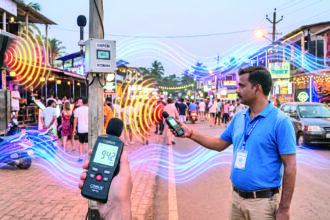
So, is the Centre and State government taking decisions that are detrimental for the people? Whether you look at the double tracking in Velsao, or you look at the Borim Bridge agitation or the Bhoma expansion or you look at strong questions being asked in various gram sabhas against the scourge of sound pollution, the general feeling is that the common man or woman in Goa is at the receiving end of authority, rather than the authority being a friend of the common Goan.
He further wrote, “Without landing into cynicism, it seems that Goans have chosen anger to vent their sense of alienation. It appears that it is development-toxicity that is afflicting Goans. They seem to be fast entering into what Indian thinker Pankaj Mishra names as ‘the age of anger’.”
Elaborating these lines, Fr Victor Ferrao said, “I was studying Pankaj Mishra’s famous book ‘Age of Anger: A history of the present’. It states that people are getting angrier across the globe and that’s why they are electing leaders like Trump, Modi and others. Although I contest this logic, people don’t want to be losers of history.”
“This kind of toxic development leaves people behind. I feel Goans are exiled in their own place. They have no say in what is happening around them. The villages are losing their character. Goa is disappearing at several levels and therefore the point is, who sold the land is one important question we may have to address. But what is being done on that land is also important, who is doing what with that land is also important,” Fr Ferrao said.
“The land has become an economic resource for Goans, as well as others. It is raw material for some people to create wealth and it looks like our government and people in various positions of power are partners in mining this wealth, which actually eliminates Goans from Goa and Goanness,” he said.
We see a lot of protests against various projects. For instance, the entire issue of double tracking in Velsao. When people said that the South Western Railways did not have the survey numbers to actually start land acquisition, the government immediately ordered a survey post facto to benefit them.
If we look at the Borim agitation, on one hand people are rushing to the NGT, then they want to rush to the High Court while on the other hand, the politicians are paying lip service, saying we are with you. But at the end of the day, the march of acquisition is continuing and the government has already announced the acquisition. So much so that during the last acquisition phase, they put out notices in some newspapers which are not widely read in the area.
Then you have situations wherein activists are being thrashed in gram sabhas for raising their voices against the skewed development policies of the government. Unfortunately, there is no scope for any justice. So, this seems to be a pattern.
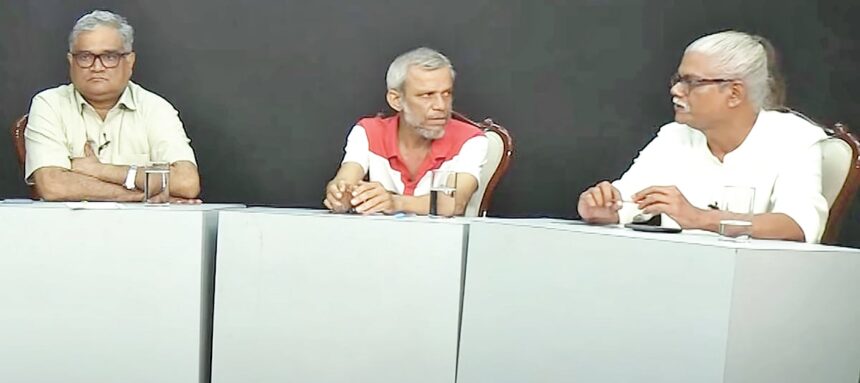
Reacting to these developments, Abhijeet Prabhudesai, Convenor, Federation of Rainbow Warriors said, “It is extremely disheartening for Goans to see what’s happening around them. All of us have grown up in an atmosphere surrounded with so many values, skills, community knowledge which you can’t quantify. Over the 10,000 years of Goan civilization, the amount of these connections and relationships that have grown, are not even recorded and not known to the outside world. But they are known to the government and each Goan can see them disappearing in front of his eyes.”
“It’s very clear that every Goan is a part of their land. These are land communities – the Gaonkari system – and that’s our culture. That’s in our blood and this land community is protected by the Goans. So for those who now are looking at the land, as a capital, as a market to make money, for them Goans are clearly the obstacle and have to be removed. Only then they can get the land,” Prabhudesai said.
When asked about the narrative that it’s the Goans who are selling their land, Prabhudesai said, “In the original scenario, there’s no question of selling the land because it would be Comunidade land. There has been privatisation of land for whatever reasons, but you know the ownership doesn’t matter. If you see the Gaukari system, under it whoever comes to live in the village, is given land to build a house, a piece of field to till, a place to live. There is enough for everybody in the system.”
So this question of private ownership doesn’t arise. But the fundamental reason the Gaunkari system has survived is because of the sustainable land use for survival of civilization. The survival of this civilization is at stake. So it’s all well connected, he said.
Giving his insights in the matter, Victor Hugo Gomes, Founder, Curator Goa Chitra Museum Group, said, “We need to understand how our ancestors divided the land under the Gaunkari system. There was land that was kept aside for housing, for different kinds of agriculture – right from low lying areas to the plateau. There was land that was kept aside for meetings and gatherings. Land kept aside even for grazing. Everyone was taken into account. I think the destruction started with this Land to the Tiller Act.”
He informed that under this Act, the system was if you had to cultivate, the land would be taken from you and given to someone else. Today this Act allows you to buy that field, but there is a clause in it. You can’t use it for any other purpose. So it means you are supposed to use it for agriculture.
“On the other side, they have become absolute owners of that land. Who are you to tell us what to do with it? You are not going to grow anything. We don’t have money. There’s no labour. That’s how the land use has changed. Again, unused areas like the grazing grounds like in Verna, because people were not planting anything, it was taken for Verna Industrial Estate,” Gomes said.
But the point here is that, somehow land is now seen as the resource for the real estate sector for the so-called development. The issue is that anybody who’s a hindrance in the way, is removed with impunity. Because of this people’s lives and livelihoods are getting adversely affected.
In Velsao, people lived up peacefully, till double tracking happened. You can do a double tracking if you want, but if it is entering into people’s homes, then there is a problem.
During the Portuguese era, there used to be a very interesting phrase called ‘right of way’. For undertaking any acquisition, it had to be ensured that a ‘right of way’ was always kept for the people who had homes. But now, that principle has completely gone away. Today land is being acquired almost up to the boundary wall. This is something which completely hurts people and goes against the basic sentiments and their rights.
So it almost seems as if the State is coming to occupy or capture. This is a feeling that people have. Why are people getting this feeling and how does one change it?
“I think the basic problem is the people themselves, the way I see it. We Goans are divided into two segments. One is Goans who are larger in numbers, who have nothing to lose and know nothing about law of the land. I call them literally egoistic idiots, who have been destroying the State. Then there is another section, which is less in number, the social activists come under this category. The larger numbers are the ones who without knowing the law of the land, are the work of activists by getting people on the ground and then finally when there’s a case, they say the matter is sub judice, there’s no voice. That’s how development is happening,” he said.
Prabhudesai said that one can’t look at the issue with a narrow vision. One has to step back and see the bigger picture.
“It’s happening across the world. It happened in England in the 18th century. Everywhere where there is an industrial economic system, it requires the resources of the land community. So, it works on grabbing the resources. When we say people did not cultivate, there are reasons. And the State is responsible for farmers not cultivating and suffering losses, to the extent that they have to give up farming,” the Convenor of Rainbow Warriors said.
“These resources are required for the industrial economic system and so my simple submission is that it’s an economic system of greed. It’s not a sustainable economic system and it needs to take the resources of the existing economic system, which is also is a part of the culture,” he said
“The whole thing needs those resources. And therefore it needs to destroy that system. So we must understand in very simple terms the industrial economic system is a cancer of the planet and the quicker we realise this the better it is,” Prabhudesai said.
But over a period of time, when the resources dry up, what happens then? How will you fuel that same economic engine, because everything ends?
“It’s like cancer. You die once it takes over the body. So the planet will die, all the life forms on the planet are already dying. Today, all of us know where the insects are gone, the frogs are vanishing. Everything is collapsing. The WWF came out with a report a month ago, saying that whatever you want to do, you do, in five years because all of the natural processes are going to the next level you cannot even imagine. If earth’s temperature continues to rise, you never know what will happen. So, we are killing the planet and let’s face it, if you don’t understand this now, in a couple of years it is going to be too late. You can’t reverse because these are physical processes. The damage has been already done and its impact would be felt for at least a century,” he said.
Coming back to the article by Fr Victor Ferrao, ‘The Boiling Point of Goan Blood’, it states that the “boiling point” has been reached or about to reach very soon. The point here is that of late, of course we’ve seen various people’s agitation with mixed success, some have been good, some have been positive, and some are not. But it’s not for the lack of trying.
Let’s put it in this way that people’s movements have always been genuine, there’s no doubt about it. But if we see, after the GBA movement, which was very successful, leading to the scrapping of RP 2011, after that though people have protested and they are very serious in doing it, but don’t you feel that in even as late as 2011, they used to be a system which sometimes reacted to the people and felt that look people’s anger is something that they cannot we cannot deal with.
If you look at the agitations that have happened after 2011 right now, undoubtedly some odd projects may have been stopped, but the mentality of governance seems to weigh more towards the chosen need, rather than what the people who choose, need.
Agreeing to the remark, Fr Ferrao said, “Yes, I agree. We Goans are unchosen people and there are chosen people who deserve the resources of Goa and the government is with them. If you look even at the panchayat level, earlier the gram Sabha would be the voice and often the resolution taken up by the gram sabha would be respected. Now, it is just a gram sabha of people who are subdued or they are divided. They fight among themselves over various issues.”
“They cannot come together. Even if they come together, nobody hears them. I have a strong feeling that Goa is becoming a colony once again and there are people with vested interests coming from outside Goa to claim the piece of cake, which this State may have to offer. This is because even politically, they have almost rendered the Opposition into a minority,” Fr Ferrao said.
“The main Opposition party, the Congress, has been reduced to almost nothing. Why was it done? What was the requirement? Can’t Goa be served with the government which has lesser numbers in the Assembly? And what has this government done for Goa even after having these numbers?” he asked.
“So the whole point, if I asked this question, it makes me think that there’s some kind of a conspiracy to colonise or recolonize, make use of Goa. Do we need coal? Do we need whatever they are talking about? Who needs that? So these are questions which are very important because they reveal to us the vested interests that are taking over Goa and people of Goa feel alienated and are actually they have been dropped off on the road and the so-called development is going ahead full steam,” he said.
Out of desperation, the Goans are now only knocking the doors of the court all the time. They are spending most of the time, money and energy towards filing cases in the court as other arms of the system – executive and legislature are seemingly not working. Is that a right assessment of the prevailing situation in our State? People going to the National Green Tribunal, approaching the high court against noise pollution, you have the mining issue going on. Point is that in the entire activism now completely zeroed in only on courts as a source of grievance redressal?
Prabhudesai said, “I look at it in a different way. There is a lot of resistance on the ground right from those who have sovereignty. A majority of the people around me are enslaved or are dependent on the government, on the industrial economic system. Only those who are food sovereigns can stand up. Their very existence is revolution. They are all the silent ones – like fishermen, farmers, tribals are defending Goa.”
“Now those of us who are fighting in the courts, I don’t have much hope for them. The court is just another arm of the government. It is limited in terms of how far it can go. Till today no court in India is willing to even talk about climate change. The Government of Goa’s action plan for climate change states 15% of Goa’s land is going to be either submerged or under perpetual floods and storms. Yet the courts don’t even want to see these documents,” he said.
Prabhudesai saw hope only in people’s revolution to set the wrong right and save Goa from further destruction.
“The only hope is that there will be a mass revolution in Goa, because every human being here can feel the things that are going wrong. While the people who are food sovereign will fight, the need is that all the others have to join the struggle. I mean there’s no other way. It has to be a revolution and in real terms, and the government has to be taken head on,” he said.