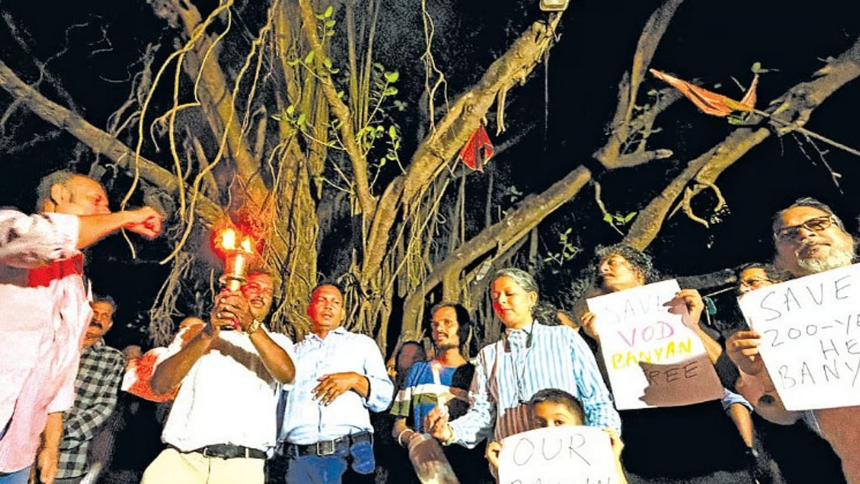
They know their protest and candlelight vigils won’t stop the in evitable . The 200 year – old banyan tree stands in the way of a multimillion- dollar six- lane flyover; and soon. its branches will be severed, reducing it to a lifeless stump before it’s finally removed. Yet, they fight. They fight till the very end, because saving even one banyan tree means giving two people the gift of a lifetime ; oxygen, hope, and a reason to believe.
Whether it is an old tree or an elderly person, both often meet the same fate; neglect.
In a world that relentlessly moves forward, anything that stands in the way is simply cast aside. Under the grand banners of progress and development, it has become almost a rule: if something obstructs the path, remove it and march ahead.

Yet, while it is true that development cannot happen without some change, it is equally true that development loses its meaning when it comes at the cost of complete environmental destruction. Fortunately, there are still those in society who understand this delicate balance and refuse to let it be trampled upon.
They fight not for personal gain, but for a future where nature and progress coexist. Some seek justice in the courts, some take to the streets, and others raise their voices in silent candlelit protests. Their struggles are often met with ridicule, indifference, or even forceful suppression by those in power. And yet, they do not give up. They persist. They endure.
The tree, which has witnessed generations come and go, now faces the risk of being uprooted in the name of progress. But those who care refuse to let it fall without a fight.
In the heart of Porvorim, nestled along the bustling NH66 highway, stands a towering banyan tree—an ancient sentinel of Goa’s ecological and cultural history. Believed to be over 200 years old, the tree has been a silent witness to the region’s transformations, sheltering generations of residents, providing refuge to diverse wildlife, and serving as a revered site of worship. Today, however, this venerable giant finds itself at the center of an impassioned struggle between development and conservation.
For months, activists, environmentalists, and local residents have rallied against the proposed translocation of the banyan tree, which is being moved to make way for a six-lane elevated corridor. Their argument is simple yet powerful: translocation is tantamount to destruction.
Protests, candlelight vigils, legal battles, and appeals to political leaders have marked their fight to preserve the tree where it stands.
A Community’s Outcry
The movement to save the tree has drawn voices from all walks of life. At a candlelight protest, Avertina Miranda of the Green Brigade made a heartfelt plea: “We have seen failed attempts at translocation in Arambol and St. Inez. Moving this tree means killing it. We urge the government to realign the flyover and let the tree remain.”
Echoing these sentiments, activist Cecille Rodrigues questioned the priorities of development, stating, “What will the future hold for our children if we continue destroying our environment? This tree is sacred, a part of our identity. Its removal is an act of pure selfishness.”
Local leader Xencor Polgi emphasized the broader significance of the struggle: “This is not just about one tree. It represents the choices we make as a society. We claim to be a land of culture and tradition, yet we are willing to erase our natural heritage in the name of progress.”