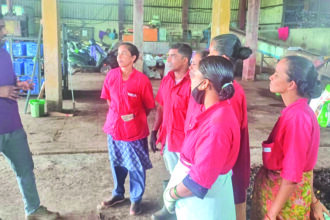
Prominent South African Architect and Professor Heinrich Wolff has recently collaborated with the students of Goa College of Architecture in preparing a module known as ‘Better Betim’ which is an architectural conjecture of the prospect of the fishing harbour in the near future.
Professor Wolff has been invited to Goa as a visiting professor to the Goa College of Architecture under the Charles Correa Chair.
Architect and Professor Wolff said, “The subject that I chose was urban externalities which refer to a concept in economics that talks about unintended consequences those economics actions on people who are not part of transactions.”
“We were looking for a place where inequality could be heightened if the wrong kind of interventions happen. Betim fishing harbour has that kind of issues. There’s a whole lot of different business trading with each other for example people selling nets, ice and fish. There is an economic interrelation that pre-exists” said Professor Wolff.
He further said that India has been rapidly increasing in inequalities and the question is how architects participate in the production of inequalities in our cities and that the main aim behind this project was to teach students the sensitivity towards the propensity on contextual capitalism to monopolise space and opportunity.
“The students have investigated the relationship between economic and urban matrices, which in turn helps in understanding of how architecture could help to chase away monetary inequality and become vigour of societal alter,” he said
A student from Goa College of Architecture who worked on the project, Pavitra Kulkarni said that “The brief that was given to us that we have proposals that will generate economy so there is an increase in the economy and our basic idea was that since Panjim caters to the commercial side whereas Betim can be called semi-urban and we wanted to retain that character. We have called some of the government officials to see the model”
Another student Aishwariya Natraj said “Our workshop was called urban externalities now this in economical terms means a transaction that occurs between A+B so if there are any profits and which actually benefit a party C is what we actually put in the model design”