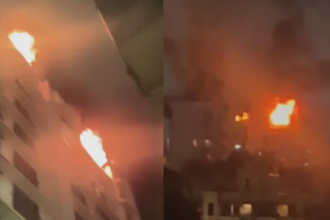
Sri Lanka’s President Gotabaya Rajapaksa declared a state of emergency from May 6-7 midnight amid protests against a massive economic crisis that has crippled the island nation mainly due to external debt. The emergency was declared by Sri Lanka President Gotabaya Rajapaksa citing “public security and the protection of public order and for the maintenance of supplies and services essential to the life of the community”.
In fact, police had to fire tear gas and water cannons at students trying to storm Sri Lanka’s Parliament as the country was brought to a halt by a trade union strike demanding the government step down. Months of blackouts and acute shortages of food, fuel and pharmaceuticals have caused widespread suffering across the island nation which has a population of 22 million. Public anger has sparked sustained protests demanding the government’s resignation over its mismanagement of the crisis. This is Sri Lanka’s worst crisis since its independence in 1948.

Also several lakh workers stayed off the job last week in a strike organised by the country’s trade union movement, with all but one scheduled train service cancelled. Private buses were off the roads while industrial workers demonstrated outside their factories waving and hanging black flags across the country in an expression of their anger against the government. Trade unions staged a nationwide strike demanding his resignation over the crisis. Over 2,000 trade unions participated in the strike against the President, Prime Minister, and the government, local newspapers in Colombo reported.
At present Sri Lanka is struggling with acute food and electricity shortages, forcing the country to seek help from its neighbours. The recession which is being attributed to is foreign exchange shortages caused by a clampdown on tourism during the COVID-19 pandemic. Sri Lanka depended heavily on tourist inflow for revenue generation. Now the country is unable to buy sufficient fuel and gas, while the people are being deprived of basic amenities as well.
With street protests mounting pressure on the government Sri Lankan Prime Minister Mahinda Rajapaksa is understood to have responded positively to President Gotabaya Rajapaksa’s request to him to quit in the face of the deepening economic crisis along with the imposition of the state of emergency in the island nation.
The Sri Lankan Cabinet had been informed that owing to the failure of the Prime Minister to cope with the country’s ongoing economic crisis, Mahinda Rajapaksa has sought to resign from his position. Naturally his resignation will also lead to the dissolution of the Cabinet. Sri Lankan media also reported that Mahinda Rajapaksa had stated that if the only solution to the persistent economic crisis in Sri Lanka is his resignation, he is willing to step down.
The Sri Lankan government had also accepted that amidst strong protests by the people it has become a serious problem to manage the economic and political crisis in the country. The crisis had resulted in an absence of tourists in the country and to top it all, the closure of factories had also piled up the burden on the already prevalent economic crisis. Sri Lankan Cabinet ministers like Prasanna Ranatunga, Nalaka Godahewa, and Ramesh Pathirana, have all agreed to Mahinda Rajapaksa’s decision of resigning as the Prime Minister of the country. However, in contradiction Minister Wimalaweera Dissanayake had stated that Mahinda’s resignation will prove futile in dealing with the country’s crisis as the resignation will not solve the real issue.
Meanwhile, last month Indian High Commissioner to Sri Lanka Gopal Baglay informed the Sri Lankan government that India has so far extended support worth US Dollar 2.5 billion to Sri Lanka over the last few months to overcome the economic crisis. He recalled that the focus has been on support for currency-currency swap; extending credit for fuel and food and energy sector.
In a laudable gesture, a girl from Tamil Nadu’s Ramanathapuram has donated her piggy bank savings of Rs 4,400 to Sri Lanka, to help overcome their worst economic crisis. The chief minister of Tamil Nadu, MK Stalin, had also announced a contribution of Rs one crore from Dravida Munnetra Kazhagam (DMK) to the state fund for Sri Lanka. Tamil Nadu Congress Committee president KS Alagiri called on Chief Minister MK Stalin recently and handed over a cheque for Rs 10 lakh towards the aid to Sri Lanka. While money is trickling in, ranging from individuals, political parties and even governments from India, the question remains that it will not be enough for Sri Lanka to overcome their crises soon. With more than US Dollar 50 billion in external debt and a shortage of foreign exchange reserves, the country is currently struggling to pay for essential imports for their daily needs.