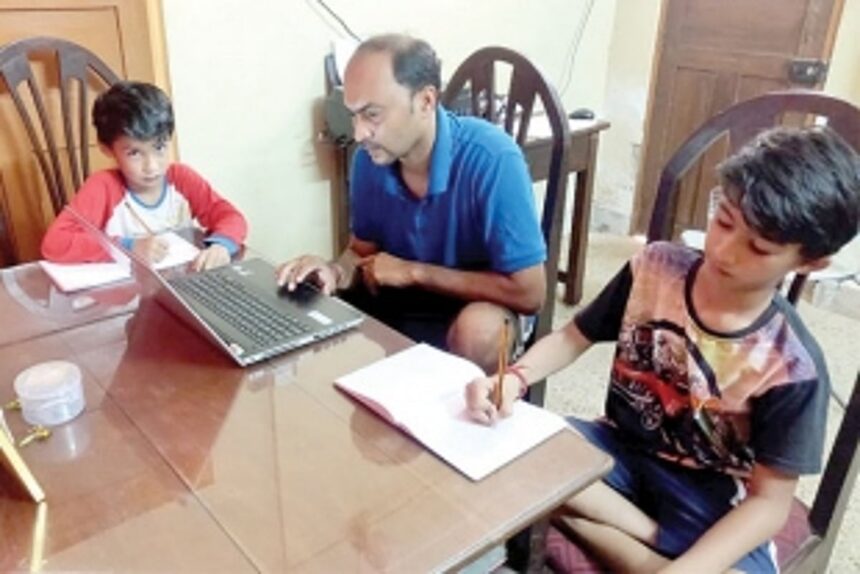
ork from home (WFH) has always been considered as perfect option for those people who always want to create a perfect balance between their work life and personal life. With the growing popularity of WFH concept more, more people are adapting to this concept. But there are very few companies who allow their employees to work from home and in India there are barely five of them. But, with this ongoing lockdown period, the entire workforce barring few, who are in essential services and manufacturing units, are now forced to work from home.
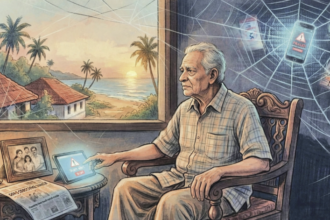
Rohini Gonsalves, Founder of Sevarat Senior Care which provides home healthcare services for the elderly across Goa believes that while work from home may be a great solution for several businesses, it is not even a viable option for them at Sevarat. “It is a more appropriate option for core technology and technology enabled businesses while we provide home healthcare to senior citizens. While I do not undermine the need and use of technology, it is in times like these, that one realizes the need for Human Touch over technology,” said Rogini Gonsalves.

Sevarat has been serving the people of Goa for almost five years now as well as delivering home healthcare for the elderly most of who are bedridden. Most of their consumers live alone or with an elderly spouse and cannot manage without the assistance they provide.
“Given the fact that the lockdown was first declared for just one day and then was extended to a 21-day –lockdown period; our customers have been most affected because of their inability to venture out and procure groceries, medical supplies like diapers and medicines. It is critical for us to ensure that nothing causes panic for our customers and their families. Hence, we ventured to support the elderly and their families in every way we can. We had to go beyond the scope of our usual work and provide all the help we could to the people we serve. So there is no ‘Work From Home’ for us as we continue to provide the best quality of professional healthcare services even in these very trying times,” added Rohini Gonsalves.
Nitin Kunkoleinker, Director of Synegra EMS Ltd and past President of Goa Chambers of Commerce and Industry (GCCI) believes that those in manufacturing operations cannot have work from home culture except for those who are non-technical people. “The two options are either to manufacture at a low scale or to completely shut down. Work from home is suitable for Information technology etc. However, it is true that fear psychosis is so high that supply chain has been disrupted. Many products used to come from China which is totally disrupted. In the last two months many manufacturing units have scaled down their production. The government is talking about creating a parallel and alternate supply system, which is not possible as it takes ages to create that system and the crisis is huge now and time is important. There is no magic wand,” said Kunkolienker.
Former President of GCCI and a noted Chartered Accountant, Sandip Bhandare is of the opinion that it is human nature to have resistance towards change, and the recent announcement regarding the lockdown in Goa due to COVID-19 was no exception. “Unlike say an IT Industry, Chartered accountants in practice usually do not have the luxury or habit of working from home due to the inherent nature of our work, which involves verification of physical documents and assets. But we have braced ourselves to accept the new normal of working from home.” said Bhandare.
The world of digitalisation has tremendously helped bridge the gap. Email interactions, video conferencing, remote access to accounting packages, digitally signed records, RFID tagging of assets have certainly aided our working from home. Apps such as Skype and Zoom have made it easier to take real time decisions with all the stakeholders.
“Ticking figures with a green pen on a physical paper gives Chartered Accountants more of a mental satisfaction. We have however, consciously embraced technology in many of our office working. The lockdown experience has only put us on an accelerated path towards this digitalisation. Working at home in the company of our dear ones and in the comfort of soft cushions and armchairs, we realise that while this cannot presently be a full substitute to the range of work that we do, this could be the precursor to the future of a fully connected world,” added Sandip Bhandare.
FMCG, which includes processed food industry believes that though the Goa government has notified certain essential services, products etc which are essential for survival and social distancing was felt essential, they decided to hold back certain employees who could manage to work from home.
Sanjay Bhandari, Corporate Affairs Manager, Nestle India Ltd and Chairman Ease of Doing Business committee at CII and Industry Committee at GCCI, said, “Our all employees from our head office and branches in metros were directed by the head of our organization to strictly work from home. Work from home definitely was bundled with huge uncertainties and big questions are what next and till when and what to do? Definitely a concern that made one bother was about family, society, work place and the expected hardship that could arise.” For an FMCG company, huge amount of energy is invested in planning various aspects of business and strategizing on movement of men and material. Further, govt approvals are required to start the essential services which was just challenging as many had no clue how to reach the concerned office without a transit pass. With time things are stabilizing and people are getting used to new way of leaving “Home quarantine”. “We individually need to behave more responsible and not panic which will be in the interest of our state and country,” added Sanjay Bhandari.
From the industry perspective this slowdown is a huge challenge and together with the support of all stakeholders it would need to collectively fight the battle for better tomorrow. Working from home is now essential for many of us and technology has made it bit easer but challenges in parts were definitely felt.
“We need to ensure that employee salaries are remitted within the prescribed time in such crises time so that there no cash crunch faced by employees,” Bhandari added further.
Lalit Saraswat former Chairman of CII, Goa Chapter and CEO Sancoale Technologies took a smart decision, and got himself and his team prepared before the actual lockdown was announced. “A week before the lockdown was announced, we at Sancole Technologies at Vasco had a dry run and tried to connect from home with each of our employees and this was only because many people around the world were talking about work from home. What we realized during the dry run was issues of network and devices at home so we had to tweak a little bit to set it right. So we were prepared for this long period as we assumed it by observing the trend of COVID-19. So we are not badly hit and in my case it is simpler as we are delivering the services through the internet and as long as connectivity is good we do not have any complaints,” said Saraswat.
He further said that now when they are working from home, they not only talk about work as a priority but we also ask about the family wellbeing during the talk which normally does not happen in office.
“Things will change after a month and people will accept the concept of work from home and we all will be better equipped to work from home in coming months. The scenario and concepts will surely change after this experience of lockdown,” added Saraswat.
President of the Goa Technology Association (GTA), Mangirish Salelkar feels that they are facing an unprecedented situation as COVID-19 ripples have been felt across the globe. In Goa, most of the IT and ITeS companies have smartly chosen to ‘Work from Home’ (WFH) ever since the advisory from Government, NASSCOM and STPI were published.
“The IT industry has an advantage of being agile. While challenges in existing infrastructure needs to be dealt with, the Goan IT industry is coping as best it can to maintain itself and keep the engine running. At GTA, over 80% of our members are working from home. Some unfortunately do not have that option. We are hopeful that the situation resumes to as near normal as possible and the govt has its processes in place to get the situation as near normal as is possible. We definitely have learnt a lot from this crisis. Business continuity planning is no longer just an obscure probability but has become an evident necessity. 70% of Goan IT businesses have clients across the globe. While economies of the US, UK, the EU and Australia are reeling due to the effects of this pandemic, we have no choice but to weather the storm,” said Mangirish Salelkar.
Ashutosh Kharangate, Managing Director of Mangal Analytics and Research Consulting Pvt Ltd (MARC) understand that India has been aping the western countries since a long time. When companies in India saw them having swanky offices, the companies decided to invest a lot of money into them. Either they buy them and spend a fortune on their interiors or rent them but still make the interiors lavish.
“I run a consulting company and for me it never made sense. If I buy an office I run the risk of outgrowing it. If I rent and spend a lot on interiors, I run the risk of losing it when I move to a different office. When the west came up with the concept of co-working spaces we quickly adopted that. We thought it was a cool thing. Well it did make sense up to a certain size of operation as you were saving on the fixed costs like rent, electricity and other operational costs,” said Kharangate.
He added that the west came up with the concept of work from home we thought that was cool as well. “In my opinion for a country like India with its population size, traffic and parking issues and scarcity of resources work from home makes a lot of sense. This forced scenario due to COVID-19 has given us an opportunity to explore this. In our organization we decided to go for a work from home from the March 23. We had a policy before that to allow work from home for two days a month for each employee irrespective of the cadre. In fact for one of our star employees who travels for about 45 kilometres one way, we had worked on a three days a week work from home model way before this incident. I truly believe work from home makes sense in our country as a lot of energy in form of resources gets spent on the travel,” said Kharangate.