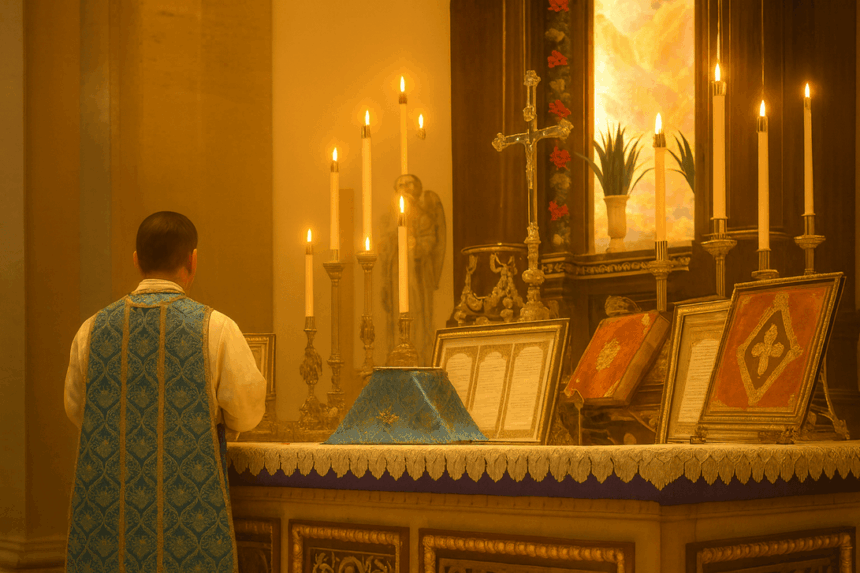
In a remarkable and historically rich liturgical tradition, the Cerulean Indult stands out as one of the Roman Catholic Church’s most distinctive privileges, allowing the use of cerulean blue vestments for Masses celebrated in honor of the Immaculate Conception of the Blessed Virgin Mary. This exception, which applies to feast days, octaves, and votive Masses dedicated to Mary’s sinless conception, departs from the standard Latin Rite norms in which blue vestments are otherwise prohibited.
This unique indult was first granted to Spain, whose deep devotion and theological advocacy played a central role in shaping global Marian piety. From there, the privilege was extended to Spain’s former colonies, including the Philippines, Latin American nations, and additional territories once under the Spanish Crown, preserving a centuries-old expression of Marian honor.

A Tradition Rooted in History
The origins of the Cerulean Indult trace back to Spain’s long-standing defense of the dogma of the Immaculate Conception, formally proclaimed by Pope Pius IX in 1854. Its usage was solidified when the Sacred Congregation of Rites, on February 12, 1864, affirmed Spain’s right to use cerulean vestments for liturgies honoring the Immaculate Conception.
Even earlier, in 1760, Pope Clement XIII had already acknowledged Spain’s profound Marian devotion by permitting the use of light blue vestments during the feast’s octave and in votive Masses. This early permission laid the foundation for what would eventually become a signature Spanish liturgical custom.
Extension to the Philippines and Beyond
The indult was further carried into the 20th century when Pope St. Pius X, on February 11, 1910, issued a specific confirmation for the Philippines. This followed a petition from the First Provincial Council of Manila, forwarded to Rome through Cardinal Rafael Merry del Val, then Secretary of State.
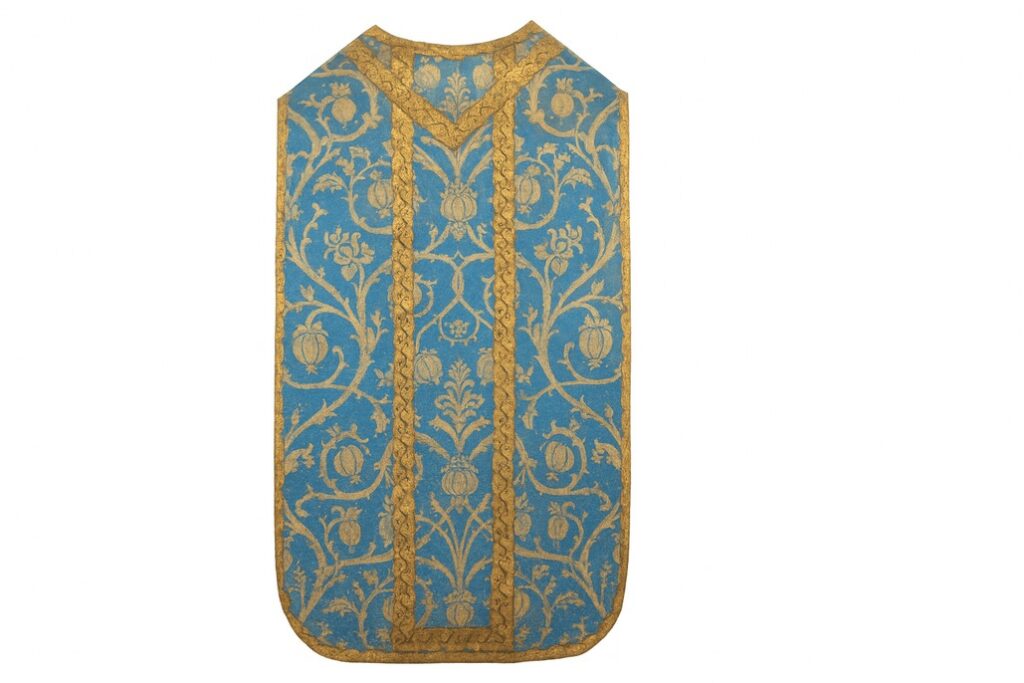
As a result, former Spanish territories such as Peru also continued the tradition. Historical artifacts, including 19th-century cerulean silk vestments embroidered in silver, preserved in Franciscan convents bear witness to the indult’s widespread acceptance and devotional beauty.
Liturgical and Symbolic Significance
The Cerulean Indult specifies cerulean, a light azure shade distinct from penitential purples or darker blues. Its selection reflects both the pigment limitations of the 18th and 19th centuries and the theological symbolism attached to Marian devotion.
Cerulean blue evokes the blue cloths covering the Ark of the Covenant, a symbol embraced by centuries of Christian tradition to signify Mary as the new Ark, carrying the Incarnate Word within her. Unlike darker hues associated with penitence, cerulean represents grace, purity, and divine favor, qualities long attributed to the Blessed Virgin.
Modern Use and Liturgical Presence
Today, the privilege remains in effect in Spain, the Philippines, and select former Spanish realms. While the indult permits cerulean vestments for all liturgies honoring the Immaculate Conception, their use is not mandatory; white vestments remain fully acceptable.
In the Philippines, historical liturgical ordines extending as recently as 2018, even for celebrations under the 1962 Missal, continue to list cerulean as the liturgical color for these Marian feasts. Some Marian shrines worldwide hold similar special permissions, though none match the breadth of the Spanish indult.
A Living Legacy of Marian Devotion
More than a simple color privilege, the Cerulean Indult reflects centuries of Marian theology, Spanish liturgical identity, and global Catholic heritage. Its continued use today preserves a vibrant tradition that honors the Immaculate Conception with beauty, symbolism, and deep historical continuity, standing as a luminous tribute to Mary’s unique role in salvation history.