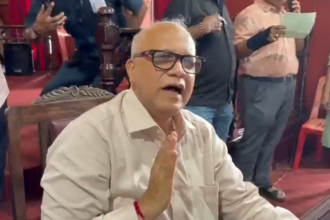
What made you come out at this moment all of a sudden and appeal to the people to start a united people’s movement to protect Goa? A: It is not sudden. For the last six to nine months, I have been coming to Goa and speaking on these issues at least at three or four forums where I was invited. I articulated what can be done and what I am now saying. After reading in your O Heraldo paper about the Arambol issue, that really made me think why people must fight for their rights. What are they fighting for? They are fight ing for their culture and heritage. Must people go on fighting for their culture and heritage? And to pre serve the hills? That was the point when I said, let me speak out. I gave my mobile num ber and people contacted me. I said okay, let me act as a fulcrum. I am not a leader. I am a fulcrum to bring everybody together — activists and NGOs who have been fighting earlier, new persons, and now sud denly everybody. There is an awakening. I drafted a charter and shared it with my colleagues. Can you tell us about the charter? A: The charter comprises 10 points that we will dis cuss during the meeting. These are more or less what I have been telling the press — saving forests, saving rivers, stopping and protecting large-scale conversions of land, paddy fields and orchard lands. Then there are offshore casino vessels in the River Mandovi which really hurt. Every successive govern ment says they will remove or relocate them and no body does. These are prom ises made to the people. When I was a lawyer, I re member that every Novem ber, December and January, boys used to participate in swimming competitions and cross the river. Today the river is full of E-coli and nobody can swim there. They have no right to anchor these vessels in the river. Earlier there were barges — that was naviga tion. What is now there is not navigation. These ves sels have to go. They cannot remain forever. Tomorrow (Tuesday) these issues will be put forward in the char ter. Hopefully there will be discussion because these concern all of us and the fu ture of our children. I want to form a broad coalition.
Can you tell us about the coalition? A: I plan to constitute a coalition of all NGOs and activists. It is not that I want political parties out of it. They are part of the system. But they will not be in our committees. The coalition will only consist of NGOs and activists, and politi cians will not be office-bearers in the coordination group. At most they can be activists, even if they have political affiliations. Across parties there are people who agree, though some may not speak out, out of fear. We want the support of everybody, but the leadership will be with NGOs and activists. What would be the nature of this movement? A: It is not a political movement. It is a movement to save Goa — its land, rivers and hills. It cuts across political is sues. How do you plan to take this movement forward? A: We must involve youngsters and women in large num bers. Women are a strong motivating force. When they be lieve in something, they move out and create impact. The protests give a picture that only a particular com munity is participating. Comment. A: After I spoke, newspapers and TV channels articulated it. That shows it is in everybody’s heart and mind. What should have been done, somebody has spoken. Now it must be converted into a mass movement. In future meetings, in every village, people must come together on common is sues so it becomes a true mass movement. Are you optimistic that it will happen? A: Is it possible? In my dictionary and vocabulary there is no word called impossible. Let us see how many people come tomorrow (January 6). We will prepare a list of NGOs and activists present. After that, we will form a coalition. It will not be immediate because we must scrutinise and select people. More names will be suggested. After a week, we will work it out. For now, a few of us have come togeth er and are working on it. People are saying this is your comeback to politics. A: I have occupied the highest post of Chief Justice of the Allahabad High Court. After retiring in 2011, a party func tionary approached me before the 2014 Lok Sabha polls. I will not name the party. He met me in Mumbai and asked whether I was interested and whether I would preside over a meeting in South Goa. I said namaskar and told him I do not do these things. I have been an MLA earlier and I have closed that chap ter. I am not interested in electoral politics. I took an oath on the Constitution and I will not come back. There are reports that you are opening your Panjim of fice and restarting practice. A: I am opening an office to help genuine NGOs by giving legal advice, which I have always done. I cannot use my res idence, so the Panjim office will be available. I will be there five days a month and on other days interact through video conferencing. There will be a secretary and I can always be contacted. I am not going to make money; I will spend from my pocket. I still have arbitration work in Mumbai, though reduced. I brought my camera to Goa to visit jungles and see birds and animals, but you mostly see wild boar and bison here. This office is for NGOs and it is my commitment. I will not give individual advice — it must be for a larger cause. How was the political situation during your brief stint as MLA in 1977? A: Corruption was practically zero. There was morality. We had not lost our moral compass then.