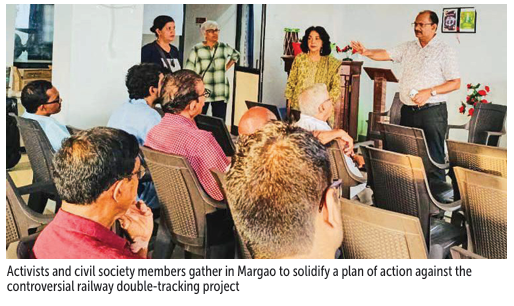
A single allega tion, delivered bluntly at a packed meeting in Margao, has come to define the grow ing resistance to the railway double-tracking project — that the State’s development push is running ahead of both due process and public consent. Without a single land acquisition document, the Railways bulldozed a second track through Velsao village. That act of impunity — al leged by anti-double track ing activist Orville Dourado at a charged meeting in Mar gao — has come to symbol ise everything the growing people’s movement against the Collem-Margao railway double-tracking project is fighting against. “They had no document to stake claim on the land,” Dourado told the gathering, “but they bull dozed their way through the property owned by the peo ple of Goa.” It is that sense of being steamrolled — by the Rail ways, by the State govern ment, by opaque clearance processes — that is now fuelling a State-wide mobilisation. Activists, villag ers, former legislators and civil society groups who assembled in Margao have set their sights on April 16, when a crucial hearing at the Matanhy Saldanha Ad ministrative Complex will offer the movement its most visible test yet. The message from the meeting was un ambiguous – come in large numbers, or lose the fight by default. The campaign slogan adopted — ‘Be on the Right Track, Amkam Naka Double Track’ — is both a rallying cry and a direct rebuke to an administration that has so far heard the protests and proceeded regardless. The State government, meanwhile, is pressing ahead. Having seen its first bid for forest diversion clearance rejected, Goa has returned to the Union Envi ronment Ministry’s Region al Empowered Committee (REC) in Bengaluru with a fresh application — seeking revocation of an abeyance order that has stalled the diversion of 15.6 hectares of forest land in and around the Bhagwan Mahavir Wild life Sanctuary. The REC has again pumped the brakes, pointing to critical gaps in the Wildlife Institute of In dia’s assessment and ruling that mitigation measures alone cannot justify clear ance without a rigorous eco logical reckoning. The gov ernment is pushing a project that its own regulatory gate keepers find unready.
For those on the ground, the environmental stakes are inseparable from a deeper political grievance. Former MLA Alina Saldanha framed the asymmetry starkly, arguing that the project “primarily benefits regions outside the State while local communities bear the impact” — a pointed ref erence to widespread suspicion that the double-tracking exists primarily to accelerate coal movement through Goa, not to serve Goans. Historian Prajal Sakhardande urged the gathering to shed any sense that this remains a village-level dispute. “Broader public participation would be key to forcing a re think on the project,” Sakhardande asserted, insisting that the agitation must evolve into something the State cannot contain or dismiss. At the meet NGO Goencho Ekvott was mandated to lead coordination and public outreach. Activists Swithun An drade and Zarina D’Cunha, writer Jose Miranda, activist Bala, Camilo Fernandes of the Goa Railway Employees As sociation, Adv Hrudaynath Shirodkar, and former sarpanch of Cansaulim, Arossim and Cuelim, Martha Saldanha were among those committing to the sustained, expanding re sistance.