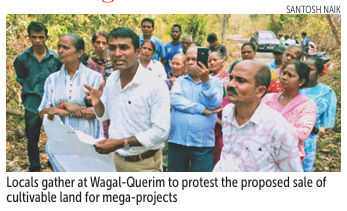
Tensions are mounting in Querim as local residents of Wagal have threatened to launch a massive agitation against proposed mega-projects and the plotting of culti vable (Aframent) land for sale to outsiders. Asserting that these developments would irre versibly alter the village’s identity and demography, locals have already de cided to install warning boards at the village en trance to deter potential buyers and have issued a direct challenge to land lords to prove the legiti macy of their ownership records. During a protest, the lo cals, supported by promi nent social activists, main tained that they will not allow the demography or identity of Querim to be altered by large-scale com mercial developments.
The locals alleged that an cestral village lands—culti vated by residents for gen erations—were transferred into the names of a few private entities through ma nipulated revenue records Addressing a press briefing, social worker Swati Kerkar highlighted the village’s long history of resistance, recall ing the 1996 agitation against the Nylon 6,6 project, where a local youth was martyred, as well as subsequent fights against SEZ and IIT projects. “These hills are rich sources of water, springs, and lakes essential for our Bagayats (or chards). We have fought for decades to protect this land for future generations,” Kerkar stated. She warned that any at tempt to push through a mega residential project on land traditionally used for farming would be met with fierce re sistance.

Activists Ramkrishna Zalmi and Dinesh Gaude delved into the legal and historical discrepancies surrounding the nearly two lakh square metres of land in question. Zalmi alleged that the land, classified as Aframent (cul tivable), cannot be legally sold under current laws. He claimed that the land was originally cultivated by villagers but was “wrongfully recorded” in the names of revenue clerks during the colonial era, who are now posing as land lords to sell the property. “The villagers have already passed a resolution to pro tect this land. Our environment, water security, and village peace depend on it,” Zalmi said. Dinesh Gaude invoked the traditional Gaonkar system, asserting that the villagers who cultivated the land were its true owners.
He argued that the Portuguese administration introduced taxes, which allowed individuals with vested interests to manipulate records. “Form 1 & 14 survey records do not automatically prove ownership. We are challenging these so-called landlords to prove how this land was transferred to them. The villagers are the real owners, not tenants,” Gaude stressed.