SHASHWAT GUPTA RAY
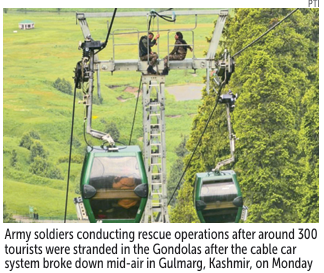
Proper training, coordination and peak physical and mental fit ness of the soldiers re sulted in the successful mass rescue of over 300 tourists stranded mid-air when the Gulmarg Gon dola system broke down above 14,000 feet on Monday, said Lt Col Austin Collaco, Goa-based Kargil conflict veteran and for mer instructor at the High Altitude Warfare School (HAWS), which spear headed the rescue opera tions. HAWS led the rescue efforts alongside the 19 Division of the Indi an Army, State Disaster Response Force (SDRF), National Disaster Re sponse Force (NDRF), and local civil adminis tration to ensure rapid deployment and medi cal triage for those res cued. Utilising advanced mountaineering and high-altitude rescue skills, HAWS operators deployed specialised ropes and equipment to safely rappel and evacu ate civilians suspended in the air. “The Gondola has large footfalls and the view the ride offers is mind-blow ing.

It takes you to the top of Apharwat peak on the Pir Panjal rang es. Rescue operations in the mountains require detailed planning due to weather conditions, and HAWS has the expertise to operate at high alti tudes. This led to the successful extraction of all tourists before last light,” Lt Col Collaco said. Speaking about the training and equipment specialisation available with HAWS, the former instructor at the School said that it conducts mountain and winter warfare courses for the Armed Forces “A lot of its training curriculum is related to descending from cliffs, overhangs, helicopters etc. Approaching and reaching the site is equally important. The equipment is familiar to the personnel undertaking the operations viz. ropes, carabiners, knots, lashes and descenders,” he said. He said that to plan and execute such a rescue operation, reconnaissance of the site or the configuration of the cable and the cabins is important. “The condition and age of the tourists have to be as sessed. Wind and weather conditions are to be assessed. Availability of needed equipment has to be assessed. Syn ergy with SDRF/NDRF personnel and civil authorities and medical assistance are all required to make the final plan,” Lt Col Collaco said. Firstly, someone would need to reach the Gondola cab ins.
This could be by aerial means and monkey crawl on the steel rope. Second step is entering the cabin. Technical and mechanical knowledge helps. The tourists need to be convinced that they are safe and will be out soon. “The actual rescue is then planned with ground forces. Priority is to evacuate the sick, aged, children and ladies first and then males. Rescue is done in tandem for those who need help. Others are strapped to a harness and low ered using controlled descending. Ladders are another means of rescue. However, all this depends on weather conditions. Once descended, medical check-up is a priori ty,” the Kargil conflict veteran said. However, there are plenty of challenges involved. First is making the troops ready, briefing them and getting the equipment to the site. Luckily the site was not far from HAWS. Secondly, coordination with civil administration.
Thirdly, fighting the prevailing weather conditions. “It was raining and a hailstorm was blowing. Winds were strong and twilight was just five hours away. The combi nation of swaying cabins, near zero visibility during the heaviest hail bursts, and freezing weather at single-degree temperature, forced the multi-agency teams—including the Indian Army and SDRF—to physically crawl along the main high-tensile cables and utilise secured manual rope and-ladder vertical lowering under highly unstable atmos pheric conditions,” he said.