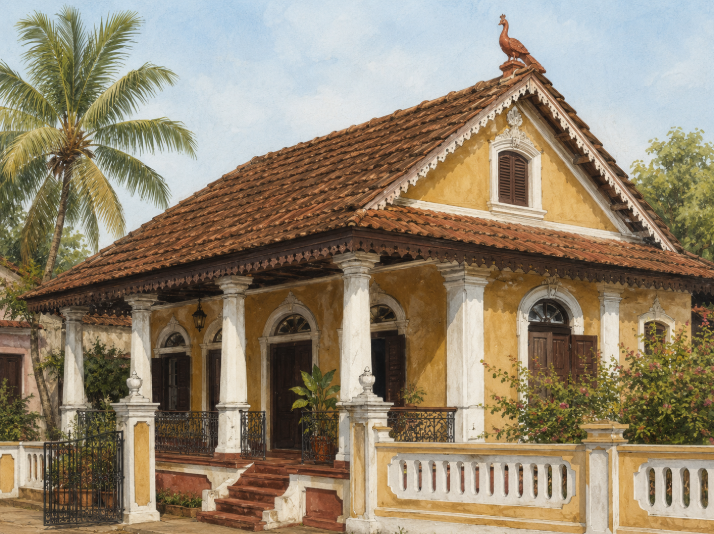
Goa’s heritage is uniquely beautiful and deserves far more attention than it currently receives. Beyond its beaches and churches lies a living culture quietly breathing through old streets, tiled roofs, ancestral homes, and forgotten symbols that many pass by without noticing.
Every corner of a Goan street has a story to tell. Some of these stories may never be found in books or archives, yet they continue to survive through generations by word of mouth, whispered by grandparents on balcãos, remembered during village feasts, and carried in the hearts of people who still cherish the soul of Goa.

As one walks through the villages and towns of Goa, one may notice small terracotta figurines placed carefully on rooftops, compound walls, gateways, or even water reservoirs known locally as gurgulethas. These are not merely decorative pieces. Each figure carries meaning, identity, belief, and history.
Among the most commonly seen are the rooster, policeman or soldado, lion, peacock, and elephant all moulded from humble clay, yet deeply symbolic.
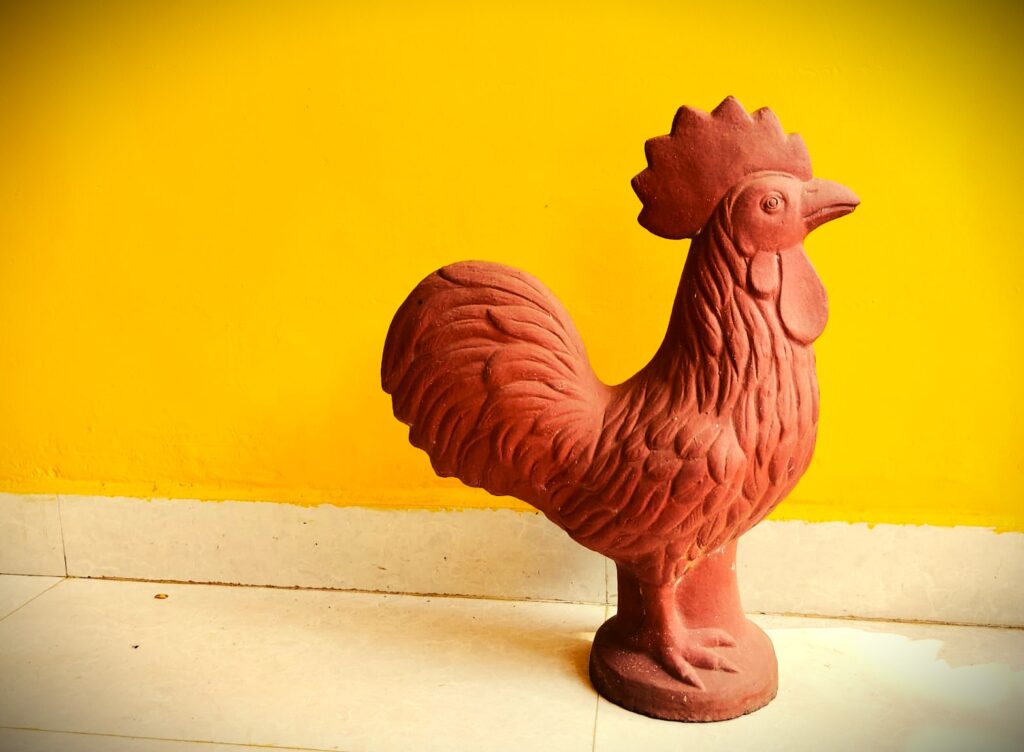
Photo credits: Eufémia Rodrigues
The Rooster: The Symbol of Faith and Justice
Perhaps the most iconic of all is the rooster, or Kombo as it is locally known.
Its origins trace back to the Portuguese town of Barcelos. According to legend, a poor pilgrim travelling to Santiago de Compostela was falsely accused of theft. Despite repeatedly declaring his innocence, he was sentenced to death by hanging.
Before his execution, the pilgrim requested one final meeting with the judge, who at the time was enjoying a grand banquet with friends. Desperate to prove his innocence, the pilgrim pointed towards a roasted rooster placed on the dining table and declared:
“As surely as I am innocent, that rooster shall crow if I am hanged.”
The guests laughed at what seemed impossible. Yet as the execution began, the cooked rooster miraculously stood up and crowed loudly. Shocked and realizing the terrible mistake, the judge rushed to stop the hanging and saved the innocent man just in time.
Years later, the pilgrim returned to Barcelos and erected a monument in honour of the Virgin Mary and the miraculous rooster that saved his life. That monument, the Cruzeiro do Senhor do Galo, still stands today in Barcelos.
Over time, the rooster evolved into a national Portuguese symbol, eventually finding its way into Goa during Portuguese rule. Today, the Kombo continues to sit proudly atop Goan homes and on gurgulethas as decorative water spouts.
For many, the rooster may also have represented loyalty and respect toward Portuguese governance in Goa.
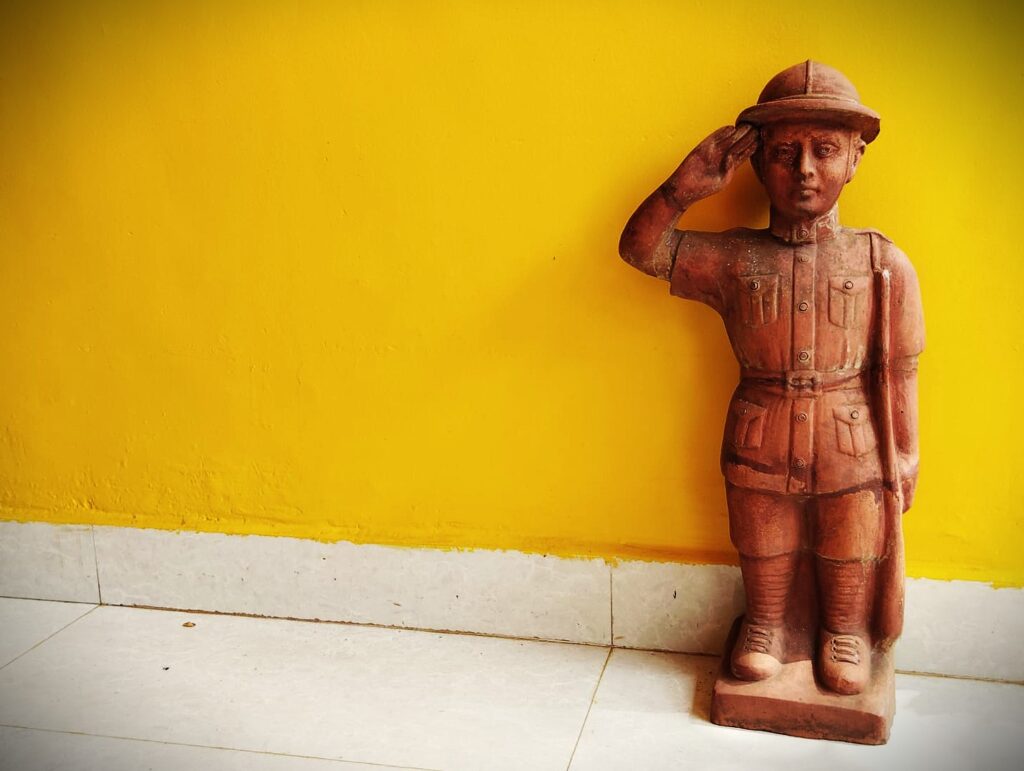
Photo credits: Eufémia Rodrigues
The Policeman or Soldado: A Reflection of Identity
Another commonly seen figure is that of the policeman or soldier, locally referred to as the soldado.
These figurines may have symbolized identity and social standing. It is believed that many of them were installed by Kshatriya families, known among Catholic Goans as Chardos, who historically belonged to warrior lineages.
The soldado possibly reflected courage, discipline, and pride in one’s ancestry. At the same time, it may also have served as an expression of solidarity with the Portuguese administration during colonial times.
Standing tall on gateways and rooftops, these figures silently guarded homes while also narrating the complex blending of local identity and colonial influence that shaped Goan society.
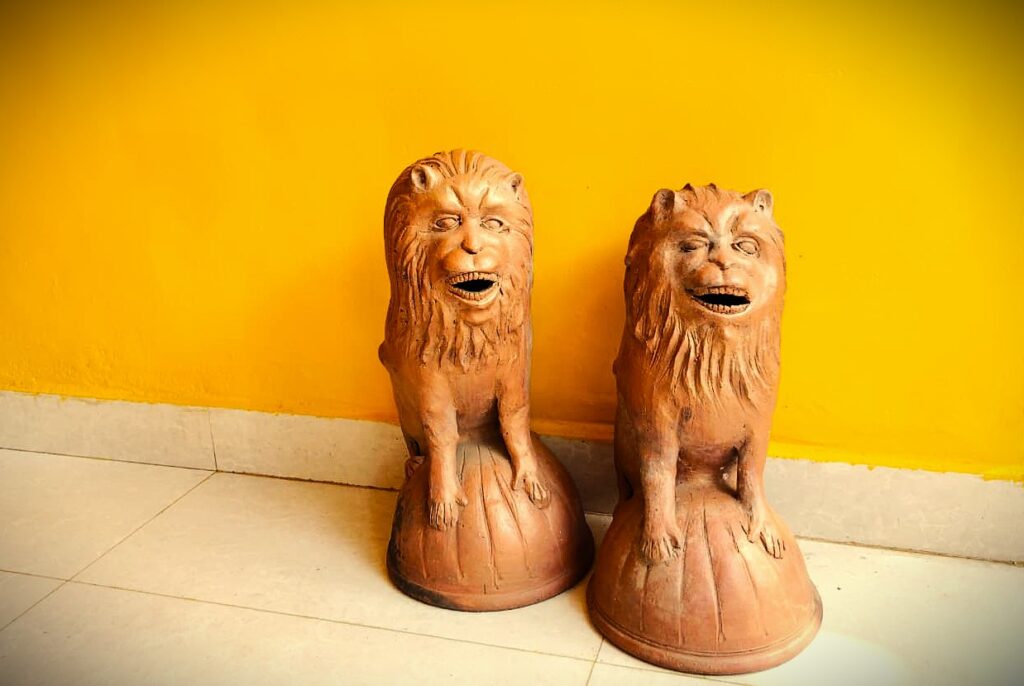
Photo credits: Eufémia Rodrigues
Lions: Guardians of Power and Prestige
Lions placed at gateways often symbolized authority, strength, and the influence a family held within society.
For households, the lion represented power and prestige, almost like a silent declaration of status and dignity.
Some also believe these lion motifs may have roots in the Kadamba dynasty, which ruled Goa between the 11th and 13th centuries. The Kadambas frequently used lion imagery in architecture and royal symbolism, and traces of that influence may still survive in Goan homes today.
Thus, even a simple clay lion on a gateway becomes a bridge between Goa’s ancient Indian past and its later Portuguese era.
Peacocks: Beauty, Divinity, and Eternal Life
The peacock, graceful and majestic, carries layered meanings across cultures.
Along the Konkan belt of India, peacocks are revered as symbols of beauty, royalty, immortality, and divine protection. Their elegance naturally inspired their inclusion in traditional art and architecture across Goa.
Within Christianity too, the peacock symbolizes everlasting life and resurrection, making it a meaningful figure in many Catholic households.
Placed atop walls or roofs, the peacock became more than decoration it represented grace, prosperity, spirituality, and the timeless beauty of life itself.
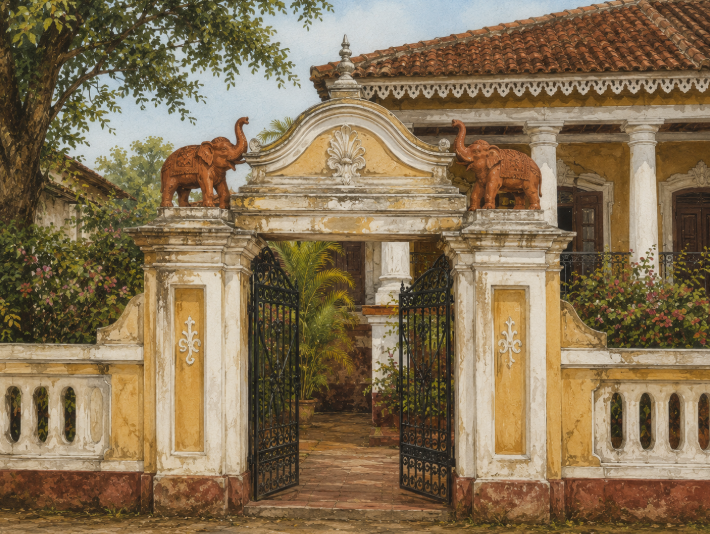
Elephants: Protectors of the Home
In Indian culture, especially within Vastu Shastra, the traditional Indian science of architecture elephants are considered guardians of the home.
Figurines placed near entrances are believed to ward off negativity, attract good fortune, and invite abundance into the household.
Strong yet gentle, elephants symbolize wisdom, protection, stability, and blessings. In Goa, where Indian traditions beautifully intertwined with Portuguese influence, the elephant naturally found its place among the symbolic figures guarding ancestral homes.
More Than Clay and Terracotta
These figurines may appear small and ordinary to an outsider, but to Goa they are fragments of memory.
They reflect a land where Indian traditions and Portuguese influences did not merely coexist but merged to create something entirely unique. Every rooster, lion, peacock, elephant, or soldado quietly speaks of migration, faith, identity, pride, folklore, and survival.
Sadly, many of these symbols are slowly disappearing as old homes are demolished and modern architecture replaces traditional aesthetics. Along with the structures, generations of unwritten stories risk being lost forever.
Goa’s heritage is not found only in monuments and museums. It lives in its homes, its streets, its oral histories, and in the silent terracotta guardians watching over villages for centuries.
Perhaps it is time we begin noticing them again.