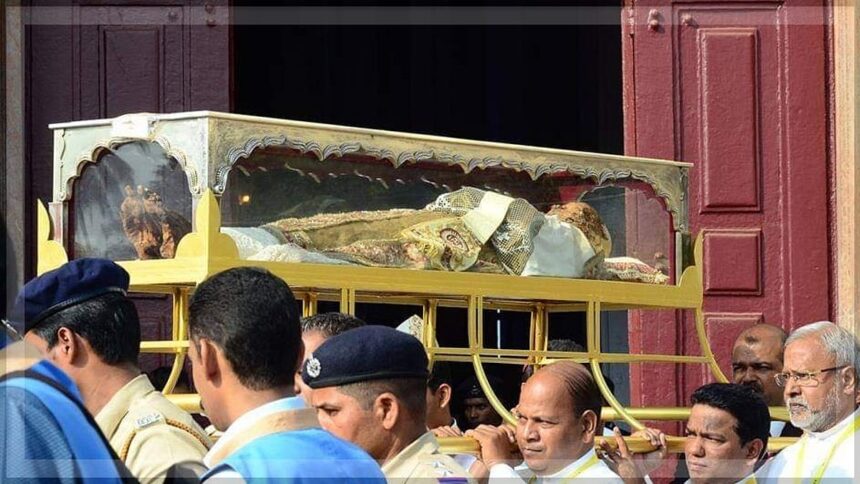
Following the Exposition of 1952, D. José da Costa Nunes, Patriarch of Goa, determined that the sacred relic should no longer be directly handled by pilgrims due to its fragile condition. Consequently, an order was placed with Casa Brandizzi in Rome for a crystal or highly transparent glass urn to encase these relics. On January 30, 1955, engineer Ettore Brandizzi arrived in Mormugão via Lisbon aboard the ship ‘India’, bringing with him the crystal urn set in a silver frame, which reportedly cost Rs 60,000.

On February 2, the old wooden coffin, which had housed the sacred relic since 1744 within the Mastrillian casket, was transported to the upper hall above the portico of the Professed House of Bom Jesus. It was opened using the three keys held by the Patriarch of the East Indies, the Governor-General of Portuguese India, and the Administrator of the Basilica.
For a duration of ten days, the engineer focused on transferring the holy relic from the wooden coffin into a crystal urn. He was instructed not to use any wax or plastic materials, as had been done in some permanent displays of relics of various saints. It is noteworthy how Italians consistently appear at significant moments in the history of St Francis Xavier’s Shrine. On February 13, 1955, the lid of the crystal urn was placed and sealed with the seals of the Patriarch, D. José Vieira Alvernaz, and the Governor-General, Paulo Bernard Guedes, affixed on either side as well as at the head and feet of the Saint’s relics.