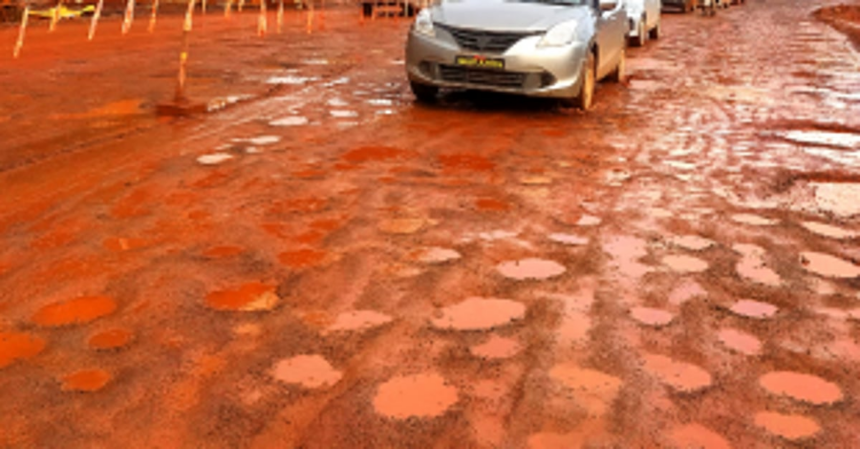
Driving on certain roads in Goa can at times best be described as a cross country experience that leaves the cars much worse for wear and the drivers exhausted by the effort of keeping the vehicle on the road.
The monsoon is coming to an end. It has rained this year more than any other in the last 100 years. And the roads have taken a beating, or rather that’s the excuse that the authorities will give for the pathetic condition of the roads. But, while nature may have weathered the roads, what is more pertinent is the quality of work that went into making and repairing the roads.

This is not a new phenomenon, and every year after the monsoon ends the roads in the State need to be repaired. The potholes are filled up with a mixture of hotmix that gets loosened quickly, the pothole reappearing almost immediately after. And herein lies the fault. The work is undertaken by contractors and the patchwork is so cursorily undertaken that it washes off with just a little rain and sometimes even before the monsoon begins. There are no quality checks on the materials used, the mixtures made and no inspection of the work being undertaken.
That is what happens in Goa. In Chennai it is different. The Chennai corporation, about six years ago,set up an inhouse department to test the quality of road construction. In 2019, the Karnataka High court declared in a judgement that the right to reasonably good footpaths and roads is a fundamental right of citizens under Article 21. The court went further to state that citizens can approach the High Court to seek compensation for loss or damage that has occurred due to bad footpaths and roads. It noted that since the municipal corporation (this is in Karnataka) is statutorily obliged to construct, repair and maintain roads, the citizens have the corresponding right to enforce these obligations on the part of the corporation.
In Goa, it is not the municipal corporations that builds roads, but it comes under the Public Works Department. However, Goa has neither a road construction quality test, nor is there accountability in government departments that holds officers responsible for the bad quality works, and therein lies the fault.
The reason for this is because the administrative system is as potholed as the roads. Very simply, there is no accountability in government. What Goa needs is a body – perhaps even a quasi judicial one – that citizens can approach with complaints of bad roads and get redressal immediately. This should be a body that will enforce the right to good roads and footpaths right from the time of constructing the road, to the maintenance and repairs. The officials of the government department who clear the bills or payment to the contractors for the road work undertaken must be held accountable for inspection of the road and also for the certificate of good quality work that they should give.
Clearly, Goa requires a complete change in the manner in which it is dealing with road construction and maintenance. The current system requires a transformation, where accountability goes all the way to the top, to the minister in charge of the department. It is only when the political and bureaucratic systems are made accountable that there will be an appreciable change in the system that will bring about a better Goa. This can happen only if the ctizens get involved to force that change and bring that answerability in the system.