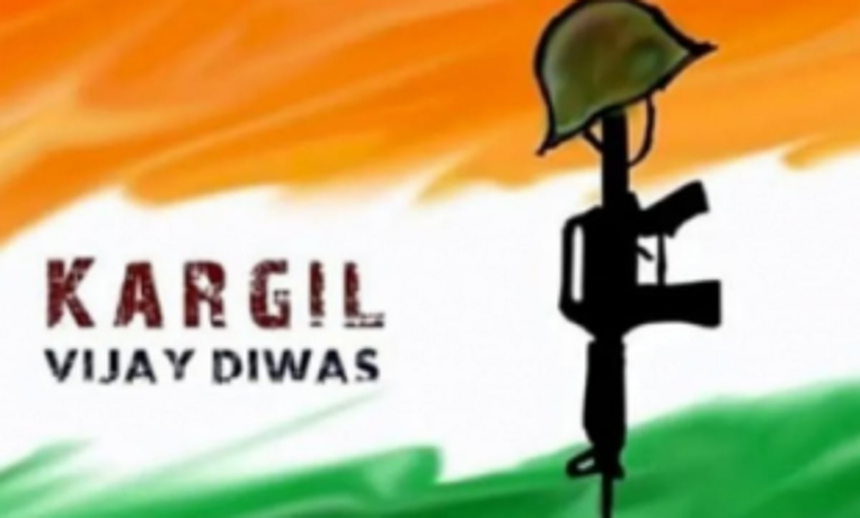
While remembering the valour and the ultimate sacrifice of the Indian Army during Kargil War twenty one years ago, India celebrated its Kargil Vijay Diwas (Kargil Victory Day). Using this occasion as an opportunity, Prime Minister Modi addressed the nation through his monthly radio programme “Mann Ki Baat” which as usual was broadcasted on all television news channels as well. Calling the day as a very special one, Modi said, “On this day, we defeated Pakistan, we will never be able to forget this day.”
The Prime Minister lamented that at that time, India was trying to improve relations with Pakistan. “But as it is said, evil’s nature is to fight everyone without reason. People of this nature can only think of doing evil even to those who try to do them good. That’s why Pakistan backstabbed India despite India’s attempts at cordial relations.” Modi took this opportunity and the message was that his speech was made for India but was indirectly targeted towards Pakistan and India felt betrayed.

On July 26, 1999, the Indian Army had announced the successful culmination of “Operation Vijay”, declaring victory after the nearly three-month-long battle in the icy heights of Kargil. About 500 brave hearts gave their ultimate sacrifice to protect the borders of India. Defence Minister Rajnath Singh, Minister of State for Defence Shripad Naik, Chief of Defence Staff General Bipin Rawat, Army Chief General MM Naravane, Air Chief Marshal RKS Bhadauria and Navy Chief Admiral Karambir Singh also paid tributes at the Amar Jawan Jyoti at the National War Memorial at New Delhi.
While recalling history and remembering and honouring our brave hearts, the major concern for India now is at the borders in Ladhak again, but this time it is with China and not Pakistan. Historically, China was never a neighbour of India but since the occupation of Tibet in early 1950s, China automatically became the neighbour of India as there was no buffer state to protect it.
China invaded Tibet in 1950. Inside its borders and across the world, Tibetans have never stopped believing Tibet is a nation. After more than 60 years of occupation, Tibetans still resist China’s rule and defy its oppression. Tibetans attempted to take back their country in an enormous uprising in March of 1959. The protests were crushed with brutal force.
Fearing for his safety, the Tibetan’s young leader, the Dalai Lama, was forced to flee across the mountains to India and live in Dharamshala, Himachal Pradesh under political asylum, much to the irritation of China. Even today all diplomatic discussion with India and China never goes without the mention of Tibet.
Tibet was divided and incorporated into Chinese provinces. The largest of these is the so-called “Tibet Autonomous Region” or TAR. Despite its name, the TAR is anything but autonomous. China rules with an iron fist, and Tibet is ranked amongst the “worst of the worst” for human rights violations but China continues to insist that Tibetans are happy and prosperous, but will not allow journalists, tourists or diplomats to see for themselves.
The recent adventure of China to get the entire “palm” which includes the “five fingers” region at the LAC has sparked a major bickering between India and China much to the dismay of Indians who saw three visits by President Xi Jinping. In fact, soon after Modi was elected Prime Minister for the first term, Chinese premier Xi Jinping visited Ahmedabad followed by visit to Goa in October 2016 during the eighth global BRICS Summit and last year in October to Chennai and Mahabalipuram. Even though Prime Minister Modi has not openly said any words to China, he has given enough tacit signals to the Dragon particularly by his surprise visit to Ladhak recently, that India this time will not take any misadventure of China lying down.
There is an eye ball to eye ball game and both countries are unwilling to blink first. India is getting a shot in the arm by countries like United States, Japan, Australia, etc who have directly called China as “land grabber” in various political circles.