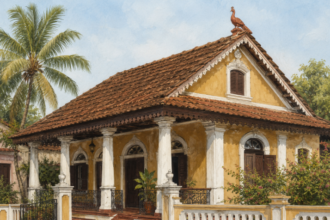
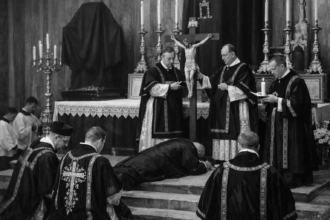
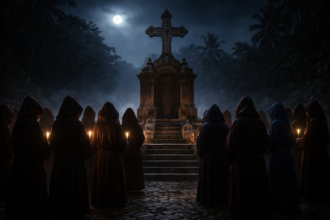
When a person dies, certain rituals are observed if the body remains at home overnight. Among Catholics, the funeral never held within the first 24 hours after death. During this period, the family and neighbors hold a night vigil beside the body, which is kept in the house near the oratory with the feet of the deceased placed in the direction of the main door of the house. A lamp is lit beside the coffin and remains burning not only through the night but also for eight days after the burial. This practice stems from a belief that the soul might return to the body within 24 hours, reviving the deceased. If everyone in the household falls asleep, some say the body might disappear, as elders believe that the devil could steal it away. Therefore, tradition requires that relatives and neighbors stay awake in the entrada (the house’s entrance), where the family oratory is usually located and where the coffin is placed. A crucifix and two candlesticks are arranged on a pedestal in this same room.
Those who spend this night with the family remained present for nine days following the funeral as a form of emotional support. Many pray to die on a Friday, believing it to be a blessed day since Jesus died on that day.

Dressing the Deceased
Elderly women aged 65 and above are dressed in a manta, a veil-like garment covering the head and body, similar to the one worn by the Virgin Mary. Spinsters wear white gowns reminiscent of wedding dresses, while bachelors are dressed in full wedding attire. Children are clothed in white outfits, and their coffins are white; adults’ coffins are black. Others are dressed in new garments or favorite clothes, and men wear suits. If the deceased was a member (irmão) of a church confraternity (confraria), he is dressed in his oppa-murça, the traditional confraternity garment, worn over his suit. The deceased’s hands are placed together holding a rosary, and gloves, shoes, and accessories are added. Relatives and friends decorate the coffin with flowers, bouquets, and wreaths.
Around twelve hours before the funeral, the church’s peddho the grave digger, traditionally of Shudra caste walks through the deceased’s village ringing a small bell called capinn. As he walks, he announces the death, the funeral time, and whether confraternity members are expected to attend. This announcement is known as Cullo gallop or Pergão gallop. Once his round is completed, he is invited into the home for tea or lunch, depending on the hour.
Departure to the Church

After the 24-hour period has passed, the parish priest visits, conducts prayers, blesses and incenses the body. The family then proceeds in a funeral procession to the church. The coffin is carried on a coffin cart, moved by family members, confraternity members, and the peddho. When the deceased was a confraternity member, the irmãos carry the coffin to the altar and from there to the cemetery. This act is considered an honor, and sometimes families falsely allow someone never part of any confraternity to wear an oppa-murça to experience the prestige of such a farewell. The brass band plays only for funerals of bachelors, spinsters, children, or if the deceased had requested it personally.
After the funeral, the house of mourning keeps its windows and doors closed for three days. Likewise, all homes facing the route of the funeral procession are to keep their doors and windows shut during its passage. Before the body leaves the church for burial, each family member kisses the deceased as a final goodbye.
Historically, Catholics were buried inside churches, but the practice was banned in the 1800s, leading to the construction of cemeteries outside.
Special Mourning Customs
If a married daughter loses a parent, she must visit her parental home briefly on the funeral day, eat something outside the house, and leave immediately; she cannot stay overnight. If a husband dies, his widow dresses like a bride on the funeral day, wearing red clothing, red flowers in her hair, and red glass bangles. When the coffin is placed in the grave, the bangles are broken and the flower dropped inside, symbolizing the end of her marriage. Upon returning home, she bathes and changes into black garments, including a veil and black bangles. On the seventh day, one of her siblings hosts her for a meal, a night’s stay, and gifts her black fabric and a veil, after which she returns home early the next morning.
When a godchild mourns a deceased godparent (Padrinho or Madrinha), they light a candle, recite a short prayer for the soul, extinguish the flame, and place the candle in the coffin. This act represents the ending of the godparent’s sacred responsibility that began at the godchild’s baptism, when the godparents had first lit candles symbolizing their spiritual duties.
Mourning Attire

Female family members wear black clothing and bangles during mourning. Some men dress entirely in black; others attach a black patch below the first button of their shirt or tie a black band around their right arm. Men attending funerals wear black suits without ties, while women wear formal black outfits. Neighbors attending typically dress in shades of white, black, blue, or gray. Sons wear complete black attire throughout the mourning period which sometimes meant even a lifetime.
If someone sick resides in the household, mourning colors are toned down to avoid worsening the patient’s condition.
It is interesting to note that women were traditionally not permitted to enter the cemetery during funerals. Equally striking is the way widows were treated in society, often regarded as inauspicious, they were barred from blessing newlyweds or raising a toast at social gatherings. These practices highlight just a few of the many forms of discrimination they were subjected to. Pregnant women and mothers of infants follow special rules: they cannot wear black or dark colors, choosing white or light blue instead, and they must avoid prolonged exposure to the body. Infants must not be brought near the deceased. Traditionally, only the deceased’s wife was allowed to attend the church service and burial.
Mourning periods last from three months up to a lifetime, depending on closeness to the deceased. Those in mourning avoid attending weddings, blessing newlyweds, or holding babies, fearing their somber attire could bring misfortune.
Cooking and Social Restrictions
For twelve days after the funeral, the grieving family does not cook at home. Neighbors either prepare food in their houses and bring it over or cook in the mourning home. On the day of the funeral, a grand meal is prepared as a farewell feast for the deceased, including boiled rice, fish curry, fried fish, pumpkin, pork, and alcohol.
For an entire year, the mourning family refrains from deep-frying foods, meaning traditional sweets like Neureo are not made, except for Dodol at Christmas. During this time, neighbors send Christmas sweets (Kuswad) to the mourning family. Grinding rice using stone grinders or steaming food in the Copro, a copper utensil, is also avoided. Loud celebrations, music, and fireworks are prohibited for a year, and family weddings are postponed until after the first anniversary Mass.
Post-Funeral Practices
After the funeral and burial, a rosary is recited daily at the home oratory for eight days. On the eighth day, snacks are served to those attending. Upon returning from the cemetery, everyone bathes before eating, as cemeteries contain soil contaminated by decomposition and disease. Standing on graves is discouraged out of respect, and bathing symbolizes purification. Serving food outside cemeteries is considered improper.
Caste-Based Burials
The caste system, inherited from Hindu tradition, historically influenced Catholic burials in Goa. Different castes were allotted graves according to rank higher castes near the church altar, lower castes farther away. Cemetery spaces were classified as Class I, II, or III. Burial was once denied to sinners who died without confession or to criminals, whose bodies were left to decay, a practice eventually banned during plague outbreaks. Wealthy families often built ornate tombs with marble sculptures, which the Church has since discouraged.
No one was ever allowed to eat or drink anything without first taking a bath after returning from the cemetery, a practice likely observed to cleanse oneself of any impurities or contaminants from the burial grounds. Sadly, it is disheartening to see this age-old custom being disregarded today, with people even serving snacks right outside the cemetery.
All Saints’ and All Souls’ Days
Catholics observe 1 November as All Saint’s Day and 2 November as All Soul’s Day. Families clean and decorate graves with flowers on these dates. It is believed that at 3 p.m. on November 1, ancestral souls descend to visit relatives and return to heaven by noon the next day. During this time, Catholics may ring church bells, ten sets of three strokes each to earn indulgences. In earlier days, boys mischievously used this period to steal fruits or move belongings, behavior later discouraged.
Throughout these two days, Catholics recite multiple rosaries for departed souls, omitting mysteries and the Gloria. On All Souls’ Day, one may attend several masses and receive Holy Communion more than once. Both days are holy days of obligation, requiring attendance at mass. Families prepare a grand meal, including pork, boiled rice, prawn curry, pumpkin, fried fish, and sanna(sweet steamed rice cakes). Children and youths once celebrated the day by harmlessly pranking neighbors, placing scarecrows at doors, relocating clothes or utensils, or taking vegetables from gardens, all done lightheartedly and without malicious intent.