VITHALDAS HEGDE
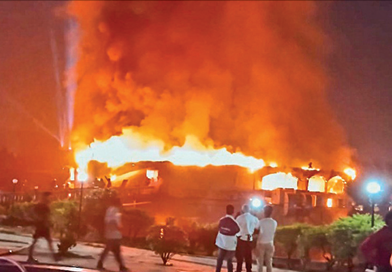
Indicting govern ment authorities for serious lapses, statutory violations and deliberate dilution of court directions, the amicus curiae appointed by the High Court has held that the dev astating fire tragedy at Birch by Romeo Lane, Arpora — where 25 persons lost their lives on December 7 — was the direct result of systemic non-enforcement of building, planning and safety laws. The tragedy primar ily occurred due to an abdication of statuto ry duties and failure to enforce key legislations, including the Goa Land Development and Building Construction Act, 2008 and Rules, 2010; the Town and Country Planning (TCP) Act, 1974; the Goa Panchayat Raj Act, 1994; and Coastal Regulation Zone (CRZ) regulations. Stating that the author ities were fully aware of the illegalities, the amicus curiae, Advocate Rohit Bras de Sa, submitted that such abdication amounts to a deliberate and gross viola tion of the rule of law en shrined in the Constitution. He asserted that criminal liability of erring govern ment officials must be fixed through investigation and prosecution. Adv De Sa was appointed amicus curiae in the suomotu public interest litigation initiated by the High Court. In compliance with the Court’s directions, the ami cus on Monday submitted a detailed 496-page memo randum placing on record earlier judgments, factu al findings and the State government’s counter- measures. The memorandum in dicts the government for creating regulatory chaos by bypassing TCP require ments and permitting vil lage panchayats to issue no-objection certificates (NOCs) for commercial use of illegal structures. It also flags the lack of road access for fire brigades in congest ed coastal areas, underlin ing the necessity of mandatory technical clearance by the TCP Department. Referring to a PIL filed in February 2024 concerning illegal structures at Anjuna, Justice Mahesh Sonak had observed that even tem porary structures erected in coastal areas for up to five years require techni cal clearance from the TCP Department.

The Court had further held that commercial estab lishments operating from illegal structures cannot be permitted merely on the basis of NOCs issued by village panchayats. “To circumvent these directions, the State government enacted the Goa Erection of Shacks on Public Beaches (Regulation and Control) Act, 2024, asserting that village panchayats have the authority to issue NOCs and thereby nullifying the requirement of technical clearance from the TCP Department,” Adv De Sa observed. Similarly, in another suomotu PIL on illegal constructions in March 2025, the High Court had directed the removal of illegal structures after categorisation. These directions, the amicus pointed out, were again diluted through amend ments to the Goa Land Revenue Code and the Regularisa tion of Illegal Structures in August 2025. “The High Court judgments did not lay down any new law but merely reiterated that existing building regula tions must be enforced. While the High Court consistently insisted on enforcement of the law, the government diluted its directions by introducing fresh enactments, the consti tutionality of which will now have to be determined,” the amicus stated. The memorandum notes that despite the issue being sub judice, the government amended laws and carved out ex ceptions to dilute mandatory technical clearance require ments. The High Court, it emphasised, had not legislated but merely directed enforcement of existing laws. By at tempting to bypass these directions, the State government bears responsibility for the present situation. A copy of the memorandum has been accessed by O Heraldo. The amicus curiae was tasked with presenting a consoli dated factual narrative of the Birch by Romeo Lane premis es and identifying, statute by statute, the permissions and NOCs required up to completion, occupancy and operation of such an establishment. He was also asked to analyse how failure to enforce this legal framework contributed to the incident, with reference to earlier PIL jurisprudence and High Court orders. Further, the amicus was requested to assist the Court on whether the tragedy was causally connected to systemic non-compliance with building, planning, CRZ, environmen tal, fire-safety and licensing laws. This included scrutiny of all trade and operational licences, mandatory inspections, periodic audits, and fixing responsibility where commer cial operations continued despite demolition orders. Among key recommendations, the amicus has urged the Court to direct the government to frame and notify, within a fixed timeline, comprehensive Nightlife and Hospitality Safety Regulations under the Goa Land Development Act, Fire Force Act, Panchayat/Municipal Acts and the Environ ment (Protection) Act. These would cover noise and sound control, strict adherence to ambient noise limits, mandato ry acoustic treatment and soundproofing of indoor clubs, prohibition of high-decibel open-air sound, specified tim ings in residential and CRZ-III areas, and defined closing hours for nightclubs in sensitive zones. The matter is now posted for hearing on January 8